The Dream Interpreter: Yusuf in Egypt
Integrity under temptation; Allah rewards the patient
Last night, we left young Yusuf (AS) in the hands of a merchant caravan that had pulled him out of a dark well and carried him to Egypt. Tonight, we follow him into a world of palaces, prisons, and power, and we learn how a boy sold as a slave became the most important man in all of Egypt, not through violence or scheming, but through patience, integrity, and trust in Allah.
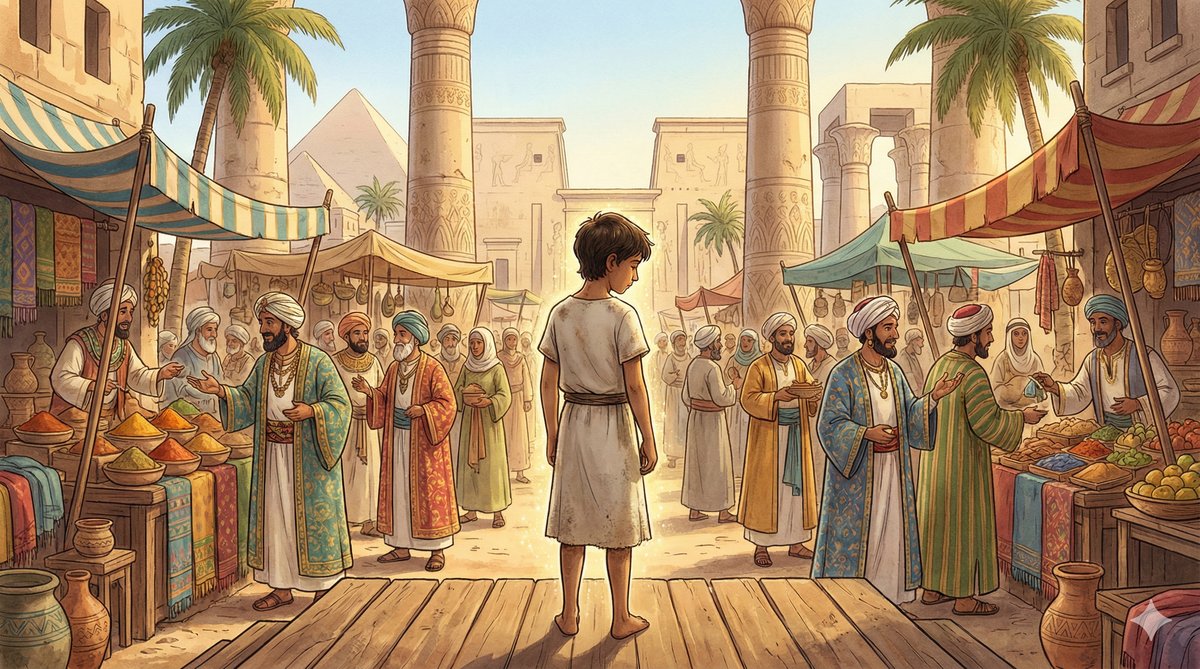
The caravan sold Yusuf in the marketplace of Egypt. The man who bought him was a powerful official known as the Aziz, a title meaning "the mighty one." The Aziz recognized something extraordinary in this young stranger. "Make his stay comfortable," he told his wife. "Perhaps he will benefit us, or we may adopt him as a son."
Years passed. Yusuf grew from a boy into a young man of remarkable beauty and wisdom. The Quran tells us: "When he reached his maturity, We gave him judgment and knowledge. And thus We reward the doers of good." Allah had already begun preparing Yusuf for something great.
But before greatness came a test of a different kind.
The wife of the Aziz had been watching Yusuf grow. Over time, something dark took root in her heart. She developed feelings for him that were wrong, and one day, when they were alone in the house, she locked the doors and approached him.
"Come," she said.
Yusuf's answer was immediate and absolute: "I seek refuge in Allah. Indeed, my Lord has made good my residence. He will not allow the wrongdoers to succeed."
Think about this. Yusuf was a slave. She was the most powerful woman in the household. He had no one to protect him, no family, no status. He could have reasoned that no one would know, or that refusing would make his life harder. But Yusuf did not calculate. He chose what was right because it was right, and he ran.
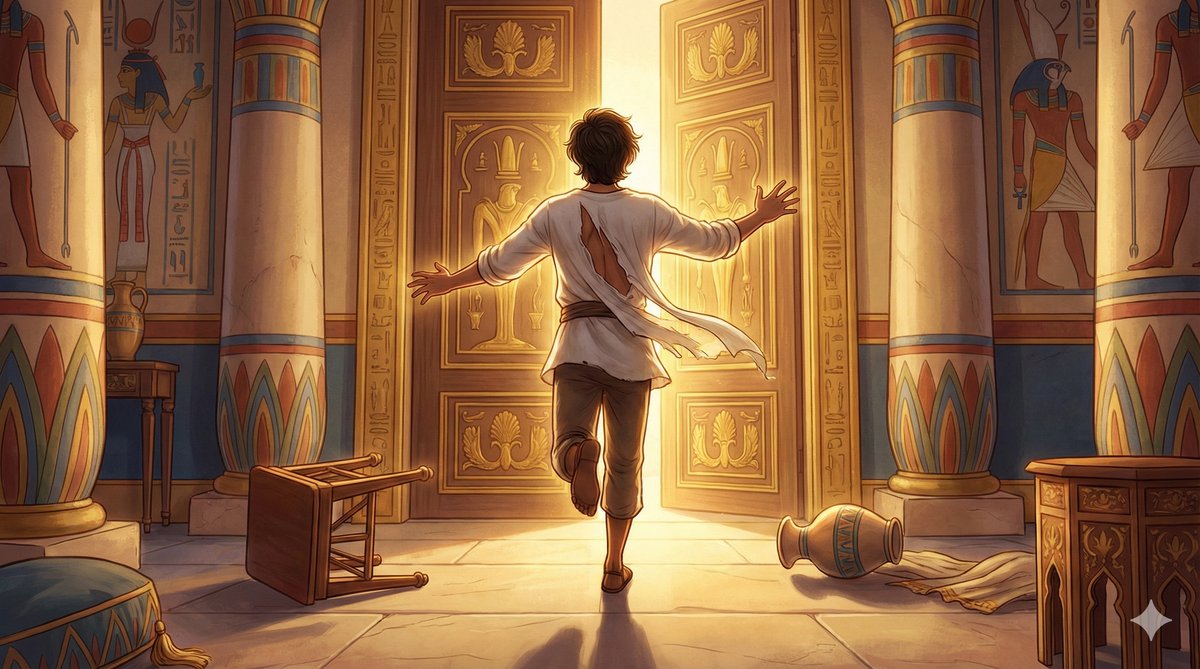
He ran toward the door. She ran after him and grabbed his shirt from behind, tearing it. At that very moment, the Aziz appeared at the door.
She immediately accused Yusuf. But Allah sent a witness: a member of the household who suggested, "If his shirt is torn from the front, then she is telling the truth. But if his shirt is torn from the back, then she has lied." They looked. The shirt was torn from the back. The truth was clear.
Yet truth does not always lead to justice, at least not immediately. The women of the city began to gossip: "The wife of the Aziz is seeking to seduce her slave boy. She is clearly in error." When the Aziz's wife heard their whispers, she invited them all to a banquet. She gave each woman a knife and fruit to cut. Then she called Yusuf to enter the room.
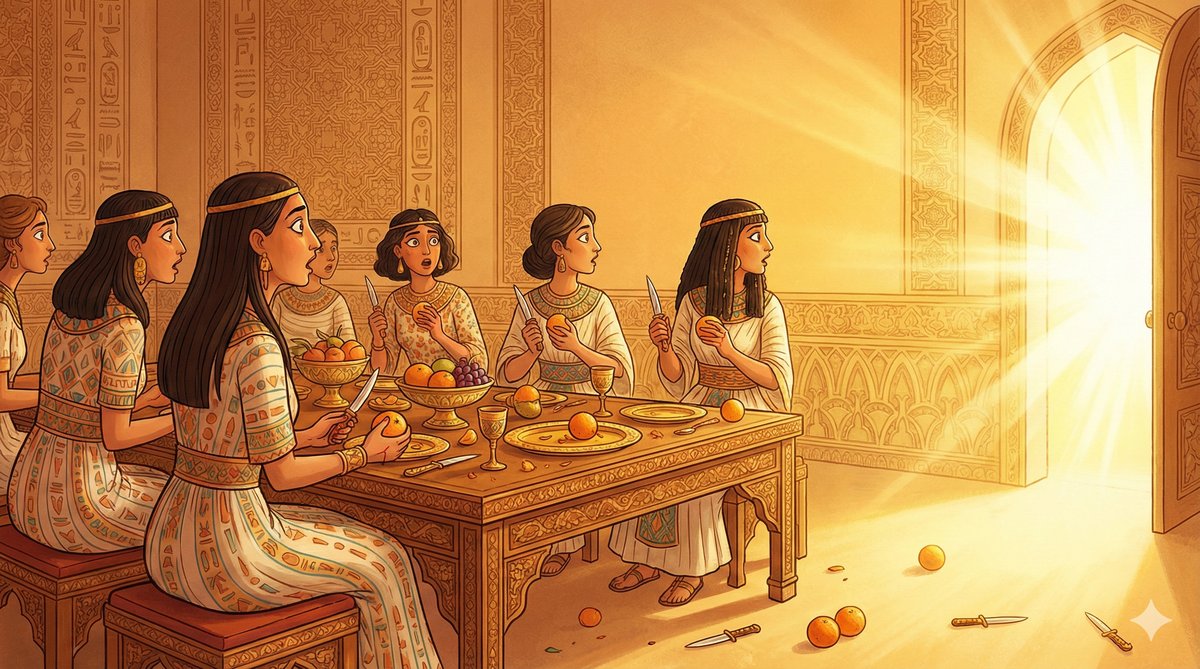
When the women saw Yusuf, his beauty struck them so deeply that they cut their own hands without realizing it. "This is not a human being," they exclaimed. "This is none other than a noble angel!"
The Aziz's wife said: "That is the one you blamed me for."

Despite the truth being known, Yusuf was thrown into prison. But listen to what Yusuf had asked for: "My Lord, prison is more beloved to me than that to which they invite me." He preferred prison to sin. He chose a cell with a clean conscience over a palace with a stained one.
In prison, Yusuf met two men. Each had a dream. One saw himself pressing wine. The other saw himself carrying bread on his head that birds were eating from. They came to Yusuf because they noticed something about him: "Indeed, we see you to be of those who do good."
Before interpreting their dreams, Yusuf did something remarkable. He did not just answer their question. He used the moment to teach them about Allah. He told them about tawhid, about the oneness of the Creator, about the falsehood of worshipping many gods. Only then did he give them the interpretation.
"One of you will pour wine for his master," Yusuf said. "And the other will be crucified, and birds will eat from his head. The matter has been decided."
It happened exactly as he said. The man who was freed was supposed to mention Yusuf to the king, but he forgot. And so Yusuf remained in prison, waiting, for several more years.

Then one night, the king of Egypt had a dream that shook him. He saw seven fat cows being devoured by seven lean cows, and seven green ears of grain and seven dry ones. He called his wisest advisors, but no one could explain it. They called it confused dreams, meaningless visions.
Then the freed prisoner finally remembered. "I can tell you its interpretation," he said, "so send me to Yusuf."
Yusuf interpreted the dream with clarity that could only come from Allah: "You will plant for seven years as usual. Leave what you harvest in its ear, except a little from which you eat. Then after that will come seven difficult years which will consume what you stored. Then after that will come a year in which people will be given rain and in which they will press fruit."
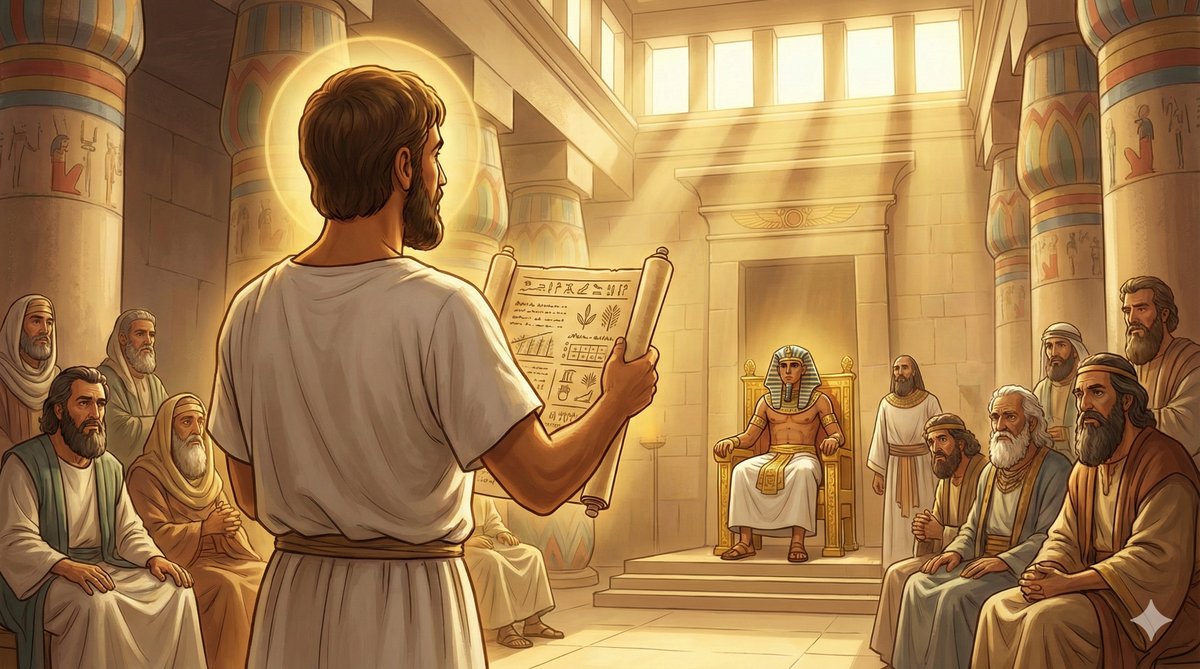
Seven years of abundance, then seven years of famine, then relief. It was a plan for survival, and it was exactly right.
The king was amazed. "Bring him to me," he commanded. But Yusuf, even with freedom within reach, would not leave prison until his name was cleared. "Return to your master," he told the messenger, "and ask him about the women who cut their hands."
The king investigated. The women testified: "We know of no evil from him." And the wife of the Aziz finally confessed: "Now the truth has become evident. It was I who sought to seduce him, and indeed, he is of the truthful."
Only then did Yusuf walk free. The king said: "Bring him to me; I will appoint him exclusively for myself." And when the king met Yusuf and spoke with him, he was so impressed that he said: "Indeed, you are today established in position and trusted."
Yusuf replied: "Appoint me over the storehouses of the land. Indeed, I am a knowing guardian."
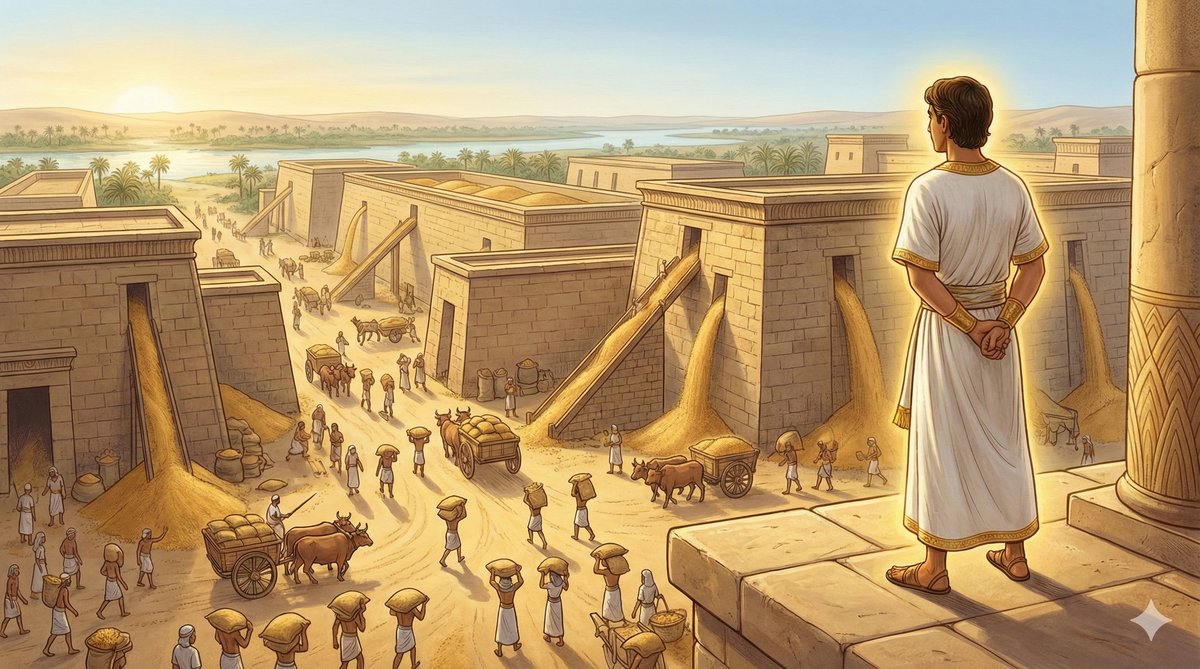
And so the boy who was sold for a few coins became the treasurer of Egypt, the man who would save an entire nation from starvation. Not through war. Not through revenge. Through knowledge, patience, and the plan of Allah.
In the Shia tradition, Yusuf's story illustrates how Allah grants knowledge, ilm, to those He chooses. Just as Yusuf could interpret dreams that baffled the wisest of Egypt, the Imams (AS) possessed knowledge that went beyond ordinary learning. Imam al-Sadiq (AS) taught that true knowledge is a light that Allah places in the heart of whomever He wills. It cannot be bought, and it cannot be forced.

But more than knowledge, Yusuf's story is about integrity. He chose right over comfort, truth over convenience, prison over sin. And Allah did not forget a single moment of his patience. Every year in that dark cell was counted, and the reward, when it came, was beyond anything Yusuf could have planned himself.
Tomorrow night, we will see what happens when Yusuf's brothers arrive in Egypt, not knowing that the powerful man before them is the same little brother they once threw into a well.
Key Verse
Qala rabbi al-sijnu ahabbu ilayya mimma yad'unani ilayhi, wa illa tasrif anni kaydahunna asbu ilayhinna wa akun minal jahileen "He said: My Lord, prison is more beloved to me than that to which they invite me. And if You do not avert from me their plan, I might incline toward them and be of the ignorant." Yusuf (12:33)
Reflection Questions
- Yusuf chose prison over doing something wrong. Have you ever had to choose something harder because it was the right thing to do?
- Even in prison, Yusuf taught people about Allah before answering their questions. What does this tell us about how we should use every situation?
- Yusuf refused to leave prison until his name was cleared. Why was his reputation so important to him, and what does this teach us about honesty?
Do you remember Yusuf from last night? The boy who was thrown into a well by his brothers, and then travelers took him to Egypt? Tonight we find out what happened next. Are you ready?
When Yusuf arrived in Egypt, he was sold in a big marketplace. A very important man called the Aziz saw young Yusuf. He could tell this was no ordinary boy. There was a light in his eyes and a calmness in his face.
The Aziz said to his wife, "Let us take good care of this boy. Maybe we can raise him like our own son."
So Yusuf went from a dark well to a beautiful palace! But Yusuf never forgot Allah. Every day, he thanked Allah and talked to Him. Years went by, and little Yusuf grew into a young man. The Quran tells us that Allah gave him wisdom and knowledge. Yusuf was beautiful on the inside too: kind, honest, and good.
But then something bad happened. The wife of the Aziz wanted Yusuf to do something wrong. She locked the doors and tried to make Yusuf disobey Allah. But Yusuf said, "No! I cannot do this. Allah is watching me, and the Aziz has been kind to me."
Yusuf turned and ran toward the door to get away. The woman grabbed his shirt from behind, and it tore! It ripped right at the back. When the Aziz found out what happened, the torn shirt told the whole truth. Because the shirt was ripped from the back, it meant Yusuf was running away. Yusuf was innocent!
But that was not the end of the trouble. The wife of the Aziz invited important women from the city to a fancy banquet. She gave each woman a knife and some fruit to cut. Then she told Yusuf to walk into the room. When the women saw Yusuf, they were so amazed by how beautiful he was that they cut their own hands without even noticing! They said, "This is no ordinary person! He must be an angel!"
Even though everyone could see that Yusuf was good and truthful, he was still thrown into prison. It was so, so unfair! First a well, now a prison, all for something he did not do!
But did Yusuf give up? Did he get angry at Allah? No! He said something surprising: "My Lord, I would rather be in prison than do something wrong. And if You do not help me stay strong, I might become weak." He chose a tiny prison cell with a clean heart over a fancy palace with a guilty one.
Even in prison, Yusuf was kind to everyone. He smiled at the other prisoners and helped them when they were sad. They could see that Yusuf was a truly good person.
One day, two men in the prison came to Yusuf. They both looked confused and a little bit scared.
The first man said, "Yusuf, I had a strange dream last night. I dreamed that I was squeezing grapes and making juice for someone to drink. What does it mean?"
The second man said, "I had a strange dream too! I dreamed that I was carrying a basket of bread on my head, and birds were flying down and eating the bread right off my head! What does my dream mean?"
"We can see that you are a good person," they told him. "Please help us understand our dreams."
Before Yusuf answered, he did something important. He talked to them about Allah first. "The reason I can understand dreams is because Allah taught me. He is the One God, the Creator of everything."
Yusuf always remembered to tell people about Allah, even in prison!
Then Yusuf explained the dreams. He told the first man, "Your dream means you are going to get out of prison! You will go and work for the king, and you will pour his drinks for him."
The first man was so happy! "Really? I am going to be free?"
"Yes," said Yusuf. Then he looked at the second man with kind, sad eyes. The second man's dream had a much sadder meaning, and Yusuf told him gently what it meant.
Before the first man left, Yusuf asked him one small favor. "When you are free and you are with the king, please remember me. Please tell the king that I am here in prison and that I did nothing wrong."
The man said, "Of course! I will never forget you!"
But guess what happened? The man did forget. He got out of prison, he went to work for the king, and he completely forgot about poor Yusuf sitting in that prison cell. Yusuf waited and waited and waited. Days turned into weeks. Weeks turned into months. Months turned into years. But Yusuf kept being patient. He kept trusting Allah. He kept praying and being good.
Then one night, something big happened. The king of Egypt had a dream. And it was a very, very strange dream.
The king dreamed he saw seven big, fat, healthy cows. But then seven thin, skinny cows came and ate up the fat cows! Chomp, chomp, chomp! Gone! Then the king saw seven tall, green stalks of grain. But seven dry, crumbly stalks appeared and swallowed up the green ones!
The king woke up sweating. He called all his wisest helpers. "Tell me what my dream means!"
They scratched their heads and shrugged. "We do not know," they said. But it did mean something. Something very important.
And then, finally, the man who had been in prison with Yusuf remembered! It all came back to him in a flash. "Wait!" he said. "I know someone who can explain dreams! There is a man in the prison named Yusuf. He explained my dream perfectly, and everything he said came true! Send me to him!"
So they sent the man to the prison, and Yusuf listened to the king's dream. Right away, Allah helped Yusuf understand exactly what it meant.
Yusuf said, "This is what the dream means. For seven years, there will be lots and lots of rain. The crops will grow tall and strong. There will be so much food that you will not know what to do with it all! But then, after those seven good years, seven very hard years will come. The rain will stop. The ground will be dry. The food will not grow. People will be very, very hungry."
But Yusuf did not just explain the problem. He gave the answer too! "Here is what you need to do," he said. "During the seven good years, when there is food everywhere, save it! Store it up! Put it in big buildings and keep it safe. Do not eat it all. Then when the seven hard years come, you will have enough food for everyone."
When the king heard this, his eyes went wide. "This is amazing!" he said. "Bring this man to me right now!"
But Yusuf did something that shows just how honest and brave he was. When the king's messenger came to the prison and said, "The king wants you! You are free!" Yusuf did not just run out the door. He said, "Wait. Before I leave, I want the king to find out the truth. Ask him to talk to the people who lied about me. I want everyone to know that I did nothing wrong."
Can you imagine? After years and years in prison, freedom was right there! He could have just walked out. But Yusuf wanted his name to be clean. He wanted the truth to be known.
So the king asked questions. He found out the truth. The people who had lied about Yusuf finally said, "We were wrong. Yusuf never did anything bad. He is truthful and honest."
Now Yusuf walked out of prison with his head held high. His name was clean. His heart was clean. And the king was waiting for him.
When the king met Yusuf and talked with him, he was so, so impressed. He said, "From now on, you are going to be one of the most important people in all of Egypt!"
Yusuf said, "Put me in charge of the food and the storehouses. I will take care of everything. I know how to save and plan."
And just like that, the boy who was once sold for a few tiny coins became the man in charge of feeding the entire country of Egypt! From a well, to a prison, to a palace. From being sold like he was nothing, to being trusted with everything. That is Allah's plan. It took a long time. It was hard. It was painful. But it was worth every single moment of waiting.
In our tradition of the Ahlul Bayt, the family of Prophet Muhammad, peace be upon him and his family, we learn something very special from Yusuf's story. Just like Allah gave Yusuf the gift of understanding dreams, Allah gave special knowledge to the Imams too. Imam al-Sadiq, peace be upon him, taught that true knowledge is a light that Allah puts in the hearts of the people He chooses. You cannot buy it at a store. You cannot find it in a treasure chest. It comes only from Allah.
But even more than knowledge, Yusuf's story teaches us about being honest and good, no matter what. Yusuf always chose to do the right thing, even when it was the hardest choice. Even when no one would have known. Even when it meant going to prison. And Allah never forgot a single day of Yusuf's patience. Every moment counted, and the reward was bigger and more beautiful than anything Yusuf could have dreamed.
Tomorrow night, we will find out what happens when Yusuf's brothers come to Egypt. And guess what? They will not even recognize him!
Key Verse
"Qala rabbi al-sijnu ahabbu ilayya mimma yad'unani ilayhi, wa illa tasrif 'anni kaydahunna asbu ilayhinna wa akun minal jahileen." "Yusuf said: My Lord, I would rather be in prison than do something wrong. And if You do not protect me from their tricks, I might become weak." -- Yusuf (12:33)
Let's Talk About It
- Yusuf chose to go to prison instead of doing something wrong. Why is doing the right thing so important, even when it is really hard?
- Even in prison, Yusuf was kind to people and told them about Allah. What does this teach us about how we should act, even when we are having a bad day?
- Allah's plan took Yusuf from a well to a prison to a palace. Can you think of a time when something hard happened to you, but then something good came from it?