The Staff and the Sea: Musa Confronts Pharaoh
Standing up to tyrants; Allah aids the oppressed
Remember the baby who floated down the Nile in a basket? Tonight, that baby returns to the palace where he was raised, but not as a prince. He returns as a prophet, carrying nothing but a wooden staff, the message of one Allah, and the command to set an entire people free.
Years had passed since Musa (AS) left Egypt. He had grown into a strong man, lived among shepherds in the land of Midian, married, and learned patience in the quiet of the desert. Then, on a cold night while traveling with his family, he saw a fire on the side of a mountain. He went toward it, hoping to bring back a burning branch.
But the fire was not ordinary. From within it, a voice spoke: "O Musa, indeed I am Allah, Lord of the worlds."
Allah gave Musa two signs. "Throw down your staff." Musa threw it, and it became a living snake, slithering on the ground. Musa stepped back in fear, but Allah said: "Take hold of it and do not be afraid." He picked it up, and it became a staff again. Then Allah told him: "Put your hand into your cloak." When Musa drew his hand out, it shone with brilliant white light, like a small sun in his palm.
With these signs, Allah sent Musa to the most powerful and most arrogant man on earth: Fir'awn.
But Musa was not sent alone. He asked Allah for a helper: "My Lord, appoint for me a minister from my family, Harun, my brother. Increase through him my strength and let him share my task." And Allah granted his request.
In the Shia tradition, this request holds deep significance. Just as Musa asked for Harun as his partner and successor, the Prophet Muhammad (PBUH) said to Ali (AS): "You are to me as Harun was to Musa, except that there will be no prophet after me." This hadith, known as Hadith al-Manzilah, is one of the foundations of the belief in Ali's special position.
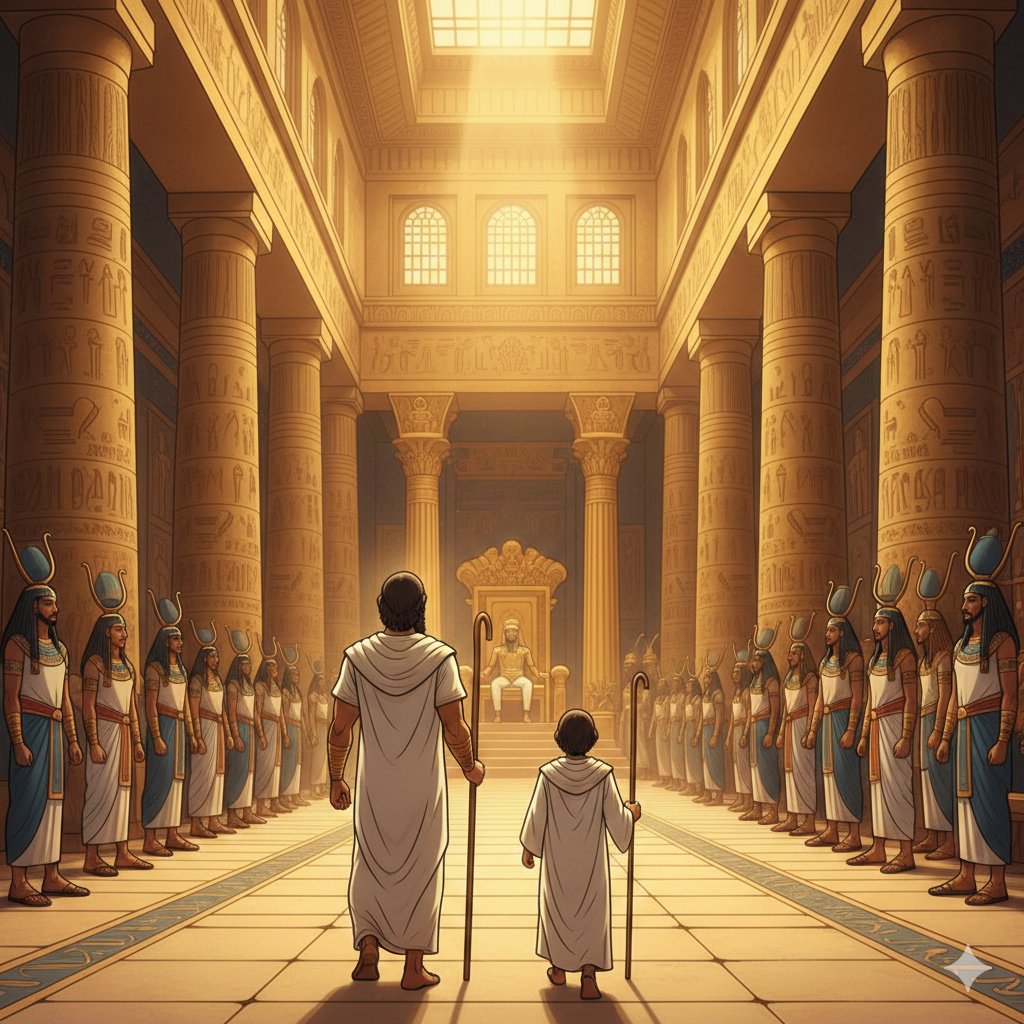
Musa and Harun walked into Pharaoh's court and stood before the throne. The court was full of advisors, generals, and priests. Every eye turned to these two men who dared to challenge the most powerful ruler in the known world.
"We are messengers of the Lord of the worlds," Musa declared. "Send with us the Children of Israel."
Pharaoh laughed. "Did we not raise you among us as a child? And you stayed among us years of your life? And then you did what you did and you are of the ungrateful?"
Musa stood firm: "I did that while I was of those astray. I fled from you when I feared you. Then my Lord granted me wisdom and made me one of the messengers."
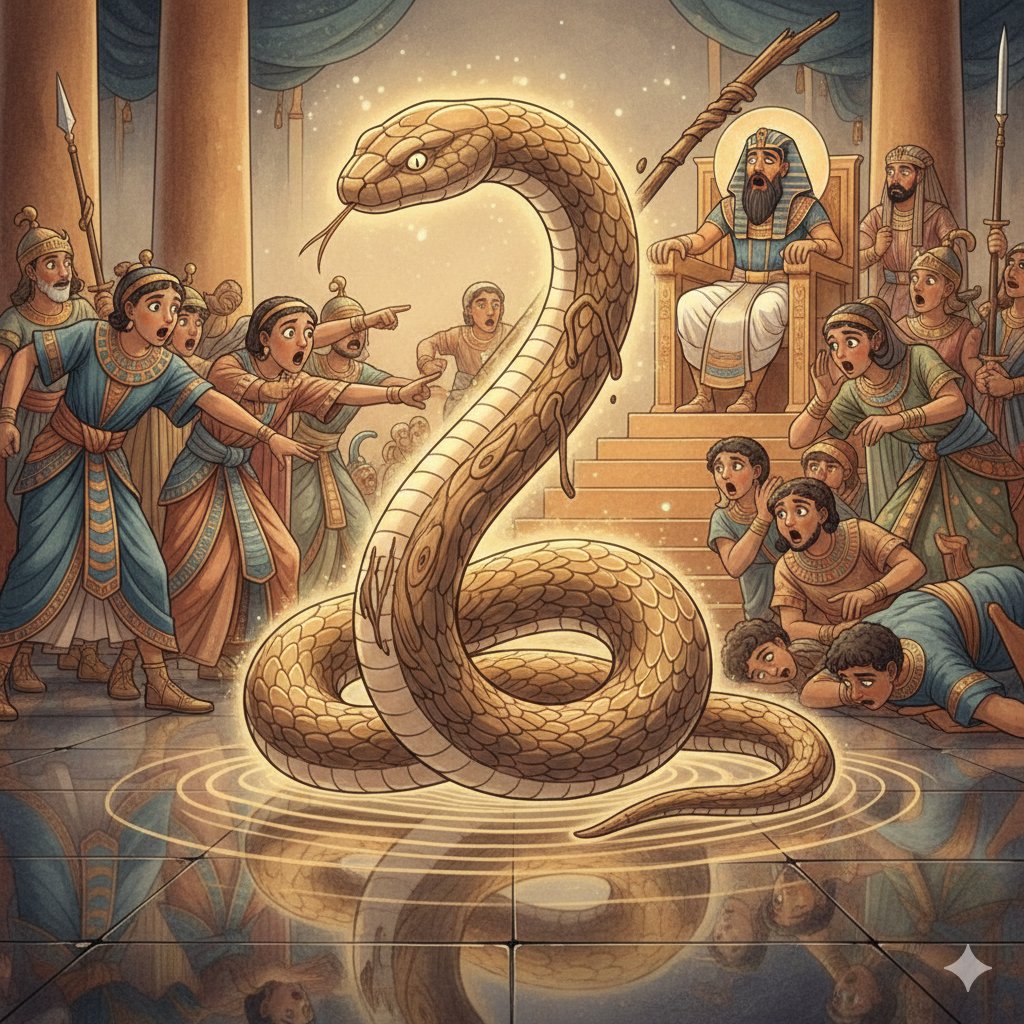
Pharaoh challenged him to prove his claims. Musa threw down his staff. It became an enormous serpent. He drew out his hand, and it blazed white. Pharaoh's court gasped.
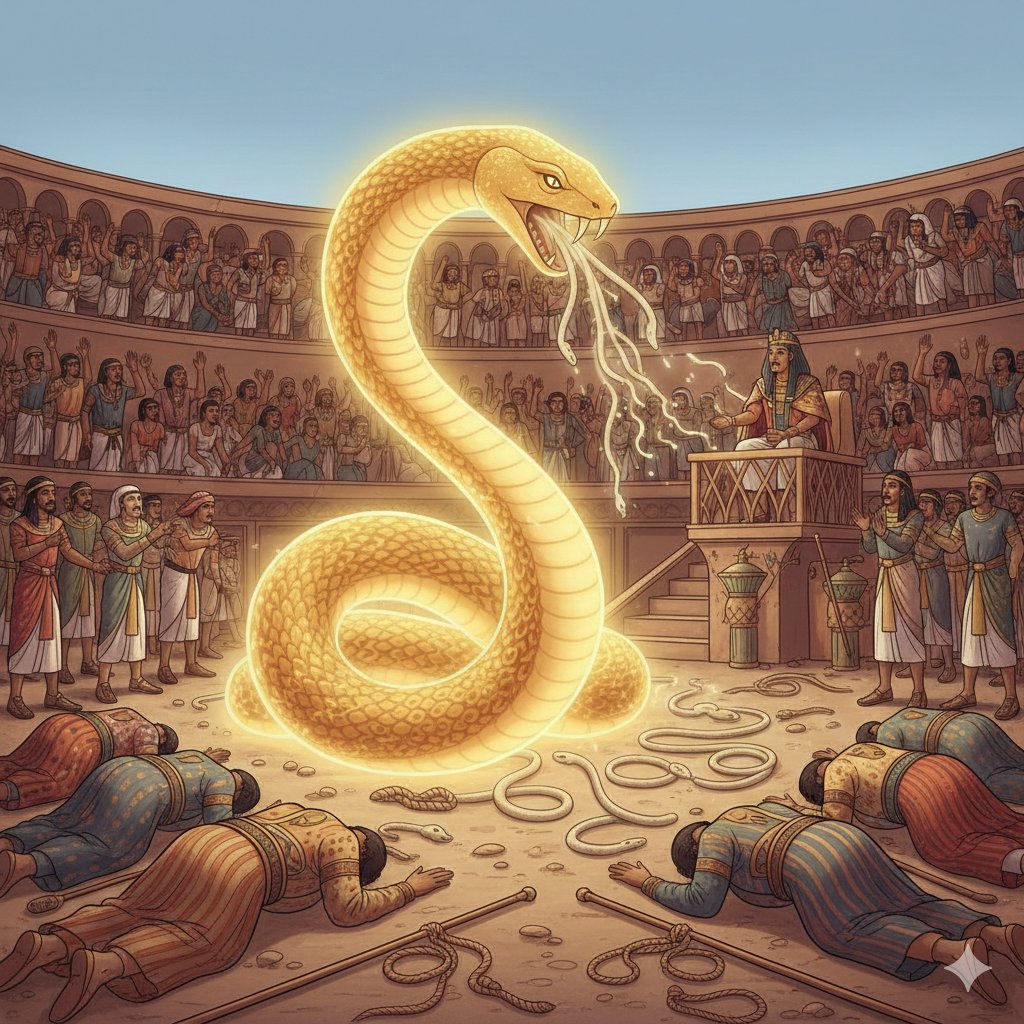
But Pharaoh, his heart hardened by pride, called his own sorcerers. The best magicians in all of Egypt were summoned for a public contest. On the appointed day, the sorcerers threw their ropes and staffs, and through their tricks, the ropes appeared to turn into writhing snakes. The crowd roared.
Then Musa threw his staff. It became a serpent so massive that it swallowed every single one of the sorcerers' illusions. Not one fake snake remained.
The sorcerers knew the difference between magic and a miracle. They had spent their lives perfecting tricks, and they knew that what Musa's staff had done was no trick. They fell into prostration right there, before the entire crowd: "We believe in the Lord of the worlds, the Lord of Musa and Harun!"
Pharaoh was furious. He threatened them with torture and death. But the sorcerers, only moments ago his loyal servants, now answered him with the courage that comes from sudden, total faith: "You can only decide for this worldly life. Indeed, we have believed in our Lord that He may forgive us our sins."
Despite all the signs, Pharaoh refused to free the Children of Israel. So Allah sent a series of signs upon Egypt: floods, locusts, lice, frogs, and blood, each one a call to Pharaoh to listen, and each time, when the suffering came, Pharaoh would promise to let the people go, and when it passed, he would break his word.
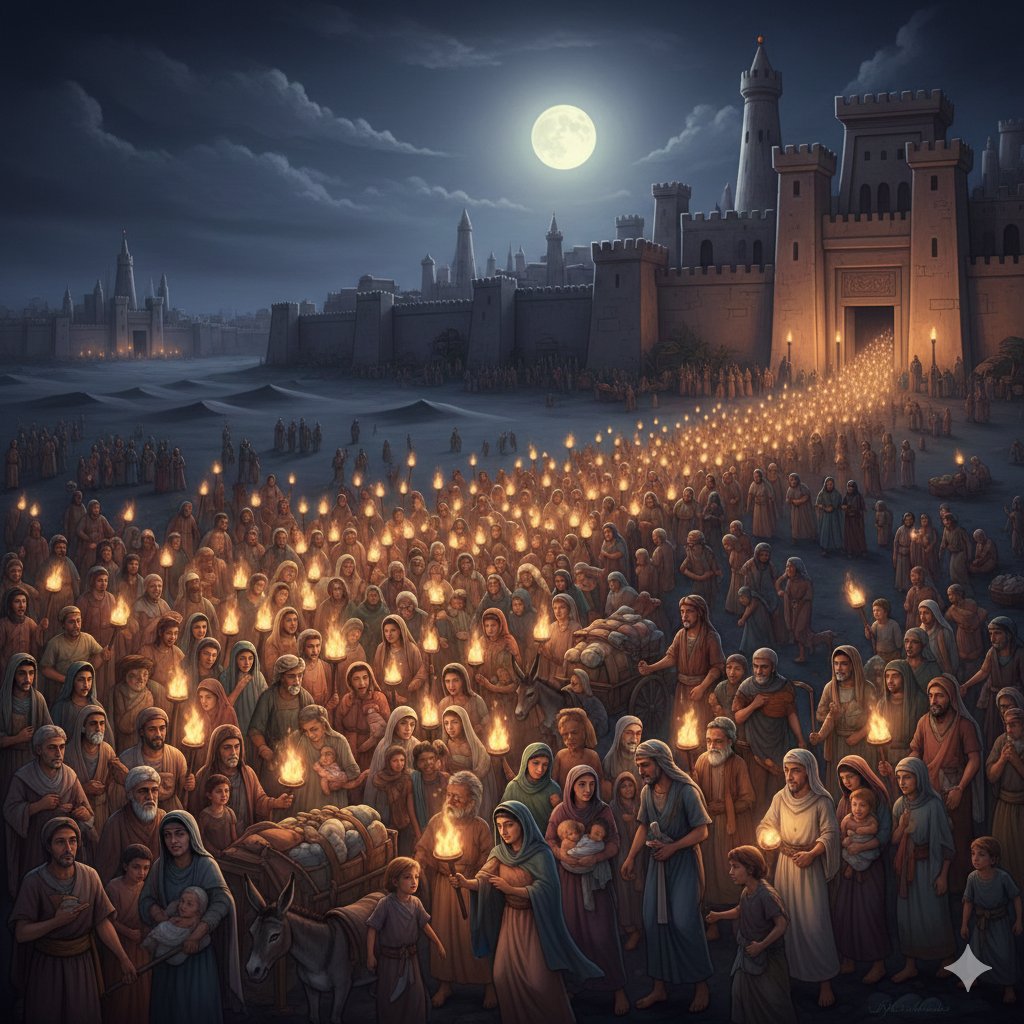
Finally, the command came for the Exodus. One night, under cover of darkness, Musa led all of Bani Isra'il out of Egypt. Thousands of men, women, and children, carrying what they could, walking toward freedom.
When Pharaoh realized they had fled, his rage was total. He gathered his army, the greatest military force on earth, chariots, horsemen, and soldiers, and he pursued them.
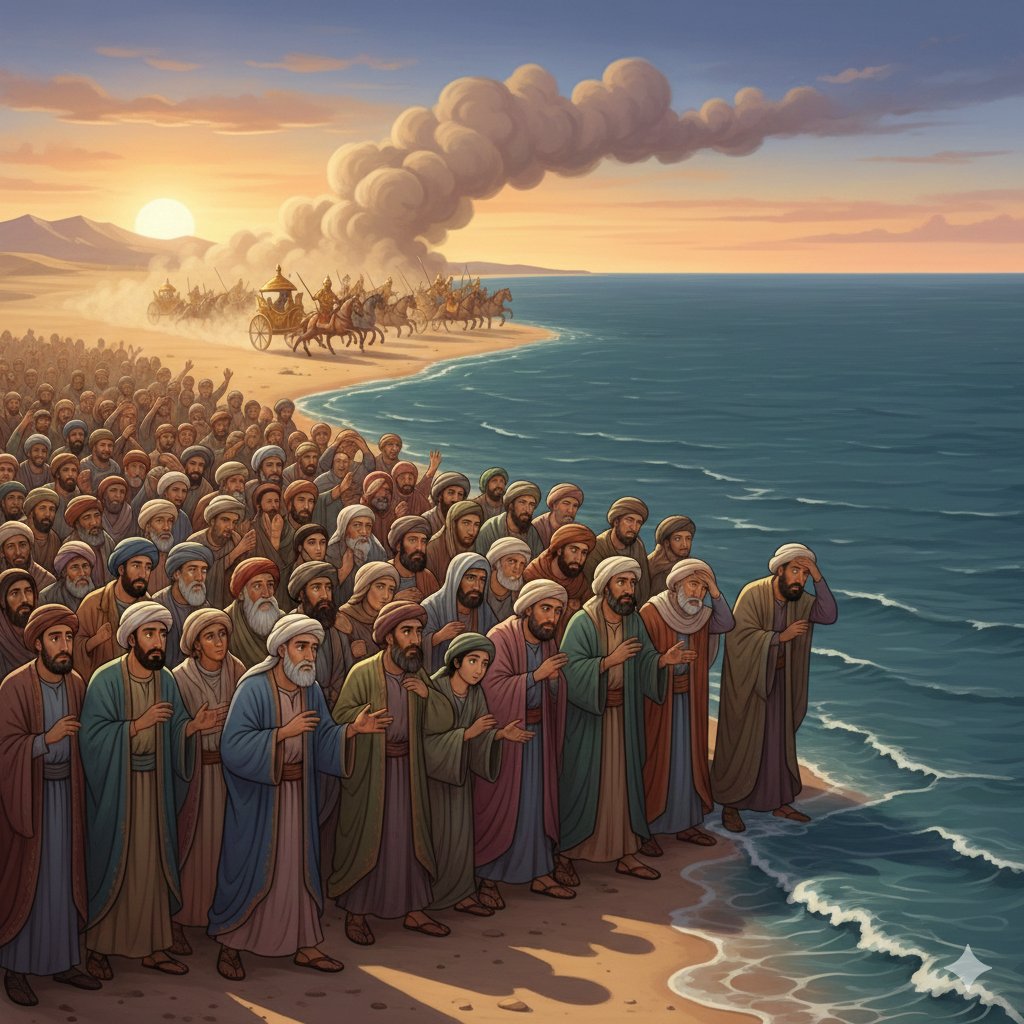
Bani Isra'il reached the shore of the sea and stopped. In front of them was water stretching to the horizon. Behind them was the dust of Pharaoh's approaching army. They could hear the chariots. They were trapped.
The people panicked. "We will surely be caught!"
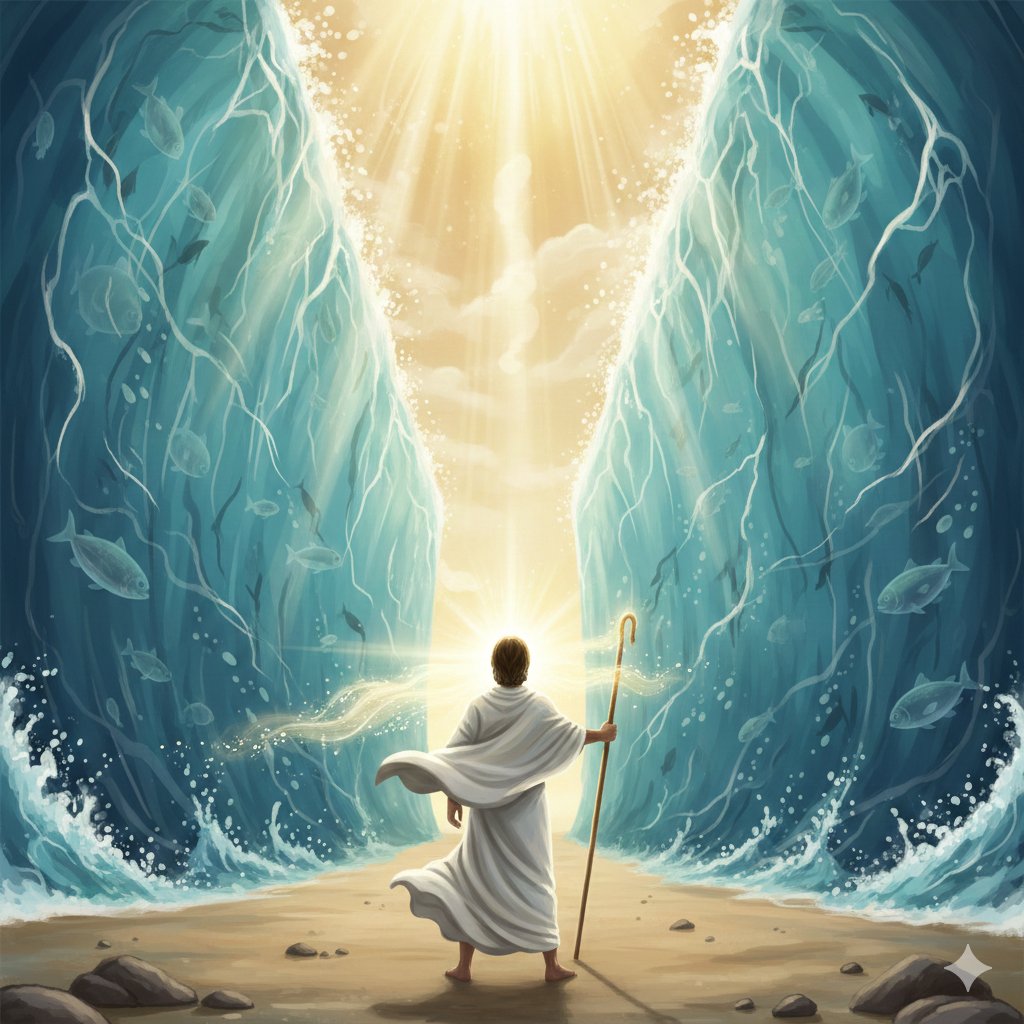
Musa's answer rings through history: "No! Indeed, with me is my Lord. He will guide me."
Allah commanded: "Strike the sea with your staff."
Musa struck. And the sea obeyed.
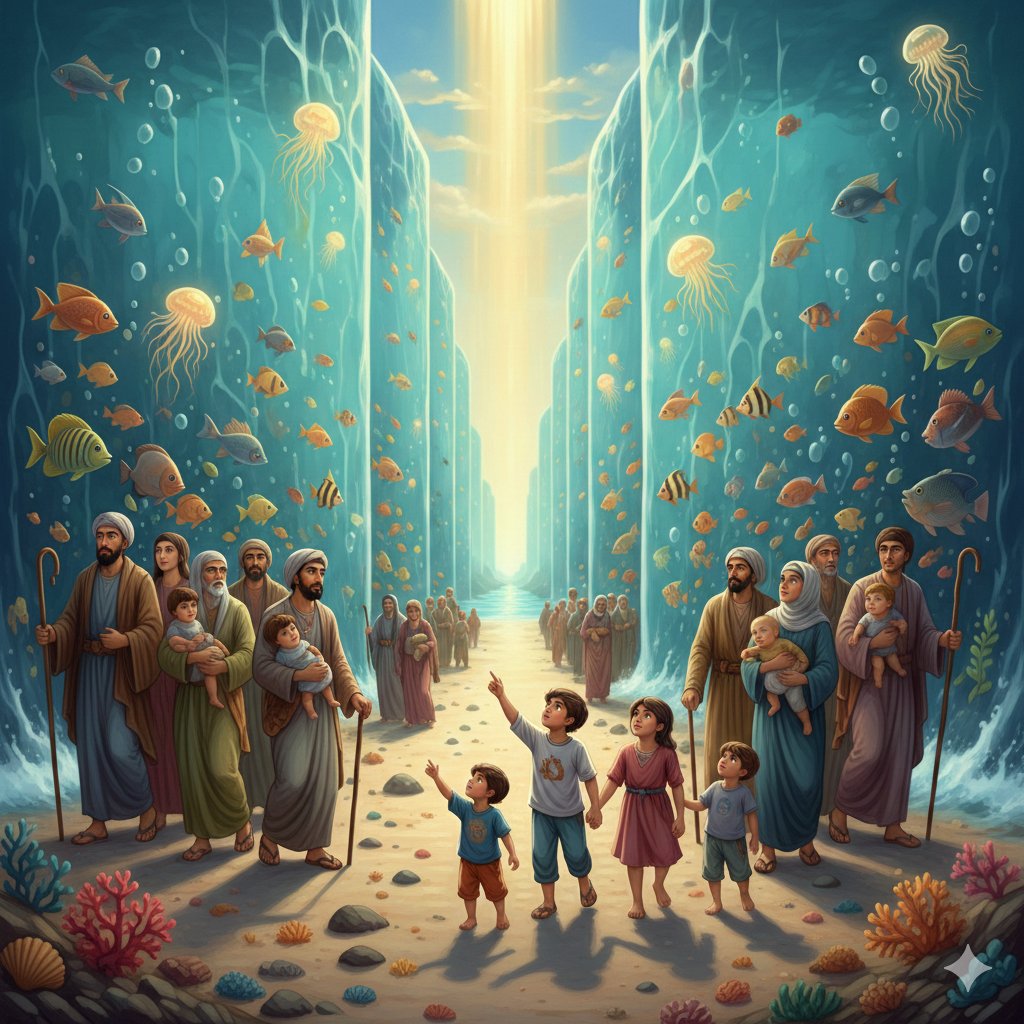
The waters rose up on both sides like two enormous walls, revealing a dry path on the seabed. The wind blew warm and strong, drying the ground beneath their feet. Bani Isra'il walked between the walls of water, the fish visible through the transparent walls, the sky visible above, the impossible made real by the Lord of the worlds.
Every man, woman, and child crossed safely to the other side.
Pharaoh saw the path and, in his arrogance, drove his army in after them. But when the last of Bani Isra'il had crossed and the Egyptians were in the middle, Allah commanded the sea to return. The walls of water came crashing down. Chariots, horses, soldiers, all swallowed by the waves.
In his final moment, as the water closed over him, Pharaoh cried: "I believe that there is no deity except that in whom the Children of Israel believe, and I am of those who submit!"
But Allah replied: "Now? And you had disobeyed before and were of the corrupters? So today We will save your body that you may be a sign for those after you."
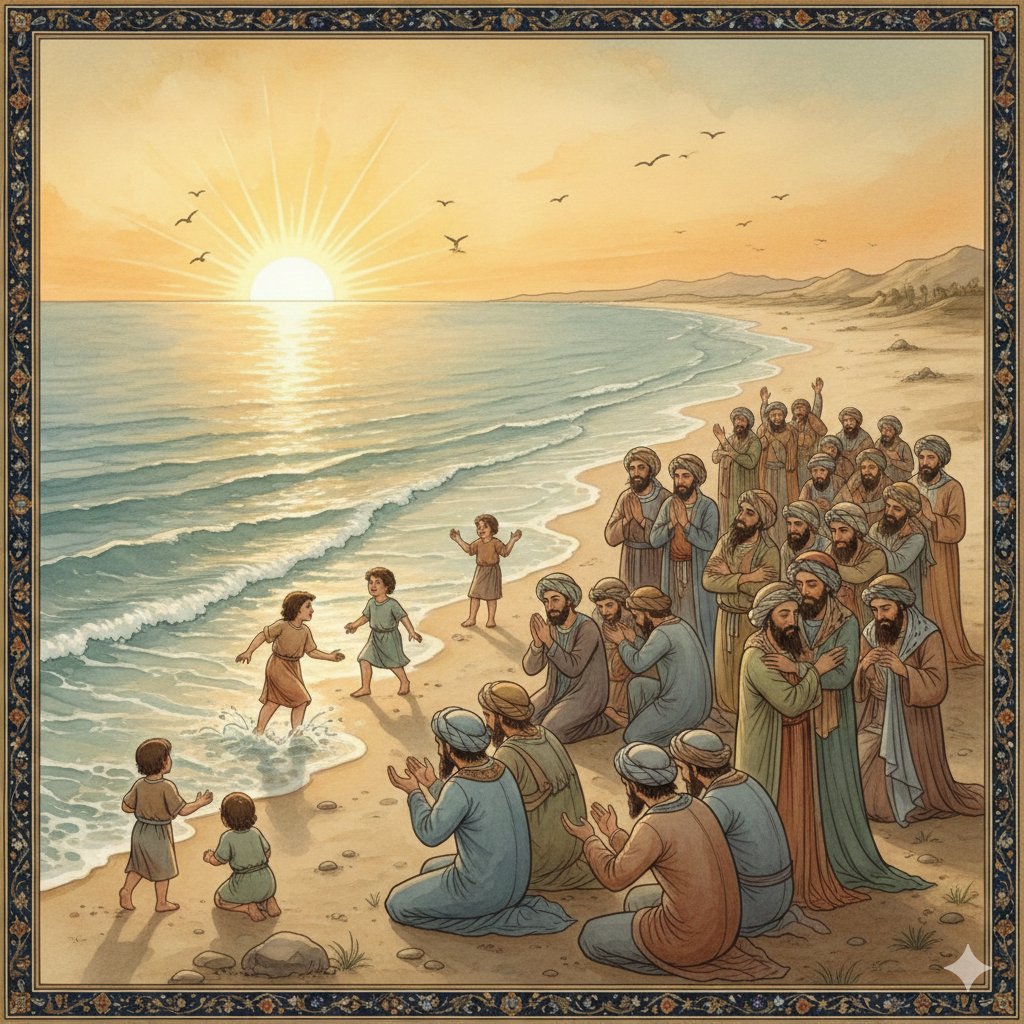
Faith at the last moment, when you have no other choice, is not the same as faith in the light of day when the choice is real. Pharaoh's body was preserved, not as a honor, but as a warning: a reminder to every future tyrant that power without justice ends in ruin.
Tonight, remember: when the sea is in front of you and the army is behind you, your job is not to solve the problem. Your job is to trust the One who can part seas.
Key Verse
Fa awhayna ila Musa anidrib bi 'asaka al-bahr, fanfalaqa fa kana kullu firqin kat-tawdil 'azheem "So We inspired to Musa: Strike the sea with your staff. And it parted, and each portion was like a great towering mountain." Ash-Shu'ara (26:63)
Reflection Questions
- The sorcerers were brave enough to accept the truth even when Pharaoh threatened them with death. What does their example teach us about choosing truth even when it is dangerous?
- When Bani Isra'il were trapped between the sea and the army, Musa said, "Indeed, with me is my Lord." How can remembering that Allah is with you help in moments when you feel trapped?
- Why did Pharaoh's last-moment belief not save him? What does this teach us about the importance of believing and doing good while we still have the chance?
Do you remember the baby who floated down the river in a little basket? That baby was Musa! And tonight, that baby has grown up into a big, strong, brave man. He is going back to the palace where he grew up, but not to live there as a prince. He is going back with a very important message from Allah. This is one of the most exciting stories in the whole Quran!
After Musa, peace be upon him, left Egypt long ago, he traveled to a faraway land called Midian. There, he became a shepherd. He took care of fluffy sheep in the quiet desert. He got married and lived a simple, peaceful life. But Allah had very big plans for Musa.
One cold, dark night, Musa was traveling with his family through the desert. They needed warmth. Then Musa spotted something on the side of a mountain. A bright, glowing light! It looked like a fire burning between the rocks.
"Wait here," Musa told his family. "I will go get some fire so we can warm up."
He walked closer and closer to the light. But when he got there, something happened that changed his life forever. A voice spoke from the glowing light. A voice like nothing Musa had ever heard before.
"O Musa! I am Allah, the Lord of all the worlds."
Musa stood very, very still. His heart was beating so fast. Allah, the Creator of everything, was talking to him!
Then Allah gave Musa two amazing signs. First, Allah said, "Throw down your stick." Musa always carried a wooden walking stick. He used it to walk and to guide his sheep. He threw it on the ground, and guess what happened? That stick turned into a real, live, slithering snake! It was moving on the ground with its tongue going in and out!
Musa jumped back because he was scared. But Allah said gently, "Do not be afraid, Musa. Pick it up." So Musa reached down, and when he grabbed it, it turned back into his stick again. Just like that!
Then Allah said, "Now put your hand inside your cloak." Musa slipped his hand into his clothing, and when he pulled it out, his whole hand was glowing with beautiful, bright white light! It was like he was holding a piece of sunshine right in his palm!
Allah told Musa, "Now I have a very important job for you. Go to Fir'awn, the Pharaoh. He has been very, very mean to the people. He hurts them. He makes them work like slaves. He thinks he is better than everyone. Tell him to stop being cruel, and tell him to let My people go free."
Musa felt a little bit nervous. Pharaoh was the most powerful king in the whole world! He had a huge army and a giant palace. So Musa asked Allah for something special. He said, "My Lord, please let my brother Harun come with me. He is a very good speaker. Let him be my helper."
And Allah said, "Yes, Musa! I will send Harun with you."
In our tradition, this is very, very important. Just like Musa had Harun as his special helper and partner, our Prophet Muhammad, peace be upon him and his family, had Imam Ali (AS) as his special helper. The Prophet even said, "Ali, you are to me like Harun was to Musa." That means Imam Ali was the closest, most trusted person to the Prophet, just like Harun was to Musa.
So Musa and Harun walked together into Pharaoh's palace. What a place it was! Huge pillars reaching up to the ceiling. Golden decorations everywhere. Guards standing with sharp spears. And there, sitting high up on his big throne, was Pharaoh, looking down at everyone with his proud, mean face.
Musa stood tall and spoke clearly. "We are messengers from the Lord of all the worlds. Let the Children of Israel go free!"
Pharaoh laughed a big, loud, mean laugh. "You?" he said, pointing at Musa. "I raised you in my own palace when you were just a little baby! You ate my food! You wore my clothes! And now you come to tell ME what to do?"
But Musa was not scared. He said, "I am a messenger of Allah. And I have proof." He threw his staff on the ground, and it turned into a huge snake, the biggest snake anyone had ever seen! Then he pulled out his hand, and it was glowing bright white like a star. Everyone gasped and stepped backward.
But Pharaoh was too proud and too stubborn to believe. "That is just a magic trick!" he said. "I have magicians who can do the same thing!" So Pharaoh called all the best magicians in Egypt.
On the big day, a huge crowd gathered to watch. The magicians threw their ropes and sticks on the ground. By using sneaky tricks, they made the ropes twist and wiggle so they looked like snakes. The crowd went, "Oooh! Aaah!"
Then it was Musa's turn. He threw his staff, and it became a snake so big, so strong, so powerful that it opened its huge mouth and swallowed up every single one of the fake snakes. Every single one. Gone! Just like that.
The magicians were very smart people. They had spent their whole lives learning tricks. They knew the difference between a trick and something real. And they knew right away that what Musa's staff did was NOT a trick. This was a real miracle from Allah!
So the magicians fell down on the ground and said, "We believe in the Lord of Musa and Harun! This is not magic. This is the truth!"
Pharaoh turned red with anger. He screamed, "How dare you! I will punish you!" But the magicians were not scared of Pharaoh anymore. They had found something much more important. They had found the truth, and the truth made them braver than they had ever been.
But stubborn Pharaoh still would not let the people go. So Allah sent many signs to Egypt, one after another. He sent big floods that covered the land. He sent little bugs called locusts that ate up all the plants. He sent tiny biting lice. He sent frogs everywhere! Frogs hopping in the kitchens, hopping on the beds, hopping on Pharaoh's throne! Each time something happened, Pharaoh would cry, "Okay, okay, I will let the people go if you make this stop!" But every time the trouble went away, Pharaoh broke his promise. He lied again and again.
Finally, Allah told Musa, "It is time. Take your people and leave Egypt tonight." So in the dark, quiet night, Musa led all the people out of Egypt. Men, women, children, grandparents, little babies, all walking together toward freedom.
But when Pharaoh found out they were gone, he was so angry! He called his whole army. Hundreds and hundreds of soldiers with horses and shiny chariots. And they chased after Musa and the people as fast as they could.
The people walked and walked until they reached the sea. In front of them was water stretching as far as they could see. And behind them? They could hear Pharaoh's army coming closer and closer. The ground was shaking from all the horses and chariots.
The people were so scared. "We are trapped!" they cried. "The sea is in front of us and the army is behind us!"
But brave Musa was not afraid. Do you know what he said? He said, "Do not worry! Allah is with me. He will show us the way."
Then Allah said, "Musa, hit the sea with your staff."
Musa lifted his wooden stick high in the air and struck the water. And then the most amazing thing happened. The sea split open! The water rose up on both sides like two giant walls, taller than the tallest buildings! And right in the middle, between those walls of water, there was a dry path. You could see the fish swimming inside the water walls. You could see the sky up above. And under your feet? Nice, dry ground.
All the people walked through. Every man, woman, child, and baby made it safely to the other side.
Then Pharaoh and his army came charging into the path between the water walls. They thought they could catch the people. But when Pharaoh and all his soldiers were right in the middle, Allah told the sea to come back together. The walls of water came crashing down! The waves swallowed up Pharaoh and his whole army.
In his very last moment, as the water closed over his head, Pharaoh cried out, "I believe now! I believe!"
But Allah said, "Now? Now you believe? After all the chances I gave you? After all the people you hurt?" It was too late. Pharaoh had chance after chance to do the right thing, and he kept choosing to be mean. When the very last moment came, his words did not count because he only said them when he had no other choice.
Allah kept Pharaoh's body so that people for thousands of years could see it and learn this lesson: being cruel to people and thinking you are the most important person in the world never, ever ends well.
Tonight, when you go to sleep, remember what Musa said when everything seemed impossible: "Allah is with me." And if Allah can split a whole sea in half, He can help you with anything. Anything at all.
Key Verse
"Fa awhayna ila Musa anidrib bi 'asaka al-bahr, fanfalaqa fa kana kullu firqin kat-tawdil 'azheem." "We told Musa: Hit the sea with your staff. And it split open, and each side was like a great, huge mountain." -- Ash-Shu'ara (26:63)
Let's Talk About It
- The magicians were brave enough to tell the truth even when Pharaoh was very angry at them. Why is it important to always tell the truth, even when it is hard?
- When the people were trapped between the sea and the army, Musa said, "Allah is with me." What can you say to yourself when you feel scared?
- Pharaoh kept breaking his promises over and over. Why is it so important to always keep your promises?