The Mysterious Journey: Musa and Khidr
Hidden wisdom; patience with what you do not understand
Tonight's story is unlike any we have told so far. It is not about defeating a tyrant or surviving a flood. It is about something harder than all of those: accepting that you do not understand everything, and trusting that there is wisdom in what seems senseless. This is the story of Musa (AS) and the mysterious man known as Khidr.
After all that Musa had been through, Pharaoh, the sea, the mountain, Allah set before him another kind of test. Not a test of courage, but a test of patience and humility. Musa was sent to meet a man who knew things that even Musa did not know.
Musa traveled with his young companion to the junction of two seas. There, they found a man described by the Quran as "a servant from among Our servants to whom We had given mercy from Us and had taught him knowledge from Our presence."
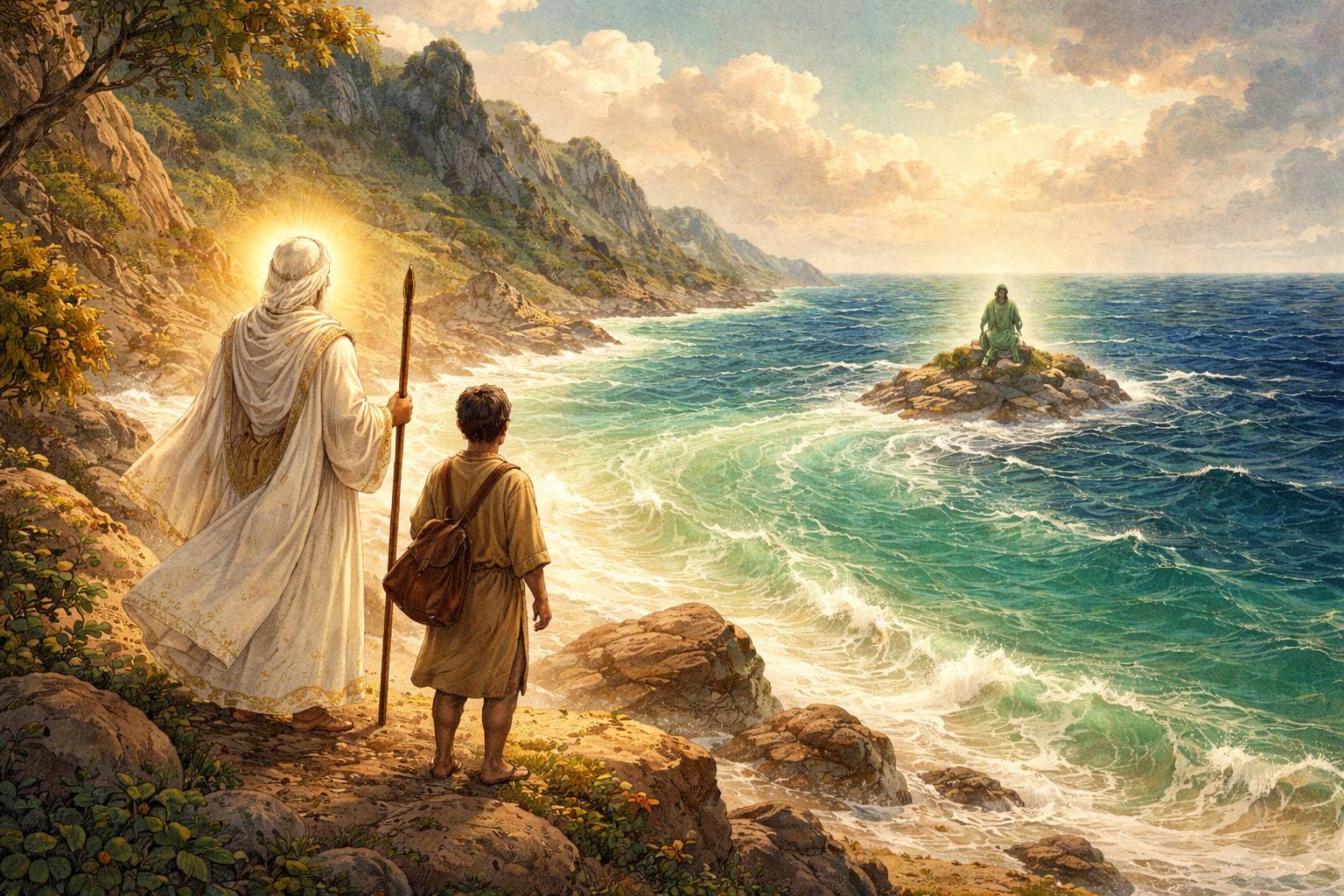
This was Khidr. In Islamic tradition, he is known as one of the most mysterious figures in all of scripture. Some scholars consider him a prophet. Others say he was a wali, a close friend of Allah, given special knowledge. In Shia tradition, Khidr holds a particularly significant place as a figure who possesses hidden knowledge, ilm al-ladunni, knowledge given directly by Allah, beyond what ordinary people can access.
Musa approached him and said: "May I follow you on the condition that you teach me from what you have been taught of sound judgment?"
Khidr's answer was direct: "Indeed, you will never be able to have patience with me. And how can you have patience about what you do not encompass in knowledge?"
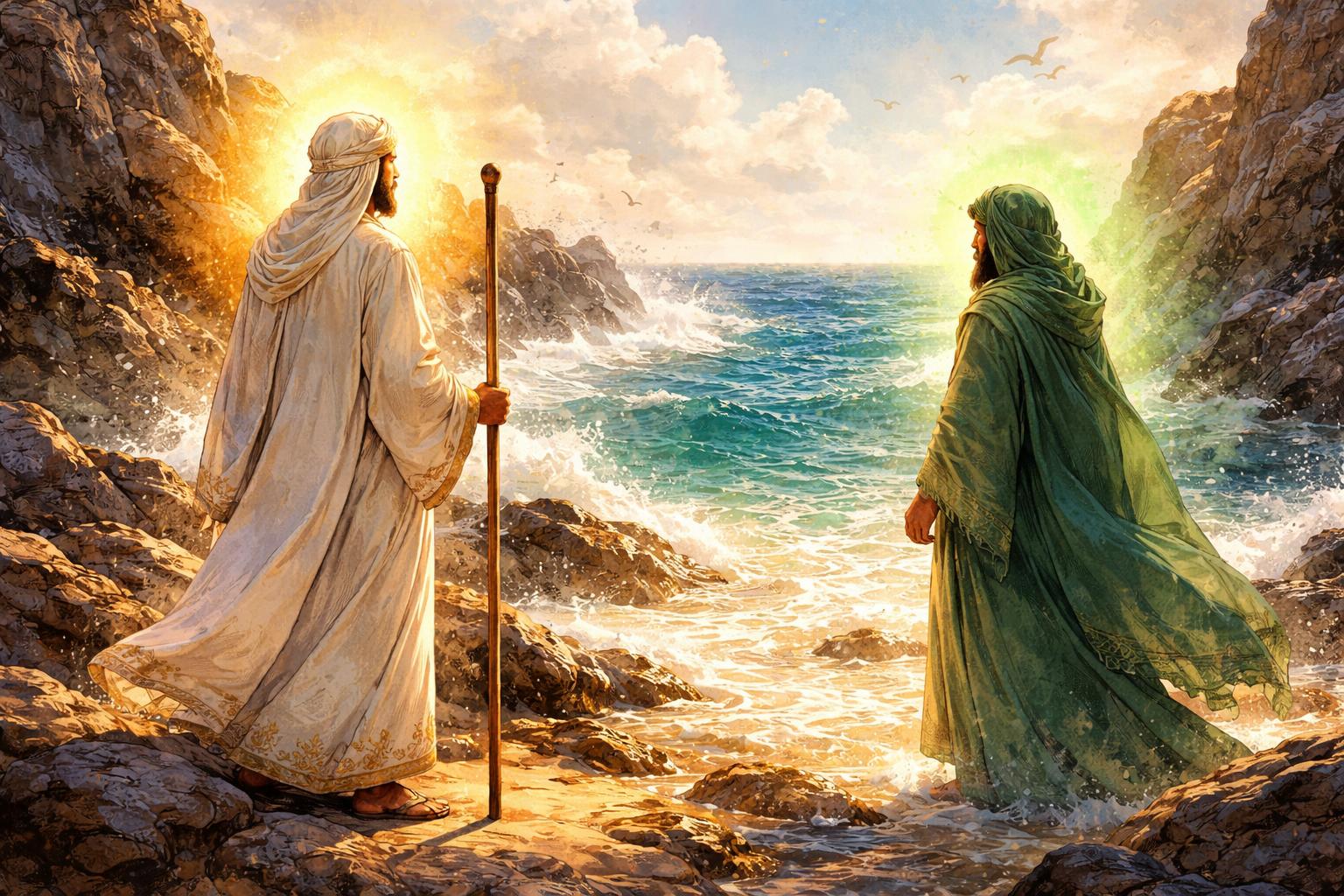
Musa promised: "You will find me, if Allah wills, patient, and I will not disobey you in any order."
Khidr set one condition: "If you follow me, do not question me about anything until I myself mention it to you."
And so they set off together. What followed were three events that tested Musa's patience to its absolute limit.
The Ship
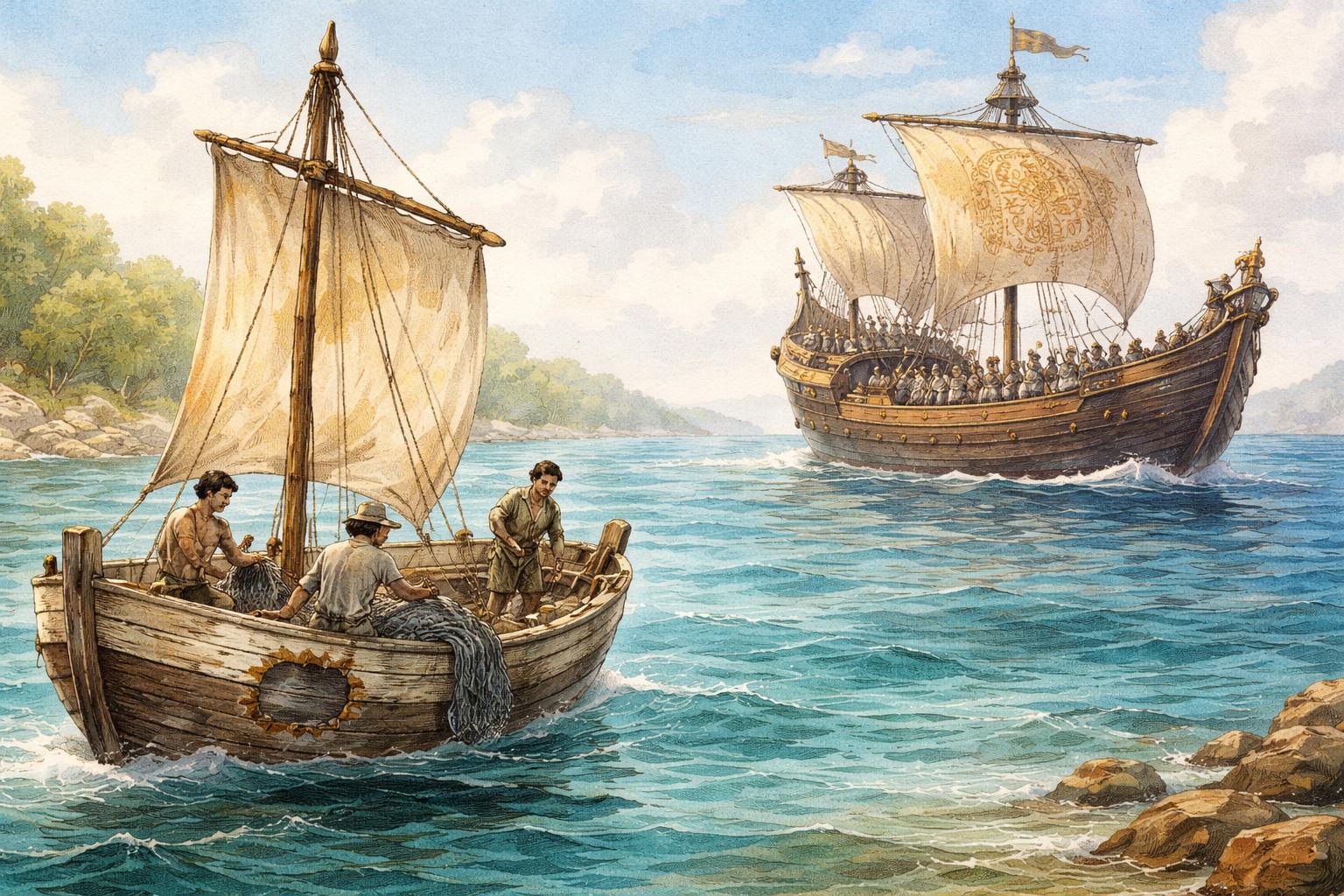
They boarded a ship with kind sailors who gave them free passage. Once at sea, Khidr pulled out a tool and made a hole in the bottom of the ship. Water began seeping in.
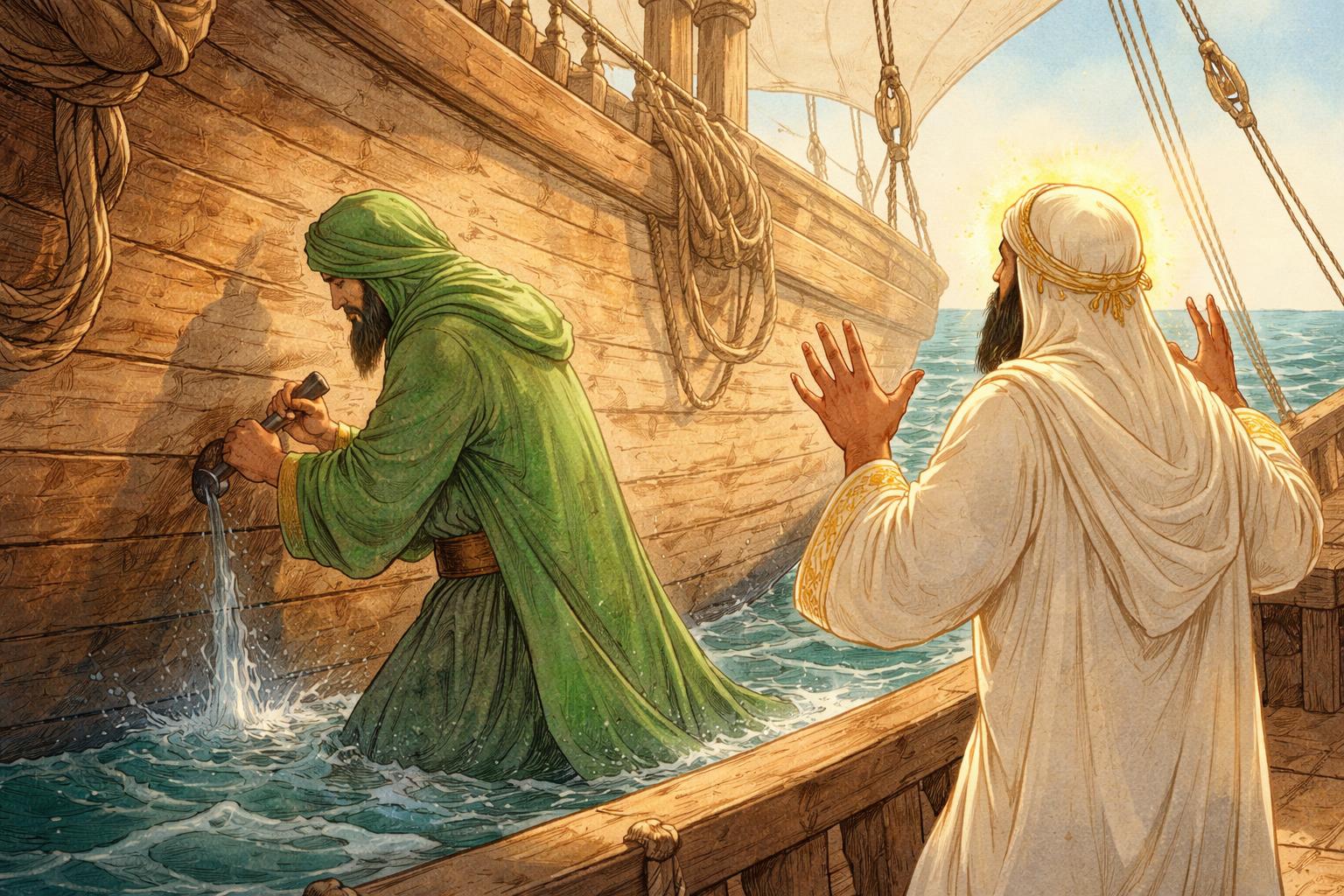
Musa could not contain himself: "Did you make a hole in it to drown its people? You have certainly done a grave thing!"
Khidr looked at him calmly: "Did I not say that you would never be able to have patience with me?"
Musa apologized. "Do not blame me for what I forgot, and do not cover me in my affair with difficulty."
The Boy
They continued their journey on land. They came upon a young boy playing. Without warning or explanation, Khidr killed him.
Musa was horrified: "Have you killed a pure soul for other than having killed another? You have certainly done a deplorable thing!"
Again Khidr reminded him: "Did I not tell you that you would never be able to have patience with me?"
Musa said: "If I ask you about anything after this, then do not keep me as a companion. You have received from me an excuse."
The Wall
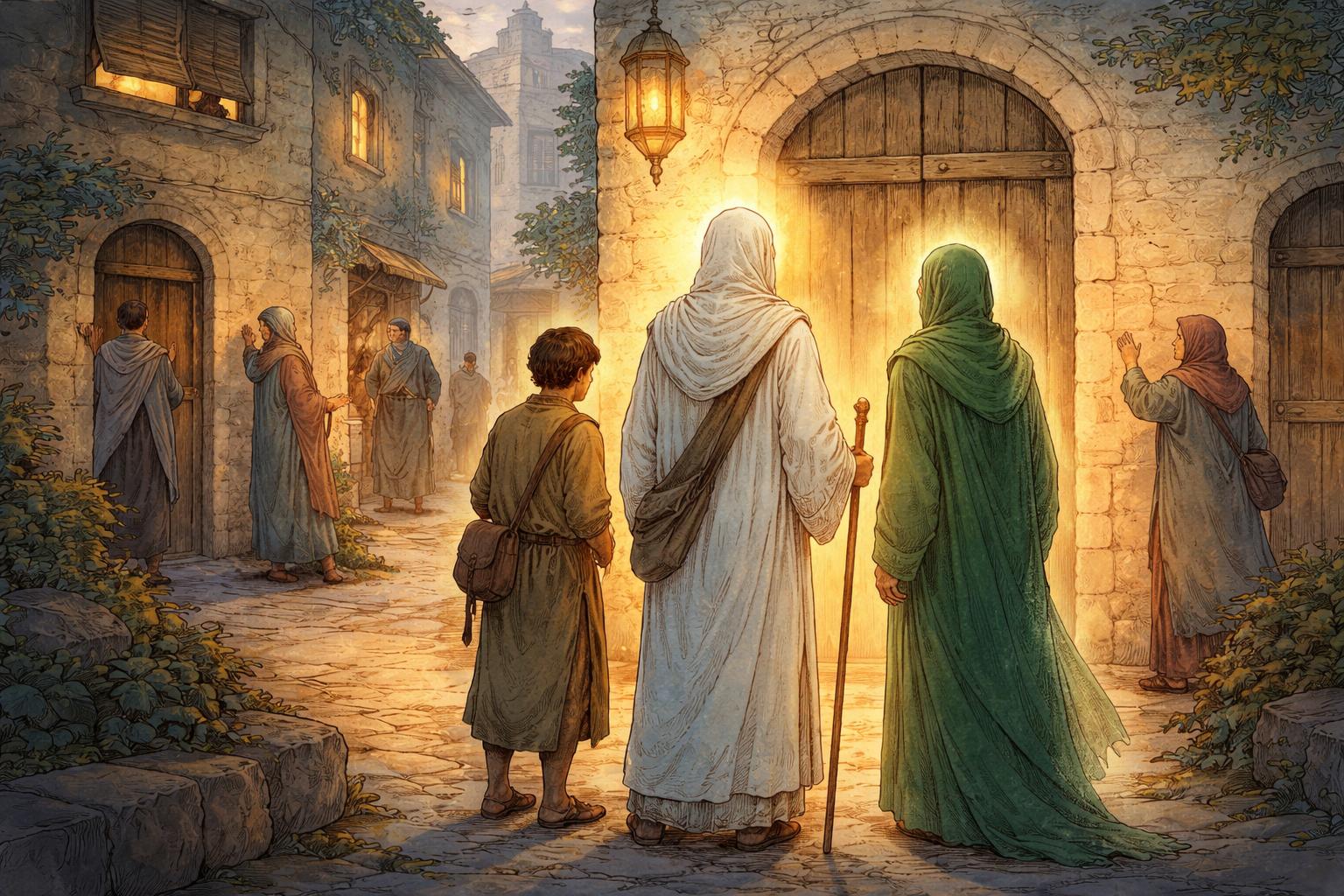
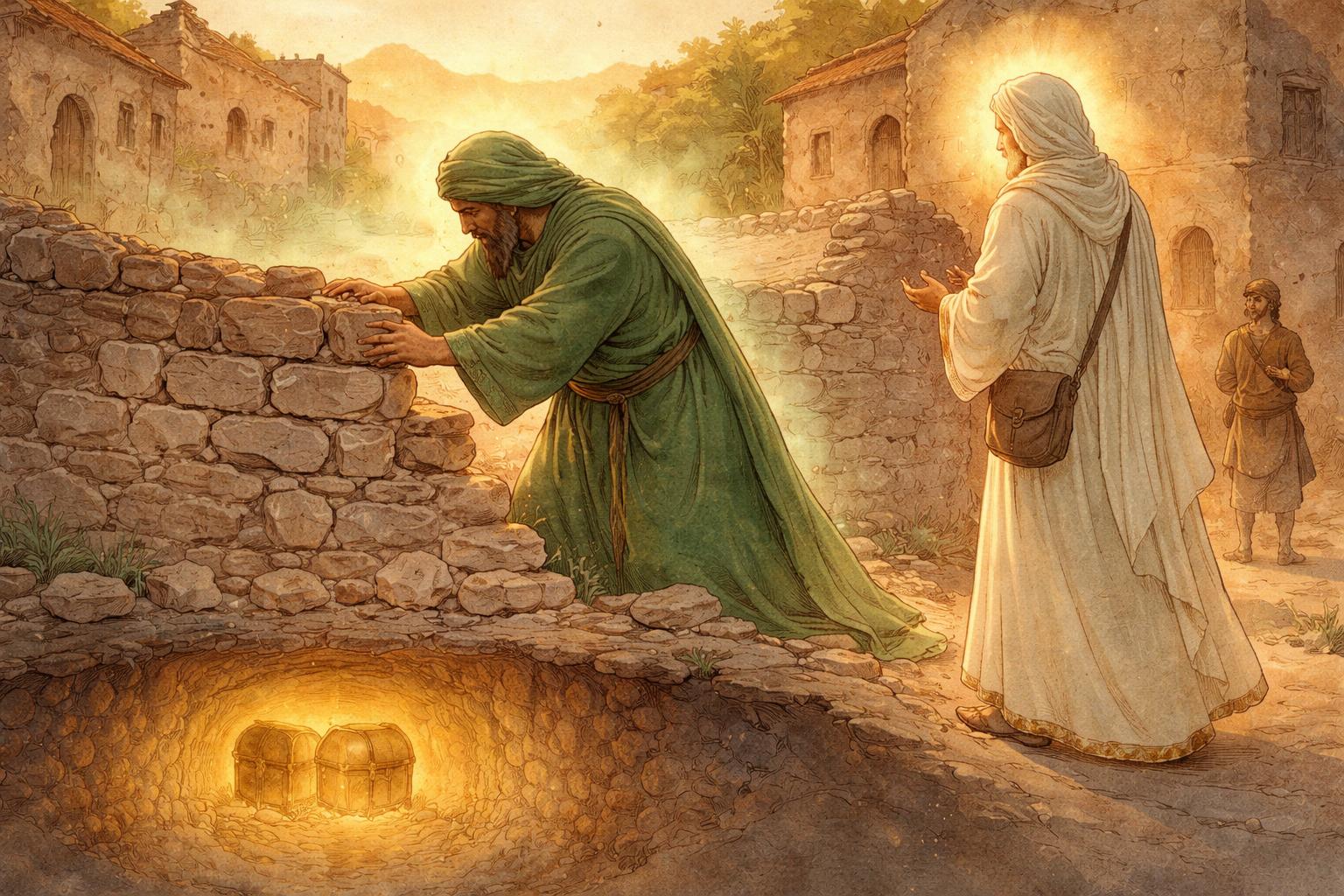
They traveled to a town where they asked the people for food, but the people refused to host them. Not a single person offered them even a morsel. Yet when Khidr saw a wall about to collapse, he stopped and rebuilt it, doing hard labor for people who had shown them nothing but rudeness.
Musa said: "If you wished, you could have taken payment for it."
Khidr said: "This is the parting between me and you. I will inform you of the interpretation of that about which you could not have patience."
And then came the explanations that changed everything.
The ship: "As for the ship, it belonged to poor people working at sea. I intended to cause defect in it because there was after them a king who seized every good ship by force." The hole made the ship imperfect. The king would pass it over, and the poor sailors would keep their livelihood. A small damage to prevent a greater loss.
The boy: "As for the boy, his parents were believers, and we feared that he would overburden them by transgression and disbelief. So we intended that their Lord should substitute for them one better than him in purity and nearer to mercy." This is the hardest one to accept. But Allah, who sees the future that we cannot, knew that this child would grow into someone who would cause immeasurable suffering to his believing parents. Allah replaced that grief with a better child. We do not understand all of Allah's reasoning, and we are not meant to. We are meant to trust.

The wall: "And as for the wall, it belonged to two orphan boys in the city, and there was beneath it a treasure belonging to them. Their father had been a righteous man. So your Lord intended that they reach maturity and extract their treasure as a mercy from your Lord." The treasure hidden beneath the wall would have been exposed if the wall had fallen. Khidr rebuilt it so that the orphans could one day claim what was rightfully theirs. He did this kindness for people who were not even present, because their righteous father had earned Allah's care for his children.
Khidr concluded: "I did it not of my own accord. That is the interpretation of that about which you could not have patience."
Every action that seemed wrong had a deeper reason. Every apparent cruelty was actually mercy. The lesson is not that we should do harmful things and call them good. The lesson is that our view of the world is limited. We see only the surface of the ocean. Allah sees all the way to the bottom.

In the Shia tradition, the story of Khidr is deeply connected to the concept of the Imam's hidden knowledge. Just as Khidr acted on knowledge that was invisible to Musa, the Imams (AS) are believed to possess knowledge from Allah that goes beyond what is apparent. Imam al-Sadiq (AS) said: "Our knowledge is of three kinds: knowledge of the past, knowledge of the future, and knowledge that comes fresh each night and day."
This does not mean we should blindly accept everything that happens without thinking. Rather, it means that after we have done our best to understand, after we have used our reason, our knowledge, and our conscience, we should trust that whatever remains beyond our understanding is held in the hands of the One who knows all.
Key Verse
Qala innaka lan tastatee'a ma'iya sabra, wa kayfa tasbiru 'ala ma lam tuhit bihi khubra "He said: Indeed, you will never be able to have patience with me. And how can you have patience about what you do not encompass in knowledge?" Al-Kahf (18:67-68)
Reflection Questions
- Khidr's actions seemed wrong on the surface but had wise reasons behind them. Can you think of a time when something that seemed bad at first turned out to be good in the end?
- Even Musa, one of the greatest prophets, could not be patient with what he did not understand. What does this teach us about how natural it is to struggle with patience?
- The Quran says Khidr had "knowledge from Our presence." What is the difference between knowledge we learn from books and knowledge that comes from closeness to Allah?
Tonight's story is different from all the other stories we have told so far. It is not about fighting a bad king or crossing a sea. It is about something much, much harder. It is about learning to be patient when you do not understand why something is happening. Are you ready for a very strange and mysterious adventure? Let us follow Musa, peace be upon him, on his most unusual journey.
After everything Musa had been through, you would think he had learned everything there was to learn, right? He stood in front of Pharaoh. He split the sea. He talked to Allah on top of a mountain! But Allah wanted to teach Musa something new. Allah wanted to show him that sometimes, things look wrong on the outside but are actually right on the inside. And to learn this lesson, Musa needed to meet a very special, very mysterious man.
His name was Khidr, peace be upon him.
Allah told Musa to travel to a place where two seas meet. Musa took a young helper with him, and they walked and walked until they reached that spot. And there, sitting quietly by the water, was Khidr. He was a servant of Allah. And Allah had given him something very special: hidden knowledge. Khidr could see things that other people could not see. He knew secret reasons for why things happen.
Musa walked up to Khidr and said very politely, "May I please travel with you? I want to learn some of the special things Allah has taught you."
Khidr looked at Musa with kind but serious eyes. He said, "Musa, I do not think you will be able to be patient with me. You are going to see me do things that you do not understand, and you will want to ask me why."
Musa said, "No, no, I will be patient! I promise! I will not ask you any questions until you are ready to tell me."
Khidr said, "All right. But here is the rule. If you follow me, you must not ask me about anything I do. No questions at all! I will explain everything when we are done."
Musa agreed, and off they went together. And that is when the very strange things started happening.
The first strange thing was about a boat.
Musa and Khidr came to the seashore. Some kind fishermen were there with their boat. These were good, hardworking people. They said, "Hop on! We will take you across the water. You do not even have to pay." That was very nice of them, right?
The boat sailed across the blue water. The waves went splash, splash, splash against the sides. Everything seemed fine. But then Khidr picked up a tool and started making a hole in the bottom of the boat! Water began dripping in through the hole!
Musa's eyes went wide. "What are you doing?!" he cried. "These kind people gave us a free ride, and you are breaking their boat! If you keep making that hole, the boat will sink! Everyone could get hurt!"
Khidr looked at Musa calmly. "Did I not tell you? You would not be able to be patient with me."
Musa felt so embarrassed. He had promised not to ask any questions, and here he was already asking! "I am so sorry," he said. "I forgot about my promise. Please do not be upset with me. I will try harder. I really will."
They got off the boat and kept walking on land. Then came the second strange thing. They met a young boy. And Khidr did something very surprising to the boy. Musa could not believe his eyes.
"Why did you do that?!" Musa cried out, even louder than before. "That does not seem right at all!"
Khidr looked at Musa again and said quietly, "Did I not tell you that you would not be able to be patient with me?"
Musa felt terrible. He had broken his promise again! "I am so sorry," he said. "If I ask you one more time about anything, you can leave me behind. I will not say another word."
They kept walking until they reached a town. They were tired and hungry from their long trip. They knocked on doors and asked people, "Please, could you share some food with us? We have been walking all day." But the people in this town were very rude. Not one person would share even a tiny bit of food. Not a piece of bread. Not a cup of water. Not even a date. They just shut their doors and walked away. How unkind!
As they were walking through the town feeling hungry and tired, Khidr noticed an old wall that was leaning way over, about to fall down. It was crumbling and cracking. Any minute, it was going to crash to the ground.
What did Khidr do? He stopped, rolled up his sleeves, and started fixing the wall! He picked up heavy stones and mud. He pushed and lifted and worked hard, building the whole wall back up. It was hot, sweaty, tiring work. And he did it all for free, for these same rude people who would not even give him a drink of water!
Musa could not help himself. He said, "Come on! These people were so mean to us. They would not even share a little bread. And you are doing all this hard work for them for nothing? You could have at least asked them to pay you!"
Khidr brushed the dust off his hands. He said, "Musa, that is the third time you have questioned me. This is where we must say goodbye. But before I go, I will explain everything. I will tell you the secret reason behind each thing I did."
Musa's ears perked up. Finally, the answers!
"The boat," Khidr said. "Those kind fishermen who gave us a ride? I made a small hole in their boat on purpose. Do you want to know why? Because there was a mean, greedy king coming along right behind us. This king had soldiers who were stealing every good boat they could find. If the soldiers saw a boat with a hole in it, they would think it was broken and not worth taking. They would leave it alone! After the king passed by, the fishermen could fix the small hole very easily and keep their boat. I broke a little piece to save the whole thing."
Musa's mouth fell open. Oh! So the broken boat was actually a rescued boat!
Then Khidr explained the second thing, about the boy. He told Musa that Allah, who knows everything that will happen, knew that this boy would grow up to hurt his good, kind parents very badly. He would cause them so much pain and sadness. So Allah, in His mercy, took the boy and planned to give the parents a new child, a child who would be kind and loving and would make them so happy. We do not always understand why things happen, but Allah sees the future and we cannot.
Finally, Khidr explained the wall. "That old wall," he said. "It belongs to two little children whose father died. They are orphans, children who have no father to take care of them. And hidden under that wall, deep in the ground, there is a treasure! Their good father left it there for them before he died. If the wall had fallen down, all the rude, greedy people in the town would have found the treasure and stolen it from those poor children. I fixed the wall so the treasure stays hidden and safe until the children grow up big and strong. Then they can dig it up and use what their father left for them."
Musa stood there quietly. Now he understood. Every single thing that Khidr did, every action that looked wrong and confusing and unfair, had a beautiful, wise reason behind it. The broken boat saved the fishermen. The wall protected the treasure for the orphan children. Everything that looked bad was actually good.
Then Khidr said something very important. He said, "I did not do any of this by myself. Allah told me to do all of it."
In our Shia tradition, the story of Khidr teaches us something very deep. Just like Khidr had hidden knowledge from Allah, our Imams, peace be upon them, also had special knowledge that Allah gave them. Imam al-Sadiq (AS) said that the Imams have knowledge of the past and the future, and knowledge that comes to them fresh. This does not mean we should stop thinking or stop asking questions. It means that after we do our best to understand something, we should trust that Allah knows things we do not know.
So tonight, the next time something happens and you think, "That is not fair!" or "I do not understand why this happened," remember this story. Remember the boat with the hole that saved the fishermen. Remember the wall that protected the treasure for the orphan children. Sometimes, things that look the most wrong have the most beautiful reasons hiding behind them. We just cannot see those reasons yet. But Allah can. And He always, always knows best.
Key Verse
"Qala innaka lan tastatee'a ma'iya sabra, wa kayfa tasbiru 'ala ma lam tuhit bihi khubra." "He said: You will not be able to be patient with me. How can you be patient about things you do not understand?" -- Al-Kahf (18:67-68)
Let's Talk About It
- Khidr broke the boat, but it was actually to save it from the greedy king. Can you think of a time when something that seemed bad turned out to be good?
- Musa found it very hard to be patient, even though he promised he would be. Is it easy or hard for you to be patient? What helps you be more patient?
- Khidr fixed the wall to protect the orphans' treasure. What does this teach us about being kind, even to people who are not kind to us?