The Sleepers in the Cave: Youth Who Stood for Faith
Courage of young believers; Allah protects the faithful
Imagine being a teenager in a city where everyone around you, your teachers, your neighbors, even the king, worships false idols. Imagine knowing in your heart that it is wrong, that there is only one God, Allah, the Creator of everything. Now imagine having the courage to say it out loud, even when it could cost you everything. Tonight's story is about a group of young people who did exactly that, and what Allah did to protect them.
Long ago, in a city ruled by a powerful and tyrannical king, there lived a group of young men. They were not prophets. They were not scholars. They were simply young people who used their minds and their hearts, and arrived at a truth that the rest of their city had abandoned: there is no god but Allah.
The Quran tells us: "They were youths who believed in their Lord, and We increased them in guidance." These were young people, probably not much older than you, who looked at the idols their people bowed to and said, "These are just stones. They cannot help us, and they cannot harm us. Our Lord is the Lord of the heavens and the earth. We will never call upon any god besides Him."
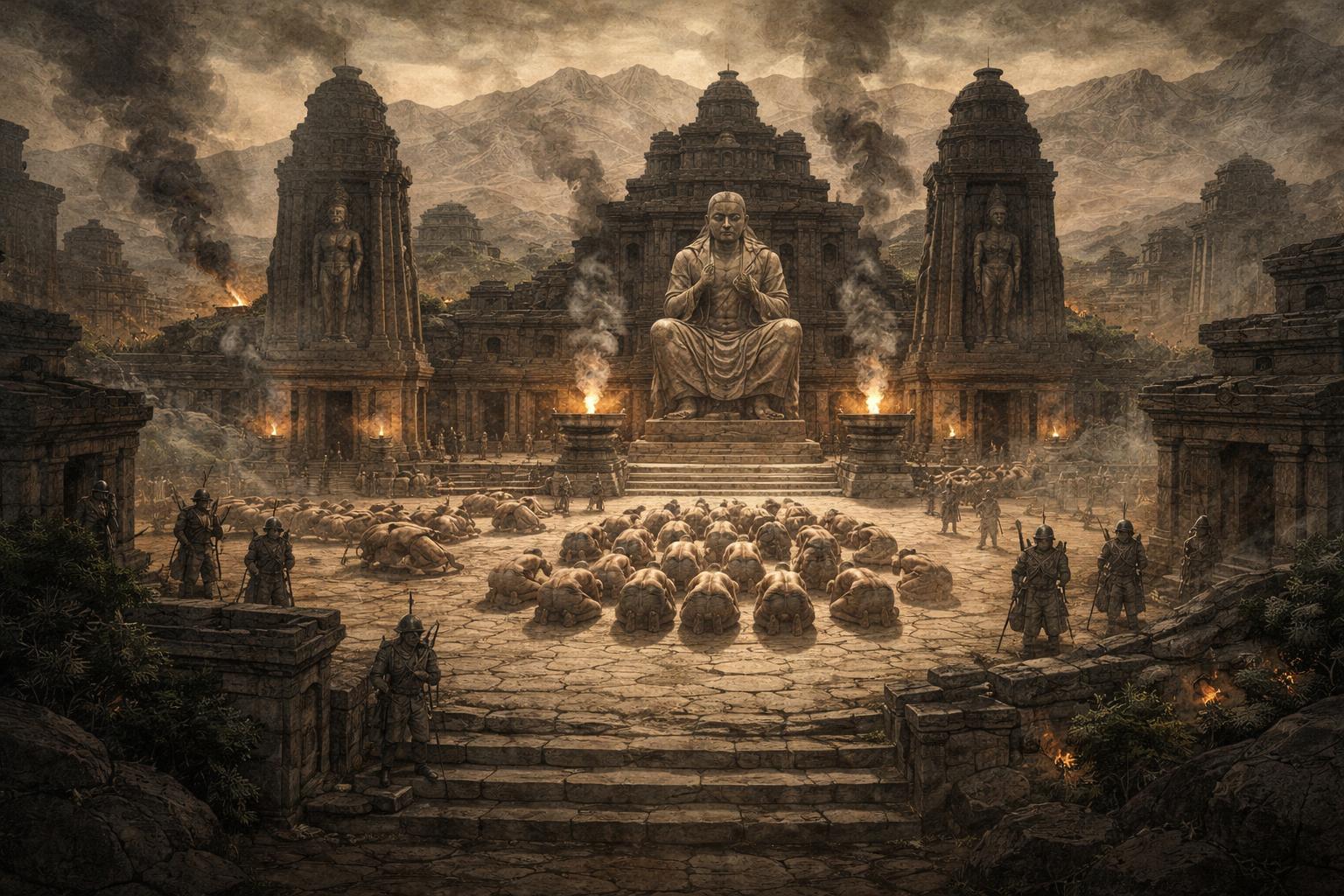
This was an incredibly brave thing to do. The king of their city was a cruel man who demanded that everyone worship the idols. Those who refused were punished severely. But these young men could not bring themselves to bow to stones when they knew the truth. Their faith was stronger than their fear.
They tried to reason with their people. "Why do you worship what cannot hear or see?" they asked. "Why do you bow to what your own hands have carved?" But the people would not listen. The king grew angry. Word reached him that a group of young men were spreading dangerous ideas about one God, refusing to worship at the temples.
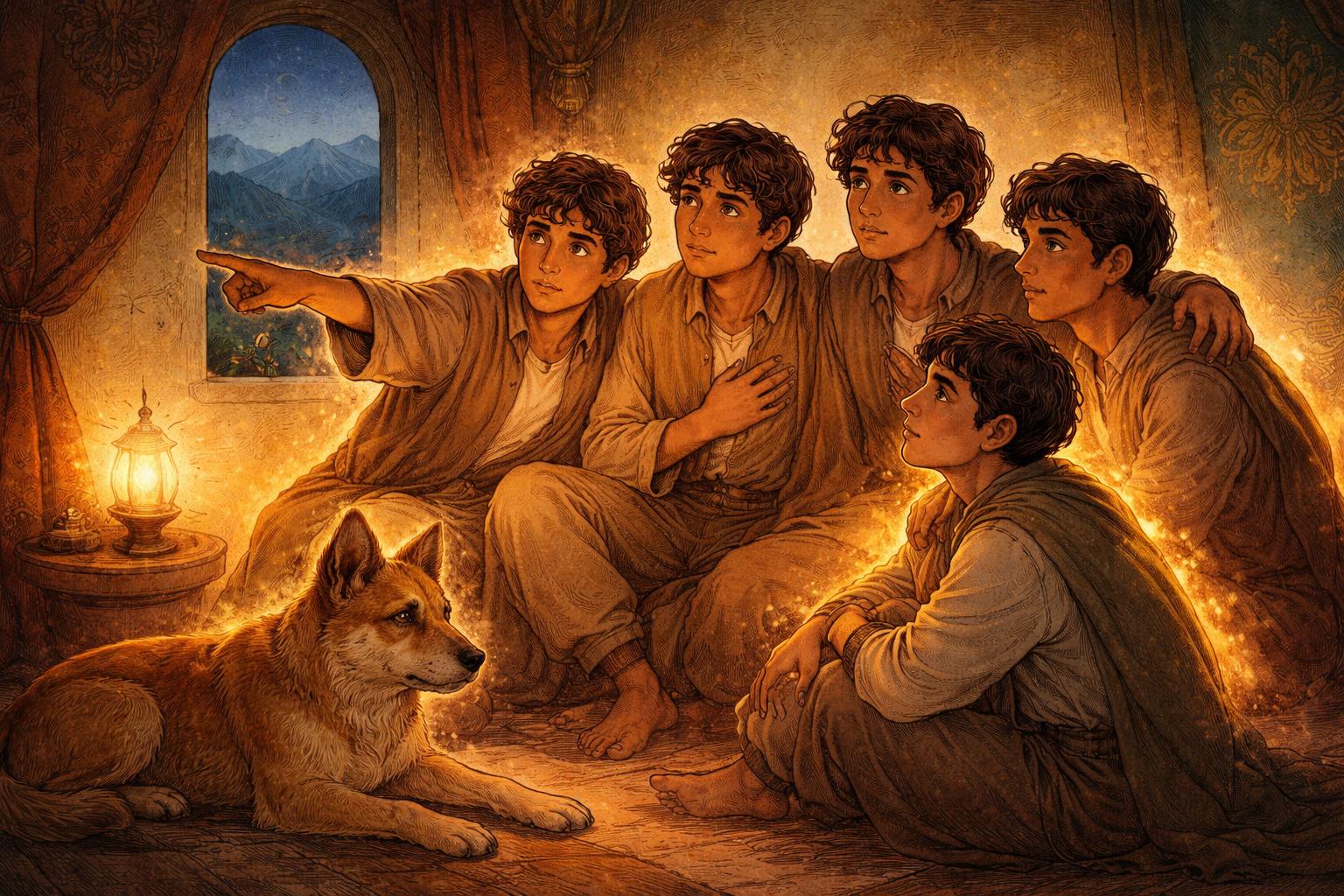
The young men knew they were in danger. They gathered together and made a decision. They would leave the city rather than compromise their faith. They would trust Allah to protect them.
"When you withdraw from them and what they worship besides Allah," they said to each other, "then seek refuge in the cave. Your Lord will spread out for you of His mercy and will prepare for you from your affair facility." They had a plan: a cave in the mountains outside the city, where they could hide until the danger passed.
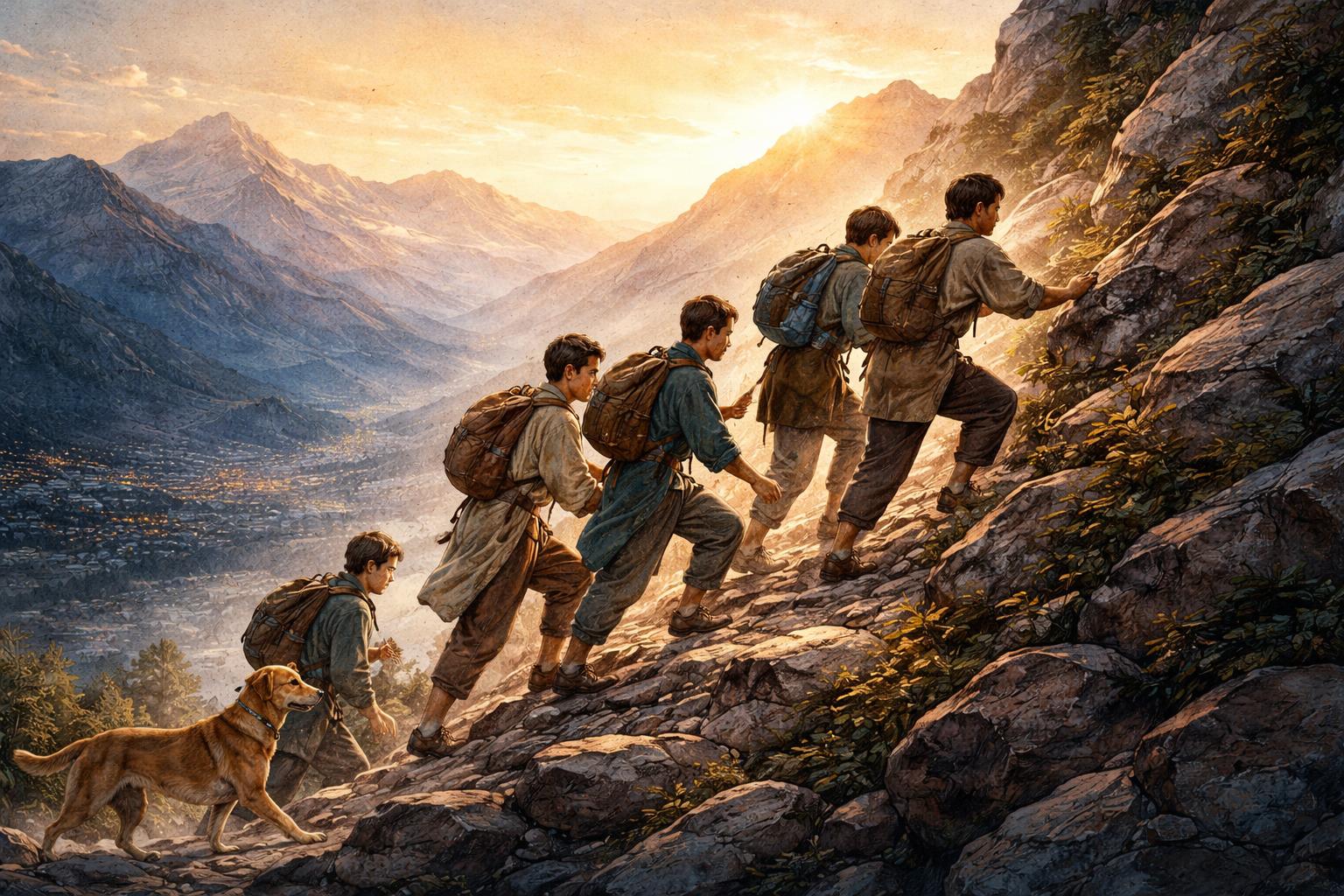
And so they left. Quietly, in the early hours, these brave young men slipped out of the city. With them went their faithful dog, who trotted alongside his masters, loyal and unquestioning. They climbed into the mountains until they found the cave, a deep shelter in the rock, hidden from the view of anyone below.
They entered the cave and lay down, exhausted from their escape and heavy with worry about what the king might do if he found them. They prayed to Allah for protection: "Our Lord, grant us from Yourself mercy and prepare for us from our affair right guidance."
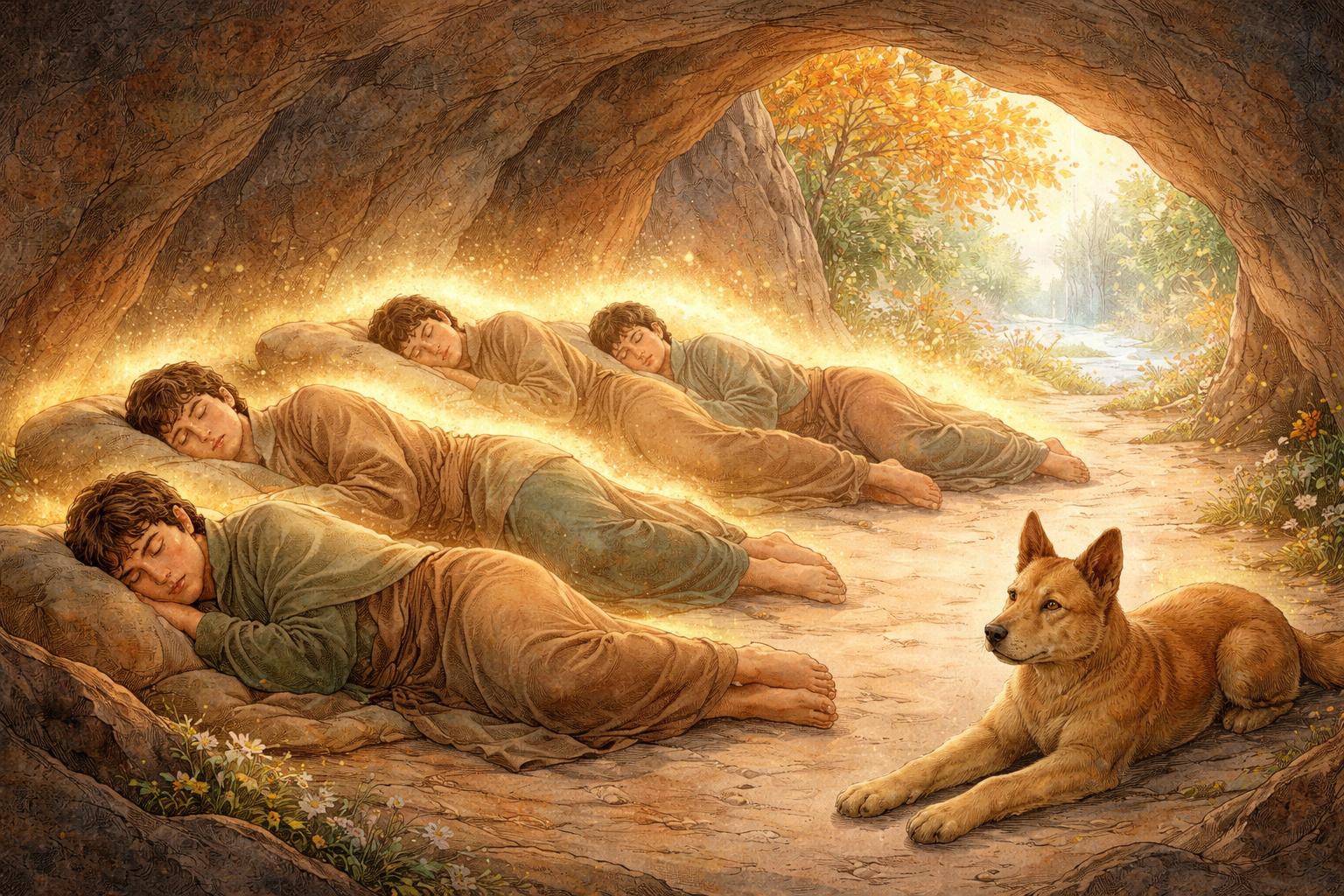
And then Allah did something miraculous. He put them to sleep. Not an ordinary sleep, but a deep, protected slumber that would last not for a night, not for a week, not for a year, but for three hundred and nine years. The Quran says: "We sealed their ears in the cave for a number of years."
While they slept, the world changed around them completely. The cruel king died. Generations were born and passed away. The city they had fled was transformed. New buildings rose. Old ones crumbled. The very language people spoke shifted and changed. Empires fell and new ones took their place. And through it all, the young men slept peacefully in their cave, protected by Allah.
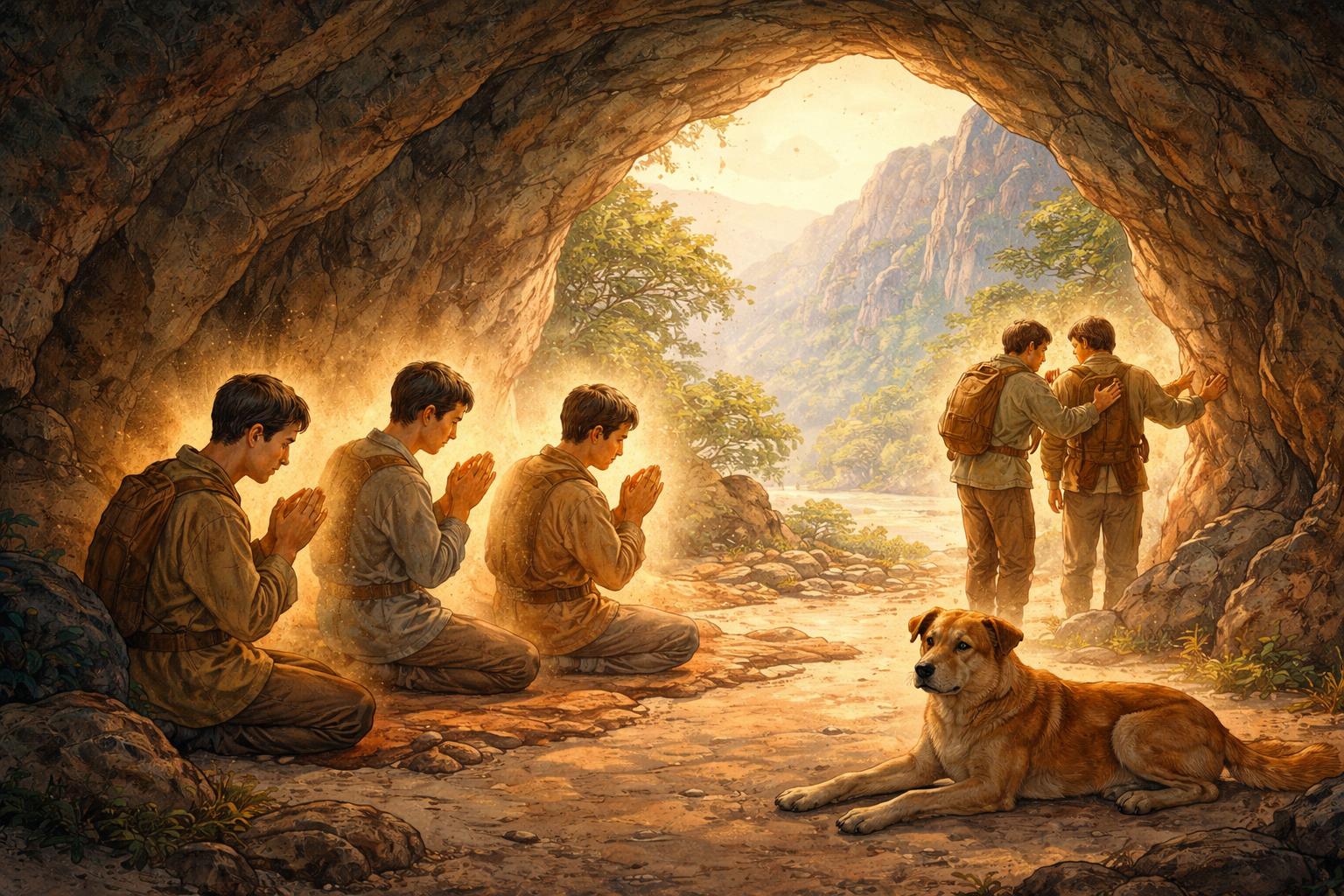
The Quran gives us a beautiful detail about how Allah cared for them even in their sleep. The sun, as it rose, would incline away from their cave on the right, and as it set, it would pass them on the left, so that its heat would not disturb them. They lay in an open space within the cave, comfortable and undisturbed. And their dog stretched his forelegs at the entrance, guarding them faithfully.
If anyone had stumbled upon the cave and peered inside, the Quran tells us they would have been filled with terror and turned away running. Allah had placed a protection over them so powerful that no one could approach.
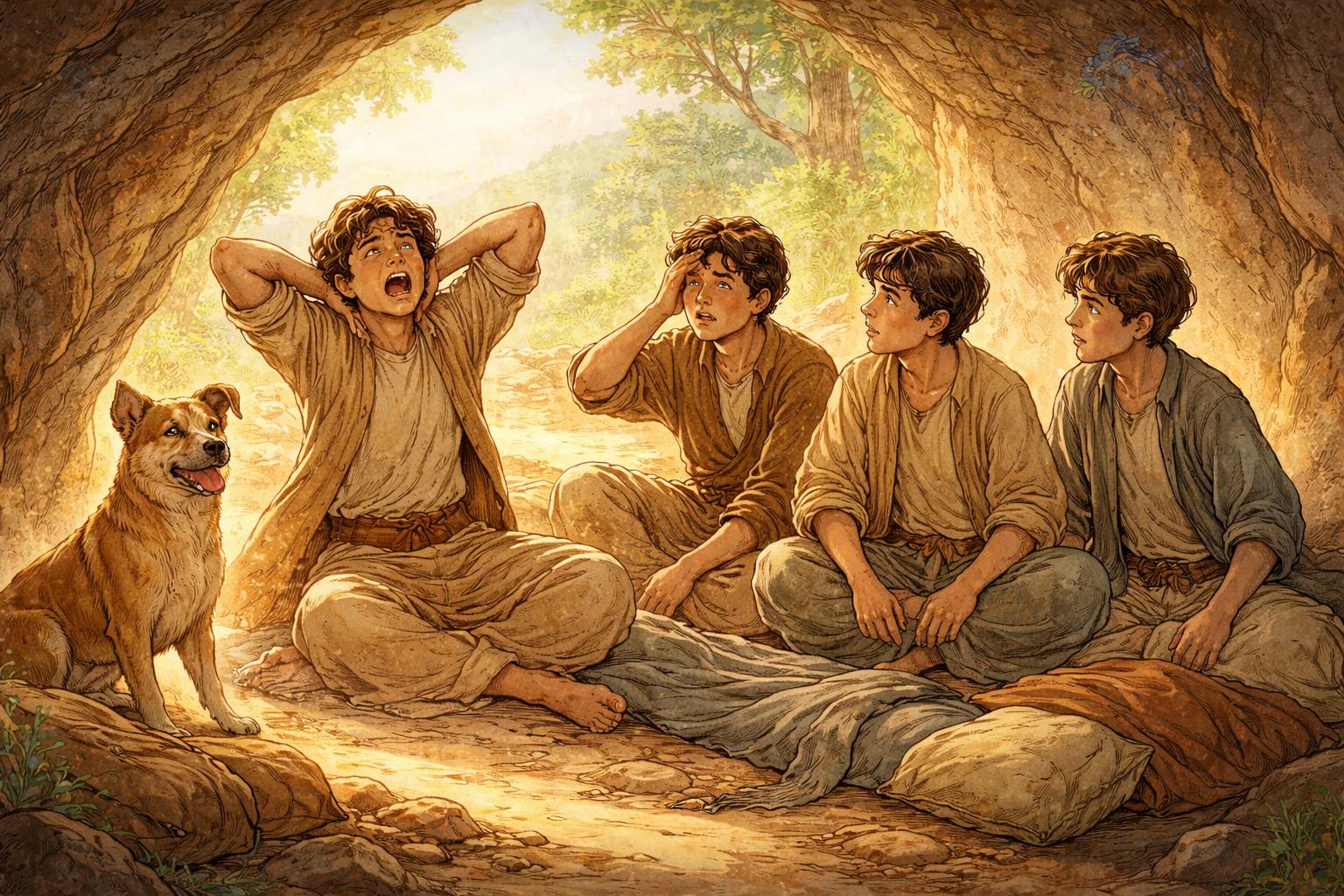
Then, after all those centuries, Allah woke them up. They stirred, stretched, and looked at each other with sleepy eyes. "How long have we stayed?" they asked one another. "We have stayed a day, or part of a day," they guessed, for that is what it felt like. Their sleep had been so deep and so peaceful that three centuries had passed like a single afternoon nap.
They were hungry, naturally. One of them was sent to the city with a silver coin to buy food. "Let him be careful," the others said. "Let him not tell anyone about us, for if they find us, they will stone us or force us back to their religion."
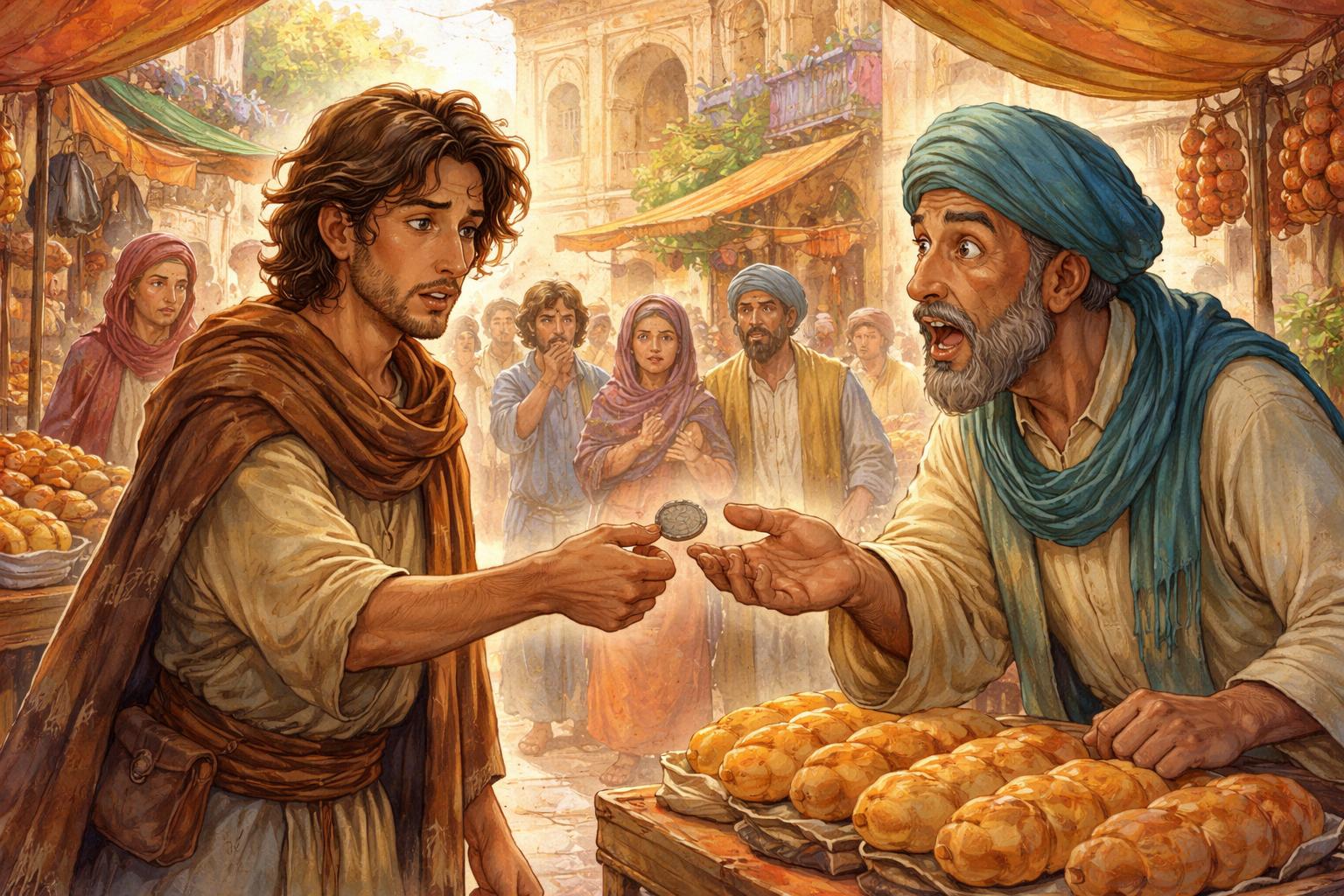
The young man entered the city and was bewildered. Everything was different. The buildings, the clothes, the faces. When he presented his ancient silver coin to a shopkeeper to buy bread, the man stared at it in amazement. This was a coin from centuries ago. Where had this young man come from?
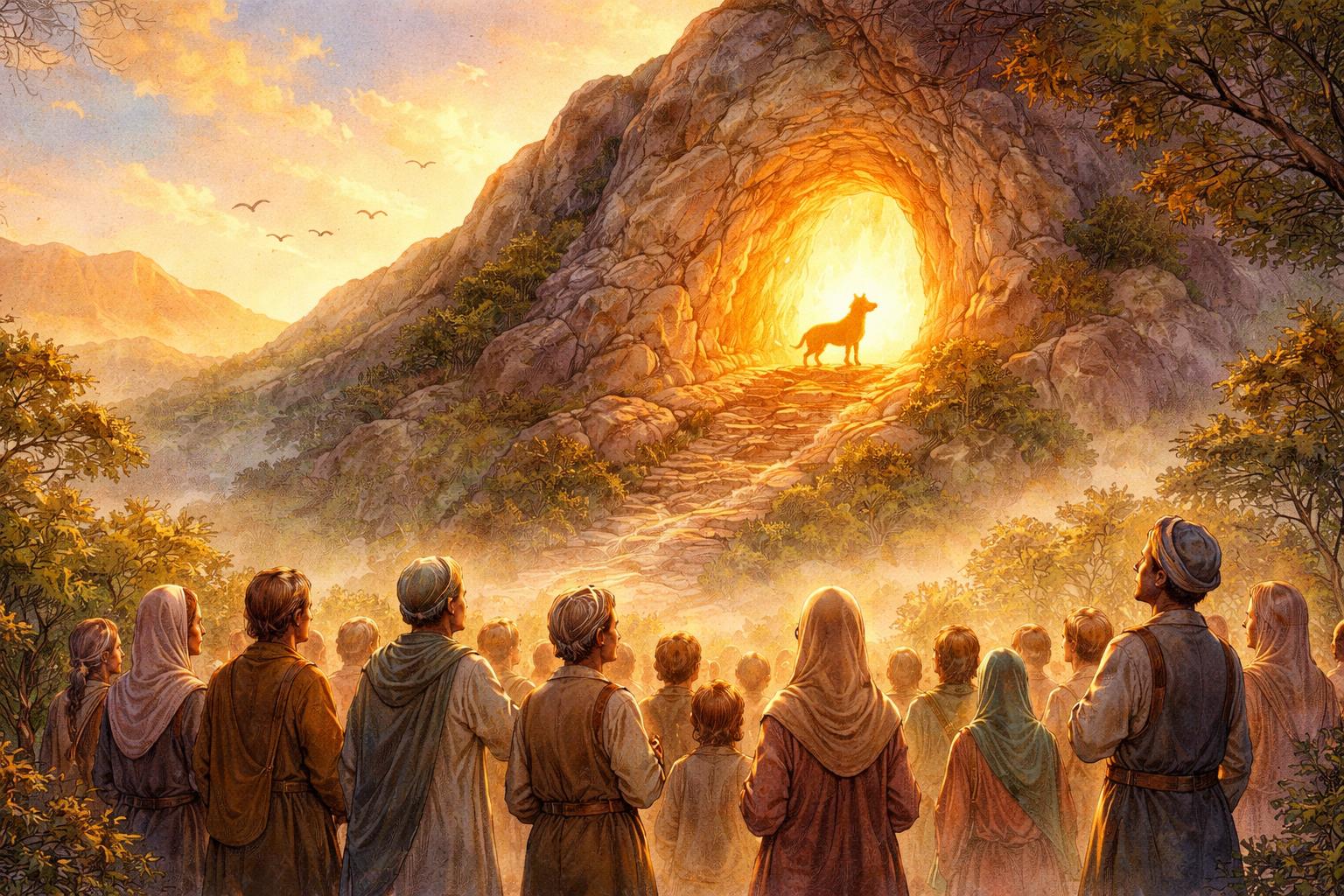
Word spread quickly. People gathered. The authorities were called. And then the astonishing truth came to light: these were the legendary young men who had vanished centuries ago. The story that had been passed down as a fable, as a myth, was real. They were alive.
The people of the city, who now believed in Allah, were amazed. The young men's story became a sign from Allah, proof that He can do all things, that He protects those who trust in Him, and that His promise of resurrection is true. For if Allah can put people to sleep for three hundred years and wake them as if no time had passed, then surely He can raise the dead on the Day of Judgment.
The Quran does not tell us exactly how many they were. Some said three, and their dog was the fourth. Some said five, and their dog was the sixth. Some said seven, and their dog was the eighth. The Quran tells us: "Say, 'My Lord is most knowing of their number. None knows them except a few.'" The exact number does not matter. What matters is their courage, their faith, and Allah's protection.
In the Shia tradition, the story of the Sleepers resonates deeply. These were young people who stood against the majority when the majority was wrong. At Karbala, the young companions of Imam Husayn (AS), some of them barely older than teenagers, showed the same courage. They stood for truth even when vastly outnumbered, knowing that standing with truth, even if you stand alone, is better than going along with falsehood.
Imam Ali (AS) said: "Do not be afraid of being few, for the truth has always been with the few." The Sleepers in the Cave were a small group. But their faith was true, and Allah honored them across the centuries.
Imam Sadiq (AS) said that the story of the People of the Cave teaches us that when you choose Allah over everything else, He will take care of everything else for you. The young men did not know how they would survive. They simply trusted Allah and entered the cave. And Allah took care of the rest, for three hundred and nine years.
Tonight, as we near the end of the second arc of Ramadan, the nights of forgiveness, remember the Sleepers. Their story is a gift, a reminder that courage is not about being unafraid. It is about being afraid and still choosing truth. Whatever cave you need to enter, whatever stand you need to take, know that Allah is with those who trust in Him.
Key Verse
"Innahum fityatun amanu bi Rabbihim wa zidnahum huda" "Indeed, they were youths who believed in their Lord, and We increased them in guidance." -- Al-Kahf (18:13)
Reflection Questions
- The Sleepers were young people, probably teenagers, who stood up for truth when all the adults around them were wrong. Have you ever felt like you knew something was right even though most people disagreed? How did you handle it?
- The Sleepers' faithful dog stayed with them through everything. What does loyalty mean to you, and who in your life has been loyal to you even when things were difficult?
- When the Sleepers woke up, centuries had passed but they felt like they had only slept for a day. What does this teach us about how differently Allah sees time compared to how we see it?
Tonight's story is about a group of brave young friends and their loyal dog, and about how Allah protected them in the most amazing way you can imagine. It is the story of the Sleepers in the Cave, and it is one of the most exciting stories in the whole Quran.
A long, long time ago, there was a city ruled by a very mean king. This king was cruel and scary. He told all the people in his city, "You must pray to my statues! You must worship me! If you do not, I will punish you!" And most of the people obeyed because they were afraid of what the king would do.
But in that city, there lived a group of young friends. They were not old. They were not powerful. They were just young people, maybe not much older than your big brother or sister. But they had something very, very special in their hearts: they believed in Allah.
These young friends looked at the stone statues that everyone was praying to, and they knew something was wrong. They said to each other, "These statues are just rocks! They cannot hear us. They cannot see us. They cannot help us. Our Lord is Allah, the Lord of the heavens and the earth. He is the only one we should pray to!"
The Quran tells us: "They were young people who believed in their Lord, and We gave them even more guidance." See? Allah saw their brave hearts and gave them even more strength and wisdom.
The young friends tried to talk to the other people in the city. They said, "Why do you pray to statues that your own hands made? They are just stones! Pray to Allah instead!" But the people would not listen. And when the mean king heard about these young people who were saying such things, he became very, very angry.
The young friends knew they were in danger. The king would try to catch them and punish them. So they got together and made a brave plan.
"Let us leave the city," they said. "Let us go and hide in a cave up in the mountains. Allah will take care of us there."
And so, early in the morning, while it was still dark, the brave young friends quietly left the city. They walked through the streets, past the sleeping houses, and out into the hills. And guess who came with them? Their dog! Their faithful, loyal dog trotted along beside them, staying close to his friends. He was not going to let them go without him!
They climbed up, up, up the mountain until they found a deep cave hidden in the rocks. They went inside and sat down. They were tired from walking and scared about what the king might do if he found them. So they prayed to Allah with all their hearts: "Our Lord, give us mercy from You, and make everything turn out right for us."
And then Allah did something truly amazing. He put them to sleep. But this was not a regular sleep like the sleep you have every night. This was a very, very special sleep. They closed their eyes, and they did not wake up for... can you guess how long?
One night? No! One week? No! One year? No! Ten years? No!
They slept for three hundred and nine years!
While the young friends slept, Allah took the very best care of them. Their dog lay down at the entrance of the cave with his front paws stretched out, like a brave guard watching over his friends. The Quran tells us that if anyone came near the cave and looked inside, they would feel so scared that they would turn around and run away. Allah had put a special protection around the cave so that nobody could bother the sleepers.
Allah even took care of the sun for them! As the sun rose in the morning, it would move away from the cave so it would not shine in their eyes and wake them up. And as it set in the evening, it would pass on the other side. Allah turned them from side to side in their sleep so their bodies would stay comfortable.
While they slept, the whole world changed. The mean king died. New people were born and grew old and passed away. Then their children did the same. And their children's children too! Buildings were built and then fell down. New buildings went up in their place. The city became completely different from what the young friends had known. And through all of it, the friends just slept peacefully in their cave, safe and sound.
Then, after all those hundreds of years, Allah woke them up! They opened their eyes, stretched their arms, and yawned. They looked at each other with sleepy faces.
"How long have we been sleeping?" one of them asked.
"Maybe a day," another said. "Or maybe just part of a day."
They had no idea that three hundred and nine years had passed! Their sleep had been so deep and so peaceful that it felt like just one afternoon nap. That is how powerful Allah is. Three hundred years felt like a few hours!
They were hungry, of course. So they gave one of their friends an old silver coin and said, "Go to the city and buy us some bread. But be very careful! Do not let anyone know who you are, because if the mean king finds us, he will hurt us."
The young man walked into the city, and he could not believe his eyes. Everything was different! The buildings were new. The streets were changed. The people wore different clothes. Nothing looked the way he remembered it at all.
He went to a shop and gave the shopkeeper his silver coin to buy some bread. The shopkeeper picked up the coin and stared at it with wide eyes. "Where did you get this?" he asked. "This coin is hundreds of years old!"
People started gathering around. They asked more and more questions. And soon, the amazing truth came out: this young man was one of the famous Sleepers of the Cave! The story that people had been telling for hundreds of years, the story they thought was just a legend, was real! The young friends were alive!
And here is the best part: the mean king was gone. He had been dead for a very, very long time. And now, the people of the city believed in Allah! The world had changed, and the young friends were safe at last.
Their story became a sign from Allah for everyone. It showed people that Allah can do anything. If He can keep people asleep and safe for three hundred years and wake them up like nothing happened, then He can surely bring people back to life on the Day of Judgment. And it showed that Allah always, always protects those who trust in Him.
The Quran does not tell us exactly how many young friends there were. Some people say three, and their dog was the fourth. Some people say five, and their dog was the sixth. Some people say seven, and their dog was the eighth. The Quran tells us that only Allah knows the real number. But the number does not matter. What matters is their courage and their faith.
In the Shia tradition, the story of the Sleepers is very special. Imam Ali (AS) said: "Do not be afraid of being few, for the truth has always been with the few." The young friends in the cave were just a small group. But they were right, and Allah honored them across hundreds and hundreds of years.
Imam Sajjad (AS) taught that the young people of the cave were brave because they stood for truth even though they were young. Just like the young companions who stood with Imam Husayn (AS) at Karbala. Being young does not mean you cannot be brave. Being small does not mean you cannot stand up for what is right.
And Imam Sadiq (AS) said that the story of the Sleepers teaches us that when you choose Allah over everything else, He will take care of everything else for you. The young friends did not know how they would survive. They just trusted Allah and went into the cave. And Allah took care of the rest for three hundred and nine years.
You do not have to be old to be brave. You do not have to be big to stand up for the truth. Even young people, just like you, can change the world.
Key Verse
"Innahum fityatun amanu bi Rabbihim wa zidnahum huda." "They were young people who believed in their Lord, and We increased them in guidance." -- Al-Kahf (18:13)
Let's Talk About It
- The young friends in the cave were brave enough to believe in Allah even when the king told them not to. What do you think makes a person brave?
- They slept for over three hundred years and Allah kept them perfectly safe. What does this tell us about how Allah takes care of people who trust in Him?
- The young friends brought their loyal dog with them to the cave, and the dog guarded them the whole time. Why is it important to be loyal and to take care of the animals around us?