The Miracle Baby: Maryam and the Birth of Isa
Faith through hardship; miracles of Allah
There is an entire surah in the Quran named after a woman. Not a prophet, not a king, but a woman whose faith was so extraordinary that Allah chose her above all the women of the worlds. Her name was Maryam, and her story is one of the most beautiful in all of the Quran. Tonight, we learn about her life, her devotion, and the miraculous birth of her son, Prophet Isa, peace be upon them both.
Maryam's story begins even before she was born. Her mother, Hannah, was a devout woman married to Imran. When Hannah became pregnant, she made a vow to Allah: "My Lord, indeed I have pledged to You what is in my womb, consecrated for Your service, so accept this from me." She intended to dedicate her child to the service of the temple.
When the baby was born, Hannah was surprised: "My Lord, I have delivered a female." She had expected a boy, because in those days, only boys served in the temple. But Allah had a greater plan. The Quran tells us: "And Allah is most knowing of what she delivered." Allah accepted the baby girl, Maryam, and granted her a beautiful upbringing.
The question arose: who would be Maryam's guardian at the temple? Many righteous men wanted the honor. In the end, it was Prophet Zakariyya (AS) who was chosen. He was an elderly prophet, wise and gentle, and he took the young Maryam under his care.
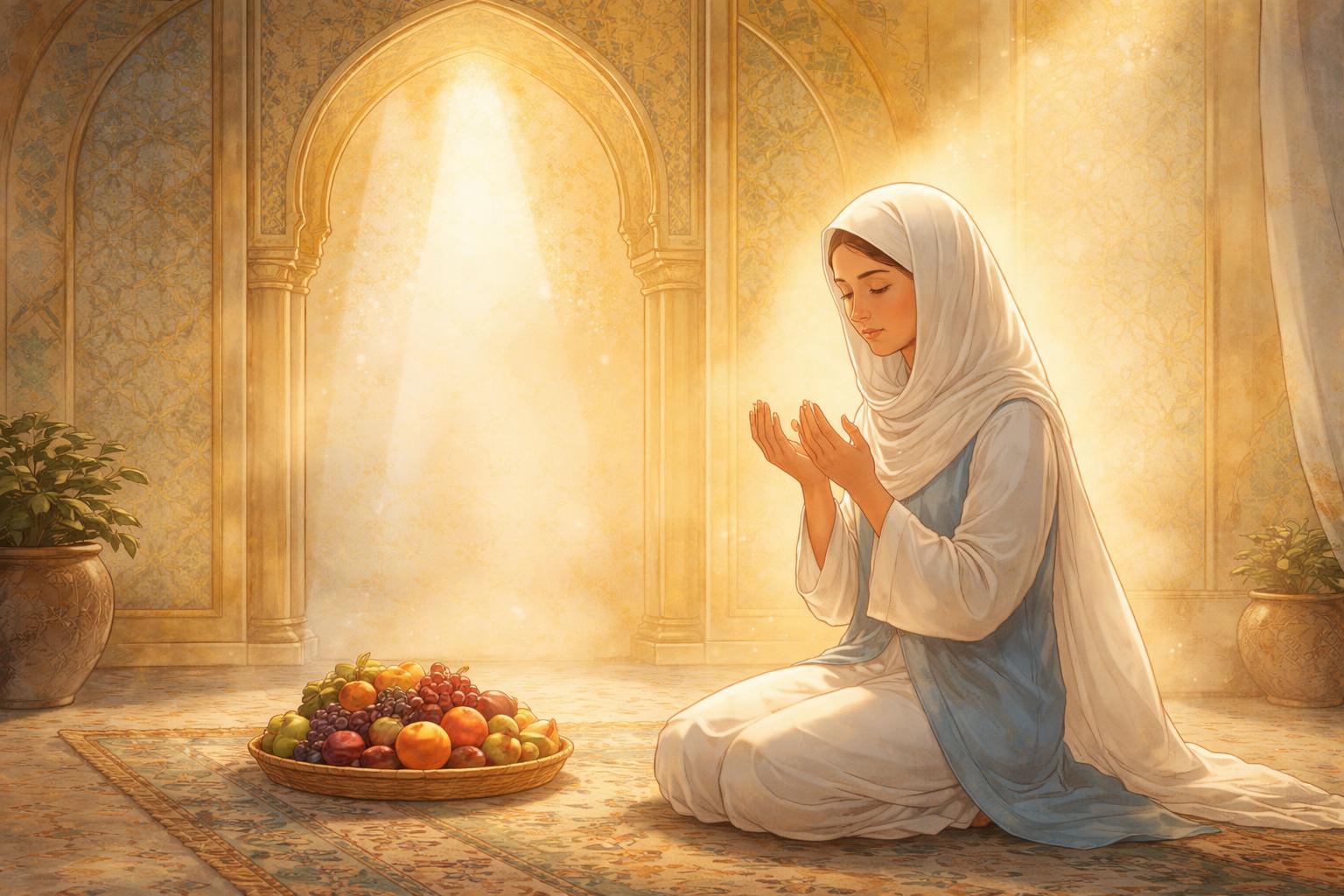
As Maryam grew, she devoted herself entirely to the worship of Allah. She had a special chamber in the temple, a mihrab, where she would pray and reflect. Her devotion was so intense that something miraculous began to happen. Whenever Zakariyya (AS) would visit her in her chamber, he would find food laid out before her, fruits that were out of season, provisions that no human hand had brought.
"O Maryam, from where is this coming to you?" he would ask in wonder.
She would answer simply: "It is from Allah. Indeed, Allah provides for whom He wills without account."
This scene so moved Zakariyya (AS) that it inspired him to make his own dua to Allah, asking for a child despite his old age. Allah granted him Yahya (John), but that is a story for another time.
As the years passed, Maryam's reputation for purity and devotion grew. She was known among her people as the devout one, the pure one, the one who lived for Allah alone. The Quran tells us that the angels themselves spoke to her: "O Maryam, indeed Allah has chosen you and purified you and chosen you above the women of the worlds. O Maryam, be devoutly obedient to your Lord and prostrate and bow with those who bow."
Then came the day that would change everything.
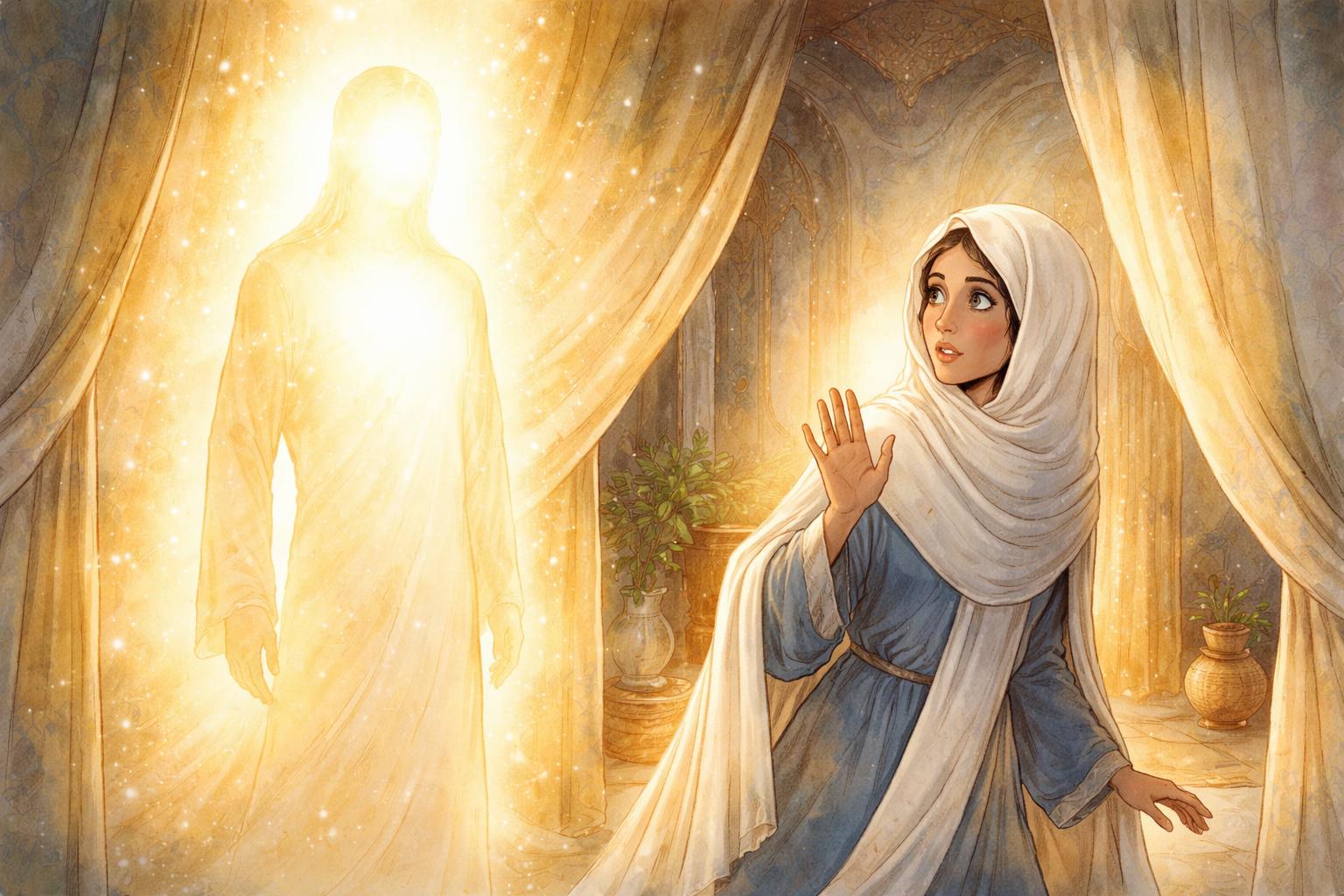
Maryam had withdrawn from her family to a place in the east, seeking solitude for worship. She placed a screen between herself and the world. And suddenly, there appeared before her a figure in the form of a perfect man.
She was startled and afraid. "Indeed, I seek refuge in the Most Merciful from you, if you should be fearing of Allah," she said. Even in her surprise, her first instinct was to invoke Allah's protection.
The figure spoke: "I am only the messenger of your Lord to give you news of a pure boy."
It was the angel Jibril (Gabriel), sent by Allah with an extraordinary announcement.
Maryam was bewildered. "How can I have a boy when no man has touched me, and I have not been unchaste?" she asked. This was a reasonable question, and it shows Maryam's intelligence and her pure character.
Jibril answered: "Thus it will be. Your Lord says, 'It is easy for Me, and We will make him a sign to the people and a mercy from Us. And it is a matter already decreed.'"
So Maryam conceived Isa (AS) by the command of Allah, with no father. This was a miracle, just as Adam (AS) had been created without parents at all. Allah who created the entire universe from nothing could certainly create a child without a father.
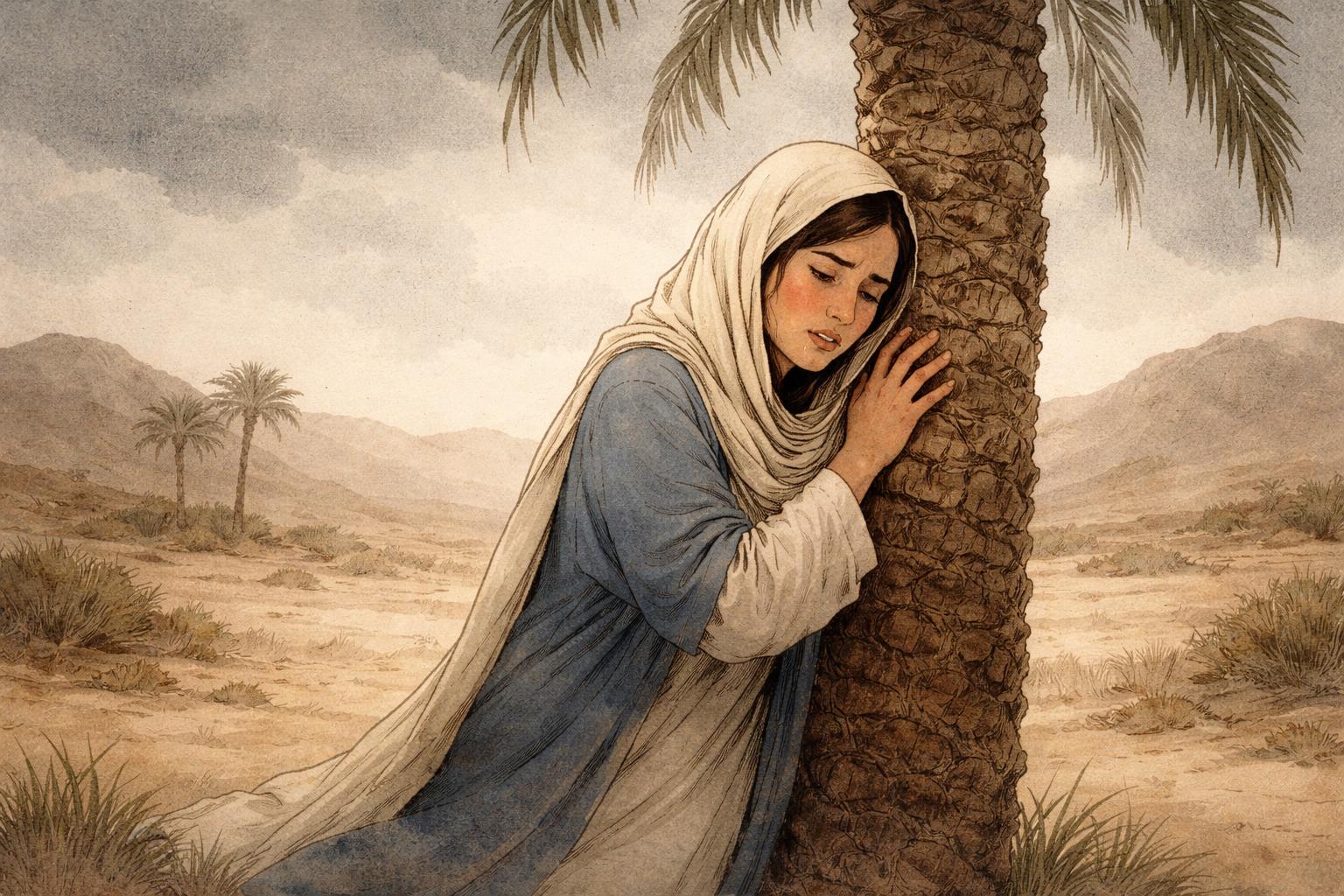
When the time of birth drew near, Maryam withdrew to a remote place. She came to the trunk of a palm tree, and the pain of labor overtook her. Alone, far from anyone who might comfort her, facing the most difficult moment of her life, she cried out: "Oh, I wish I had died before this and was in oblivion, forgotten!"
This is one of the most human, most vulnerable moments in the entire Quran. Maryam was in physical pain, she was afraid of what people would say, and she felt utterly alone. She wished she could simply disappear.
But she was not alone. Allah was with her, as He always had been.
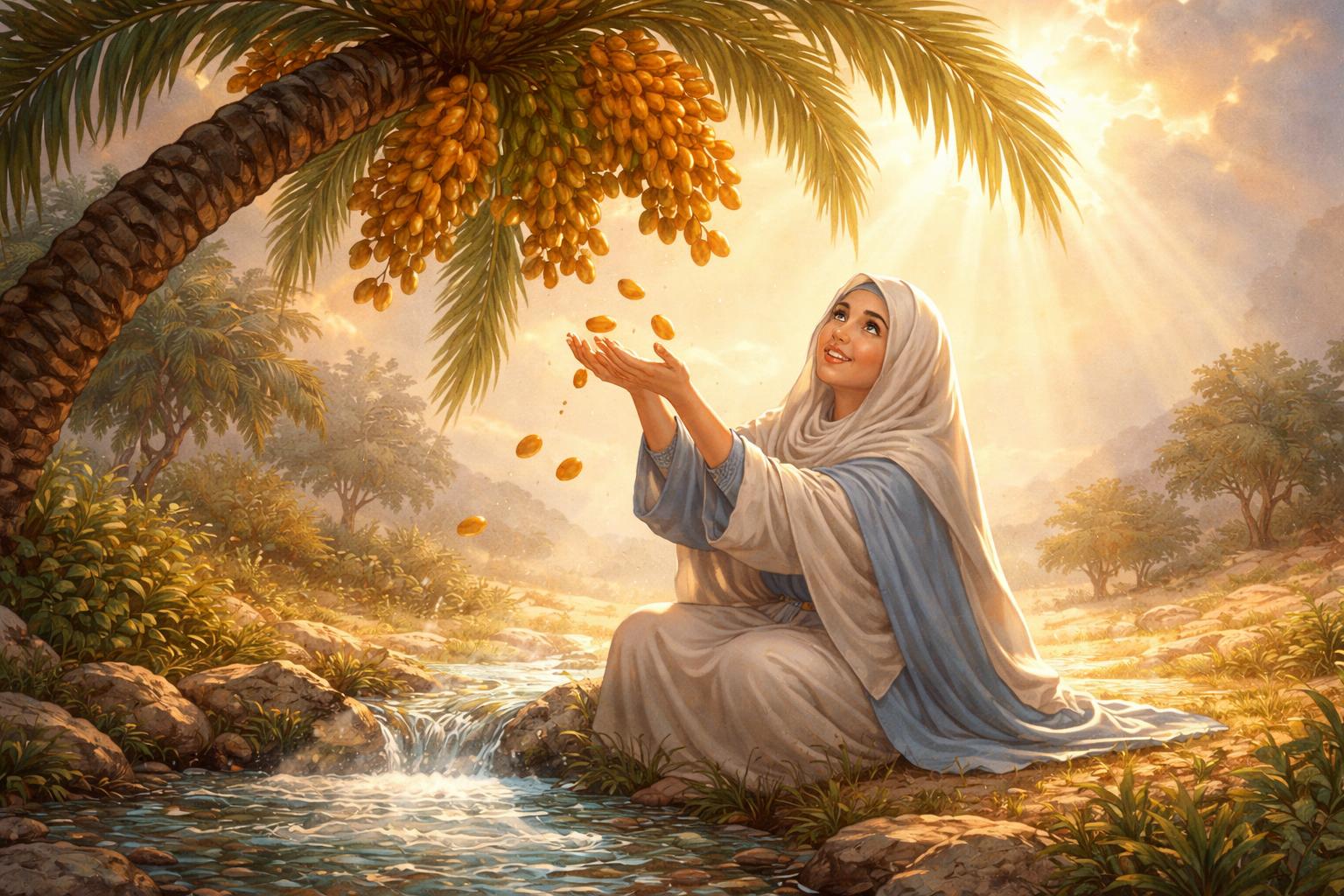
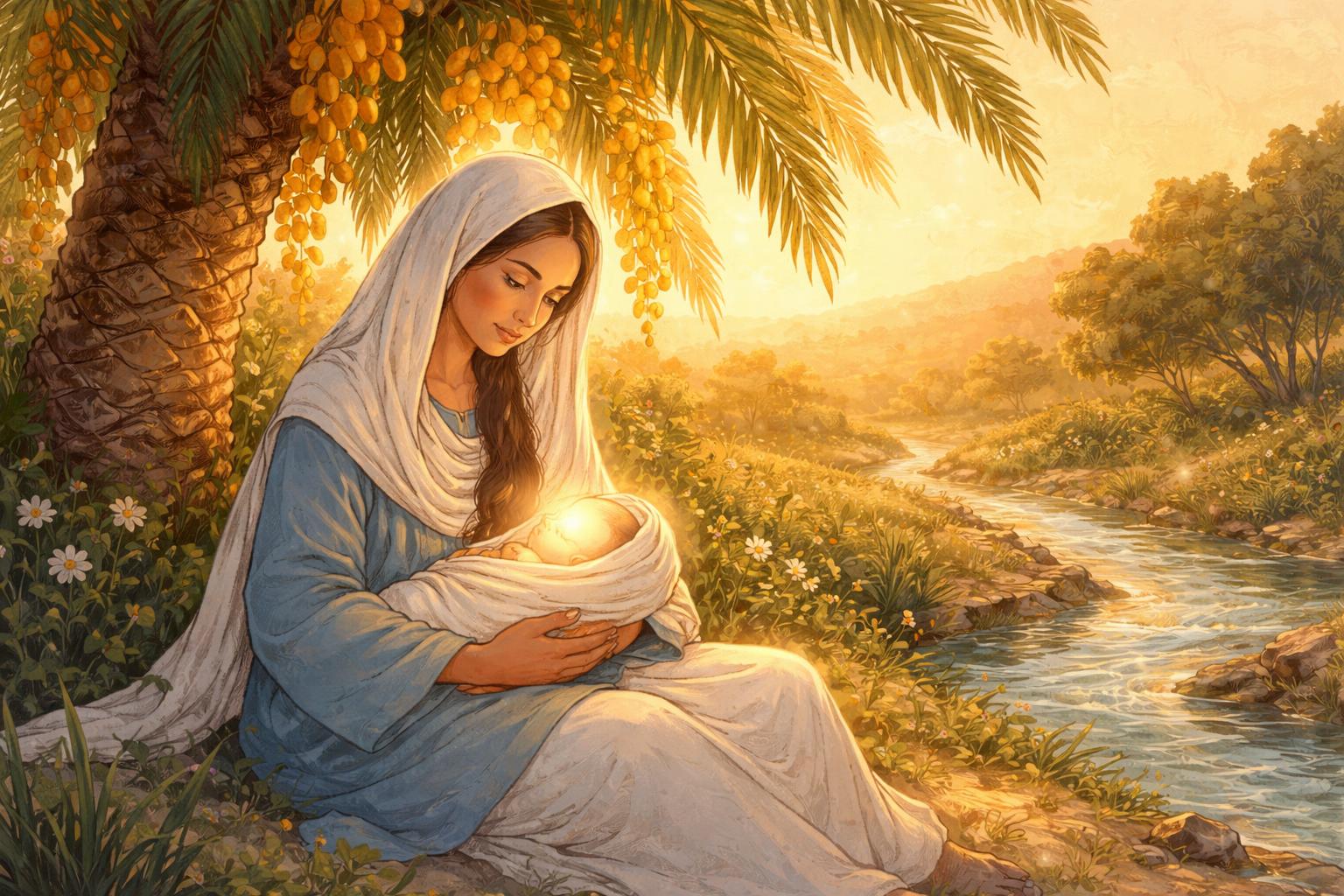
A voice called out to her from below: "Do not grieve; your Lord has provided beneath you a stream." A stream of fresh water appeared at her feet. Then the voice told her: "And shake toward you the trunk of the palm tree; it will drop upon you ripe, fresh dates. So eat and drink and be contented."
In her weakest moment, Allah provided for her. Water to drink, dates to eat, and comfort for her heart. The palm tree, which normally would require great strength to shake, bent its fruit to her at Allah's command.
Then came the instruction she dreaded: "And if you see any human being, say, 'Indeed, I have vowed to the Most Merciful a fast, so I will not speak today to any human.'" She was to remain silent, no matter what people said.
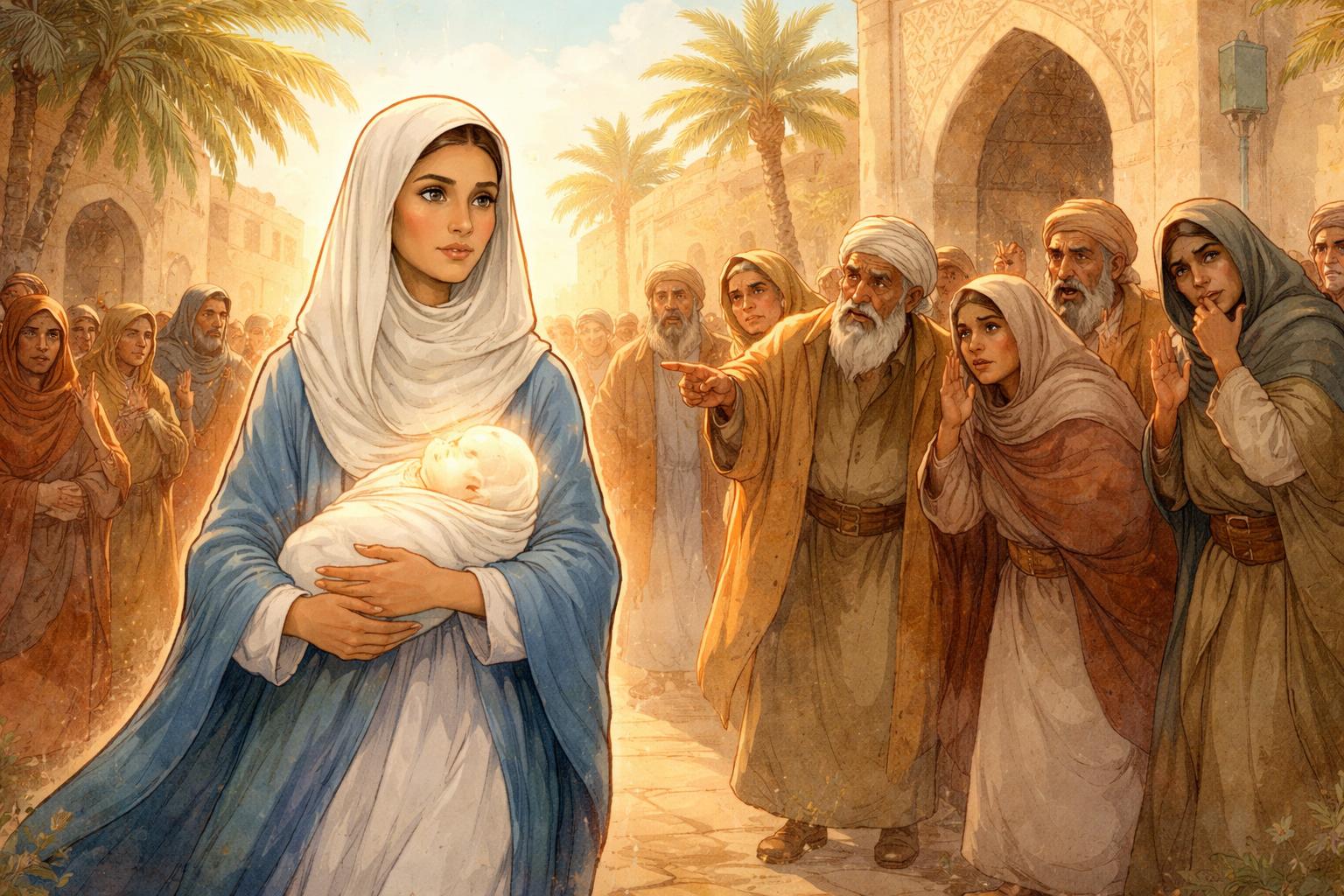
Maryam returned to her people carrying the baby Isa. As she expected, they were shocked and cruel. "O Maryam, you have certainly done a thing unprecedented!" they accused. "O sister of Harun, your father was not a man of evil, nor was your mother unchaste!"
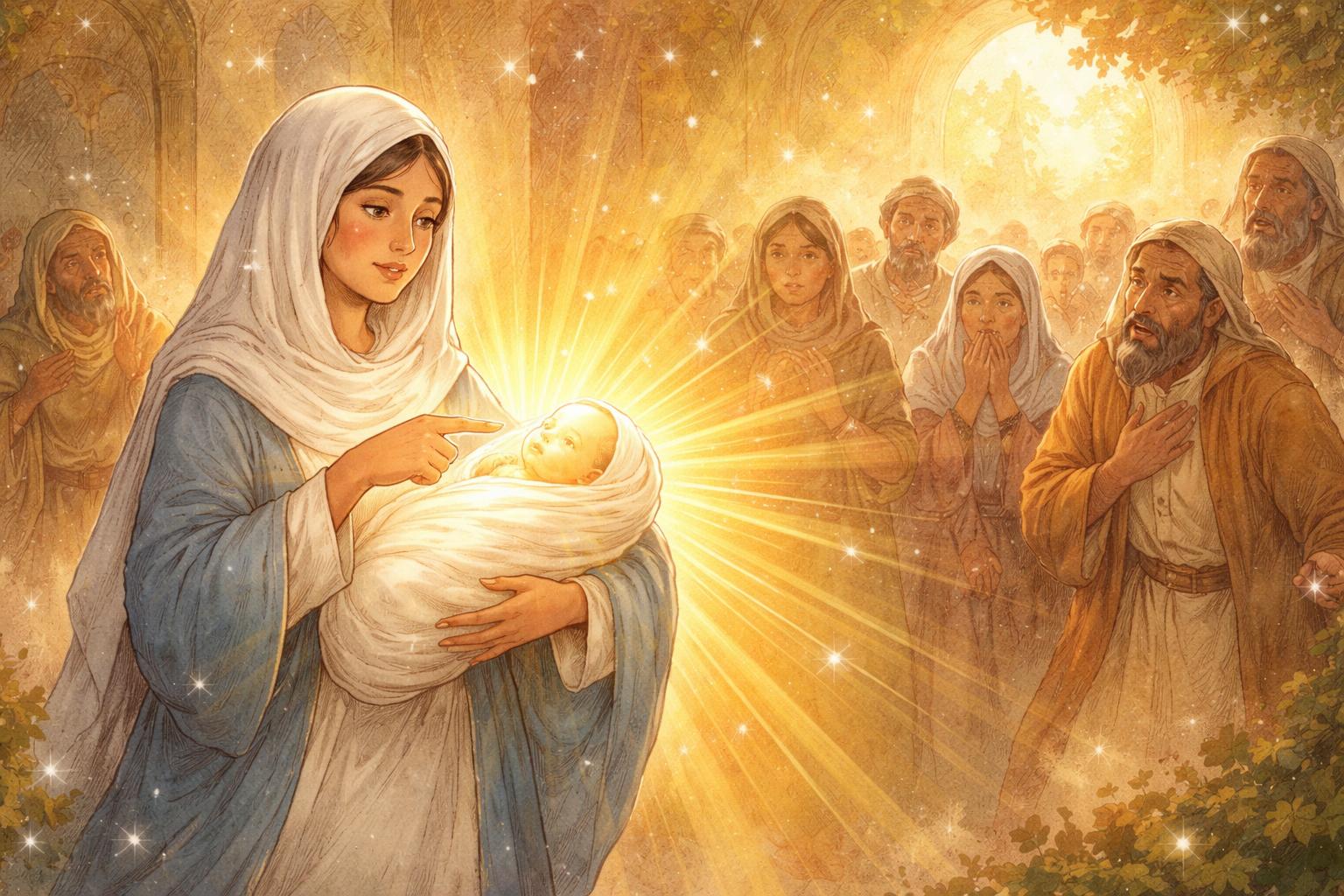
The accusations stung, but Maryam said nothing. She simply pointed to the baby.
The people laughed. "How can we speak to one who is in the cradle, a child?"
And then, one of the greatest miracles in history occurred. The baby Isa, still an infant in his mother's arms, spoke. His very first words were:
"Indeed, I am the servant of Allah. He has given me the Scripture and made me a prophet. And He has made me blessed wherever I am and has enjoined upon me prayer and charity as long as I remain alive. And He has made me dutiful to my mother, and He has not made me a wretched tyrant. And peace is on me the day I was born, and the day I will die, and the day I am raised alive."
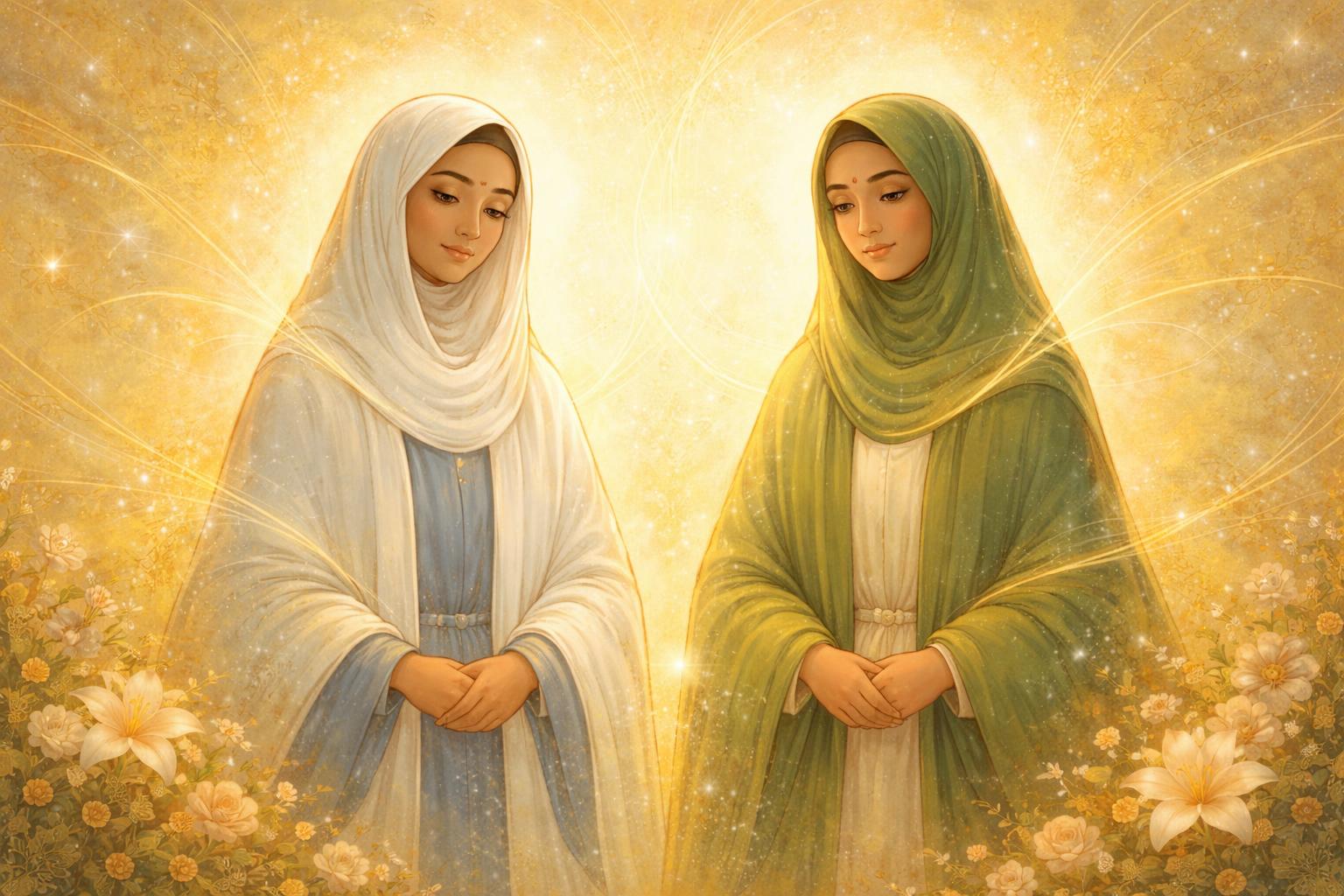
A baby, speaking complete sentences of profound truth. The people stood in stunned silence. Every accusation against Maryam was answered not by her, but by her miraculous son, speaking by the power of Allah.
In the Shia tradition, Maryam holds a special place. She is considered one of the four greatest women who ever lived, along with Asiya (the wife of Pharaoh), Khadijah (the wife of Prophet Muhammad), and Fatima al-Zahra (AS) (the daughter of Prophet Muhammad). The parallel between Maryam and Fatima is particularly beautiful: both were women of extraordinary purity and devotion, both endured suffering and accusations from their communities, and both raised children who would carry divine messages to the world.
Imam Sadiq (AS) said that Maryam was called "Siddiqah," the truthful one, because she confirmed the truth that came from her Lord. This same title was given to Fatima al-Zahra (AS), showing the deep connection between these two blessed women.
The story of Maryam teaches us that faith does not protect you from difficulty. Maryam faced loneliness, physical pain, and cruel accusations from the very people she had served through her devotion. But her faith gave her the strength to endure, and Allah provided for her in ways she could never have imagined, a stream from nowhere, dates from a barren tree, a speaking infant to defend her honor.
Whatever difficulty you face tonight, remember Maryam under the palm tree. Remember that the darkest moments of your life can be the ones where Allah's mercy shines the brightest.
Key Verse
"Fa asharat ilayh, qalu kayfa nukallimu man kana fil-mahdi sabiyya. Qala inni 'abdullahi, ataniyal-kitaba wa ja'alani nabiyya" "So she pointed to him. They said, 'How can we speak to one who is in the cradle, a child?' He said, 'Indeed, I am the servant of Allah. He has given me the Scripture and made me a prophet.'" -- Maryam (19:29-30)
Reflection Questions
- When Maryam was in pain and alone, she cried out that she wished she could disappear. But Allah provided water, dates, and comfort at that exact moment. Have you ever felt alone and then received help from an unexpected place?
- The baby Isa's very first words were "I am the servant of Allah." Why do you think this was the first thing he said, and what does it teach us about what matters most?
- Maryam is honored in the Quran as one of the greatest women who ever lived. What qualities of Maryam do you admire the most, and how can you practice them in your own life?
Did you know that there is a whole chapter in the Quran named after a woman? Not a king, not a warrior, but a woman. Her name was Maryam, and Allah loved her so much that He chose her above all the women in the whole world. Tonight, we are going to hear her beautiful story, and the story of her amazing baby boy, Prophet Isa (peace be upon him).
Maryam's story begins even before she was born. Her mother, whose name was Hannah, loved Allah very, very much. When Hannah found out she was going to have a baby, she made a special promise to Allah. She said, "O my Lord, I promise to give my baby to serve in Your holy house." She wanted her child to grow up praying and helping in the temple, which was a special place where people worshipped Allah.
When the baby was born, Hannah was surprised. "It is a girl!" she said. In those days, only boys worked in the temple. But Allah had a special plan for this baby girl. Allah accepted little Maryam, and He gave her a beautiful, beautiful life.
A kind, old prophet named Zakariyya (peace be upon him) took care of young Maryam. He was gentle and wise, like the best grandfather you can imagine. He made sure Maryam had everything she needed and taught her about Allah.
As Maryam grew up, she spent her days praying and talking to Allah in her special room in the temple. She loved Allah with all her heart. And something amazing started to happen. Every time Prophet Zakariyya came to visit her, he would find fresh food in her room! There would be beautiful fruits, fruits that were not even in season. It was like finding strawberries in the middle of winter!
"Maryam!" Zakariyya would say, his eyes wide. "Where did this food come from?"
And Maryam would smile and answer, "It is from Allah. Allah gives to whoever He wants, whenever He wants."
Is that not wonderful? Allah was sending food straight to Maryam because she was so devoted to Him. This was a little miracle, just for her.
As Maryam grew older, everyone knew her as the purest, kindest, most devoted woman in the land. The angels themselves spoke to her! They said, "O Maryam, Allah has chosen you. He has made you pure. He has chosen you above all the women of the world."
Imagine hearing that! The angels of Allah telling you that you are special. Maryam must have felt so grateful and so humble.
Then one day, something very surprising happened.
Maryam had gone to a quiet place, away from everyone, to pray alone. She liked her quiet time with Allah. Suddenly, she looked up and saw a man standing right there in front of her!
Maryam was scared. She did not know this person. She said quickly, "I ask Allah to protect me from you!" Even when she was frightened, the first thing she did was ask Allah for help. That is how strong her faith was.
But the man said, "Do not be afraid. I am not a man. I am Jibril, an angel sent by your Lord. I have come to give you wonderful news. You are going to have a baby boy, a pure, special boy."
Maryam was very confused. "How can I have a baby?" she asked. "I am not married!"
The angel Jibril answered, "Allah says it is easy for Him. He wants to make your son a sign for all people and a mercy from Him. It has already been decided."
And so, by the power of Allah, Maryam was going to have a baby. No father was needed, because Allah can do anything. He created Adam (peace be upon him) from nothing at all! Creating a baby without a father was easy for Allah.
When it was time for the baby to be born, Maryam went far away from her town, all by herself. She came to a palm tree in a lonely place. And there, all alone, she felt the pain of the baby coming. It hurt so much, and she was so tired, and she was so scared about what people would say.
Maryam cried out, "Oh, I wish I could just disappear! I wish nobody would ever remember me!"
Have you ever felt so sad or so scared that you just wanted to hide? That is how Maryam felt. She was in pain. She was alone. She was worried.
But guess what? She was not really alone. Allah was right there with her!
A voice called out to her, "Do not be sad, Maryam! Look, your Lord has made a little stream of water flow right under you!" And when Maryam looked down, she saw cool, fresh water flowing by her feet, water that had not been there before!
Then the voice said, "Shake the trunk of the palm tree, and fresh, ripe dates will fall down for you. So eat the dates, and drink the water, and be happy."
Can you picture it? Maryam was tired and hungry and hurting, and Allah sent her fresh water to drink and sweet dates to eat. He took care of her in her hardest moment. The palm tree bent down and dropped its best fruits, just for her.
Then the voice gave her one more instruction: "If anyone asks you questions, just say that you have promised not to talk today. Do not say a word to anyone."
So Maryam had her beautiful baby boy. She held him close and felt Allah's peace in her heart. Then, carrying her baby, she walked back to her town.
When the people saw her with a baby, they were shocked. "Maryam!" they said. "What have you done? Where did this baby come from?" They said mean things to her. They did not understand.
Maryam remembered what the voice had told her. She did not say a single word. She just pointed down at the baby in her arms.
The people laughed. "Are you joking? How can we talk to a tiny baby in a cradle?"
And then, the most amazing miracle happened. Baby Isa opened his little mouth and spoke! A tiny newborn baby, and he talked in clear, beautiful words!
He said, "I am a servant of Allah. He has given me a holy book and made me a prophet. He has told me to pray and be kind as long as I live. And He has told me to be good to my mother. Peace be upon me the day I was born, and the day I will pass away, and the day I am raised to life again."
Can you imagine everyone's faces? Their mouths must have dropped wide open! A brand new baby, speaking perfect words about Allah! Every mean thing they said about Maryam was answered by her tiny baby son, speaking by the power of Allah.
In our Shia tradition, Maryam is one of the four greatest women who ever lived. The other three are Asiya (who was brave against the mean Pharaoh), Khadijah (the loving wife of Prophet Muhammad), and Fatima al-Zahra (peace be upon her), the daughter of Prophet Muhammad.
Maryam and Fatima are very much alike. Both of them loved Allah more than anything. Both of them were pure and kind and strong. Both of them went through very hard times, and people were not always nice to them. But both of them kept their faith strong, and both of them raised children who brought light to the whole world.
Imam Sadiq (peace be upon him) told us that Maryam was called "the Truthful One" because she always believed in what came from Allah. Fatima al-Zahra was given the same beautiful name. That shows us how connected these two amazing women are.
The story of Maryam teaches us something very important. Sometimes, life gets really hard. Sometimes, you might feel alone or scared or sad, just like Maryam felt under the palm tree. But Allah is always, always with you. He sees you. He hears you. And He will send you help, maybe a kind word from a friend, or a hug from your mom, or a feeling of peace in your heart.
So whenever you feel alone, remember Maryam. Remember the cool water and the sweet dates. Remember that Allah takes care of the people He loves, especially when things are hardest.
Key Verse
"Fa asharat ilayh, qalu kayfa nukallimu man kana fil-mahdi sabiyya. Qala inni 'abdullahi, ataniyal-kitaba wa ja'alani nabiyya" "So she pointed to him. They said, 'How can we talk to a baby?' He said, 'I am a servant of Allah. He has given me a holy book and made me a prophet.'" -- Maryam (19:29-30)
Let's Talk About It
- When Maryam was sad and alone under the palm tree, Allah sent her water and dates. Can you think of a time when you were sad and something nice happened to make you feel better?
- Baby Isa's very first words were "I am a servant of Allah." What do you think it means to be a servant of Allah?
- Maryam and Fatima al-Zahra are both called "the Truthful One." What does it mean to be truthful, and how can you be truthful every day?