The Man and the Donkey: A Journey Through Time
Allah's power over life and death; resurrection
Have you ever looked at something that was completely broken, completely gone, and wondered: could it ever be made whole again? A shattered glass, a fallen building, a dead tree? Tonight's story is about a man who asked that very question, not about a glass or a tree, but about an entire city. And Allah showed him the answer in the most extraordinary way imaginable.
The Quran tells us about a man who passed by a town that had fallen to ruin. Some scholars say this man was Uzair (AS), a righteous servant of Allah. Others say he was a traveler whose name is known only to Allah. What matters is what happened to him, and what it teaches us.
This man was traveling with his donkey, carrying provisions for his journey, including food and drink. His path took him past the ruins of a town that had once been alive and bustling. Now its buildings were crumbled, its walls collapsed, its streets empty. The bones of its former inhabitants lay scattered among the rubble. It was a scene of complete and utter desolation.
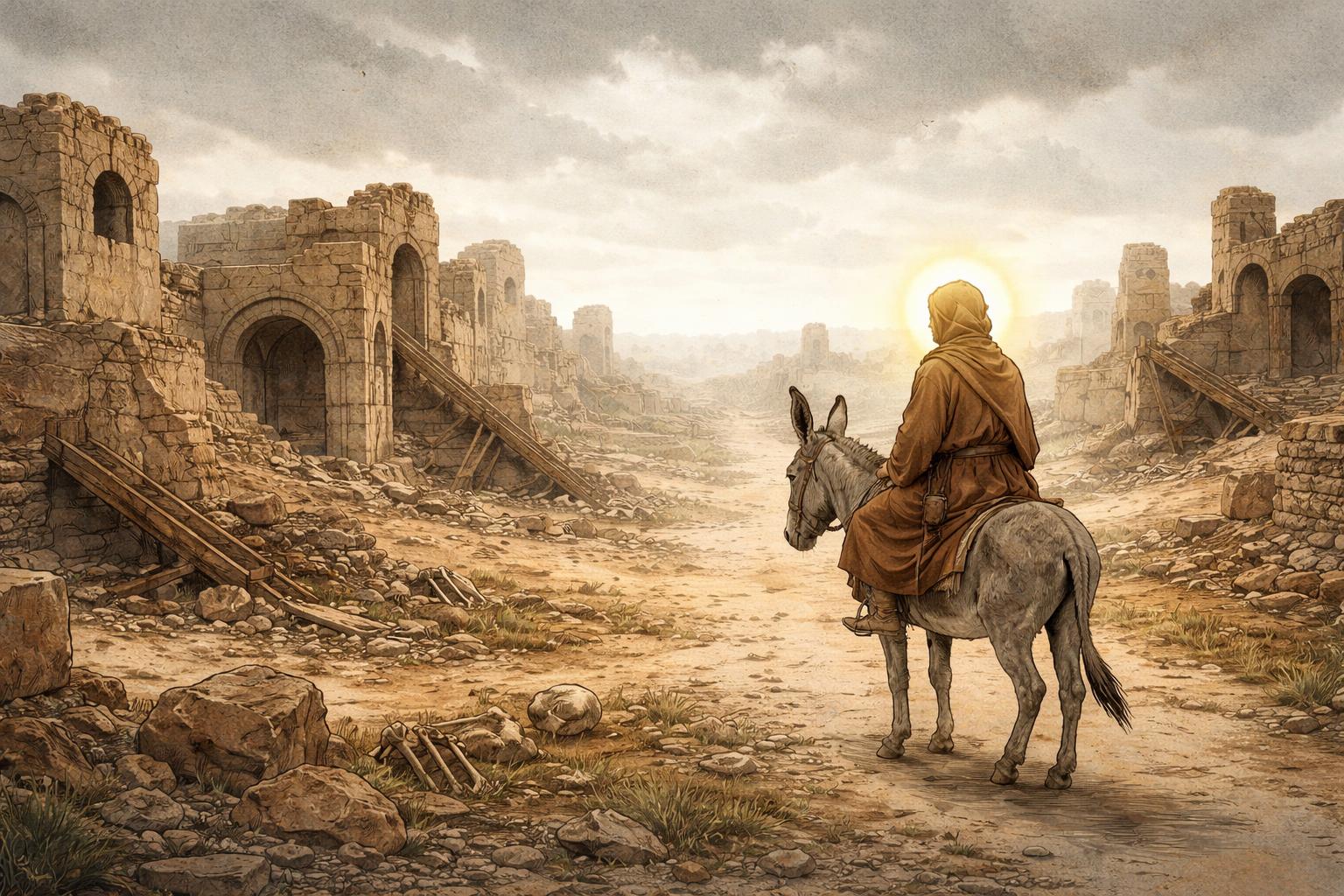
Looking at this devastation, the man was overwhelmed by a thought. He asked aloud: "How will Allah bring this town to life after its death?"
It was not a question of doubt, not in the way that arrogant people deny Allah's power. It was a question of wonder. He believed in Allah. He knew Allah could do anything. But looking at this destruction with his human eyes, he genuinely wondered: how? The gap between this pile of rubble and bones, and a living, breathing city, seemed impossibly vast. How could what was so thoroughly dead ever live again?
Allah decided to answer his question not with words but with a demonstration.
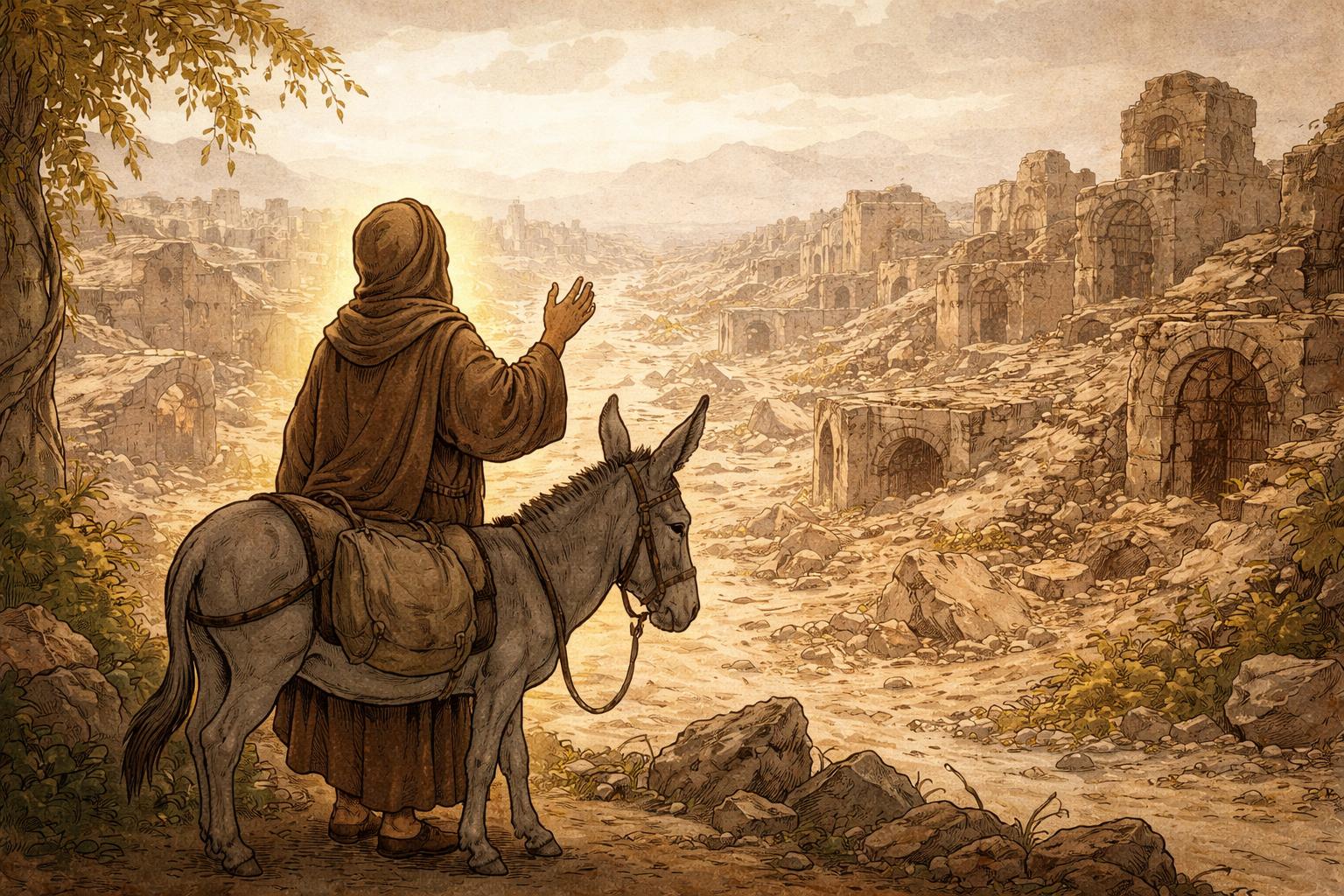
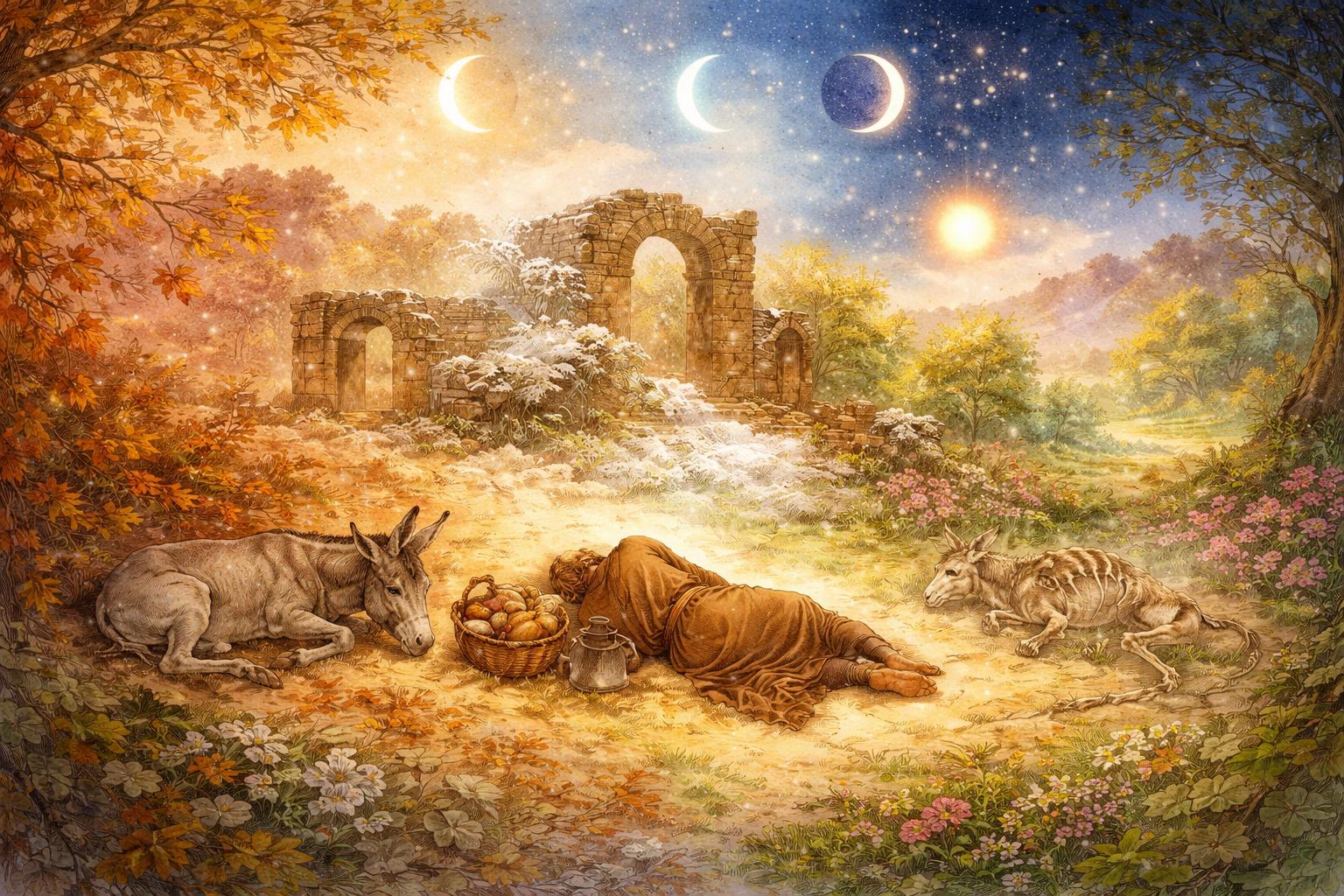
"So Allah caused him to die for a hundred years; then He revived him."
Just like that. The man died, right there beside the ruins, with his donkey beside him and his food and drink nearby. And he stayed dead for a hundred years.
Think about what happened during those hundred years. The seasons turned. Summer came and went, again and again, a hundred times. Rains fell. Winds blew. The ruins around him continued to crumble. His donkey died beside him, and its body decomposed until only white bones remained. The vegetation grew and withered and grew again. An entire century passed.
And then Allah brought him back to life.
The man opened his eyes. To him, it felt like he had simply fallen asleep for a short time, perhaps a few hours. He looked around, confused. The landscape seemed different, but he could not quite place what had changed.
Allah asked him: "How long have you remained?"
The man answered honestly, based on what he felt: "I have remained a day or part of a day."
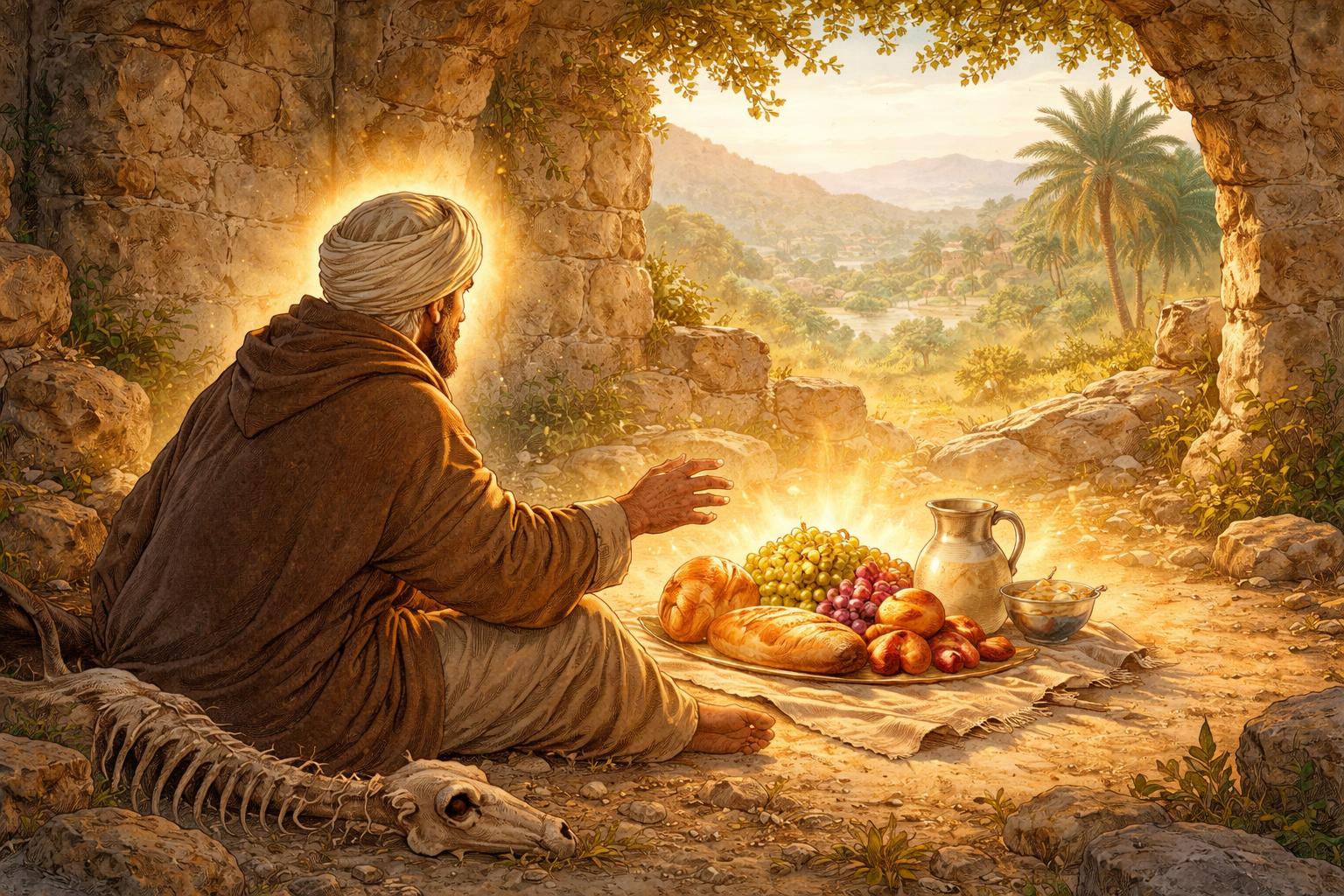
Allah said: "Rather, you have remained one hundred years."
One hundred years. A century of human history had passed while he lay there. Generations had been born and died. The world had changed completely. And yet, to him, it felt like an afternoon nap.
Then Allah directed his attention to two things.
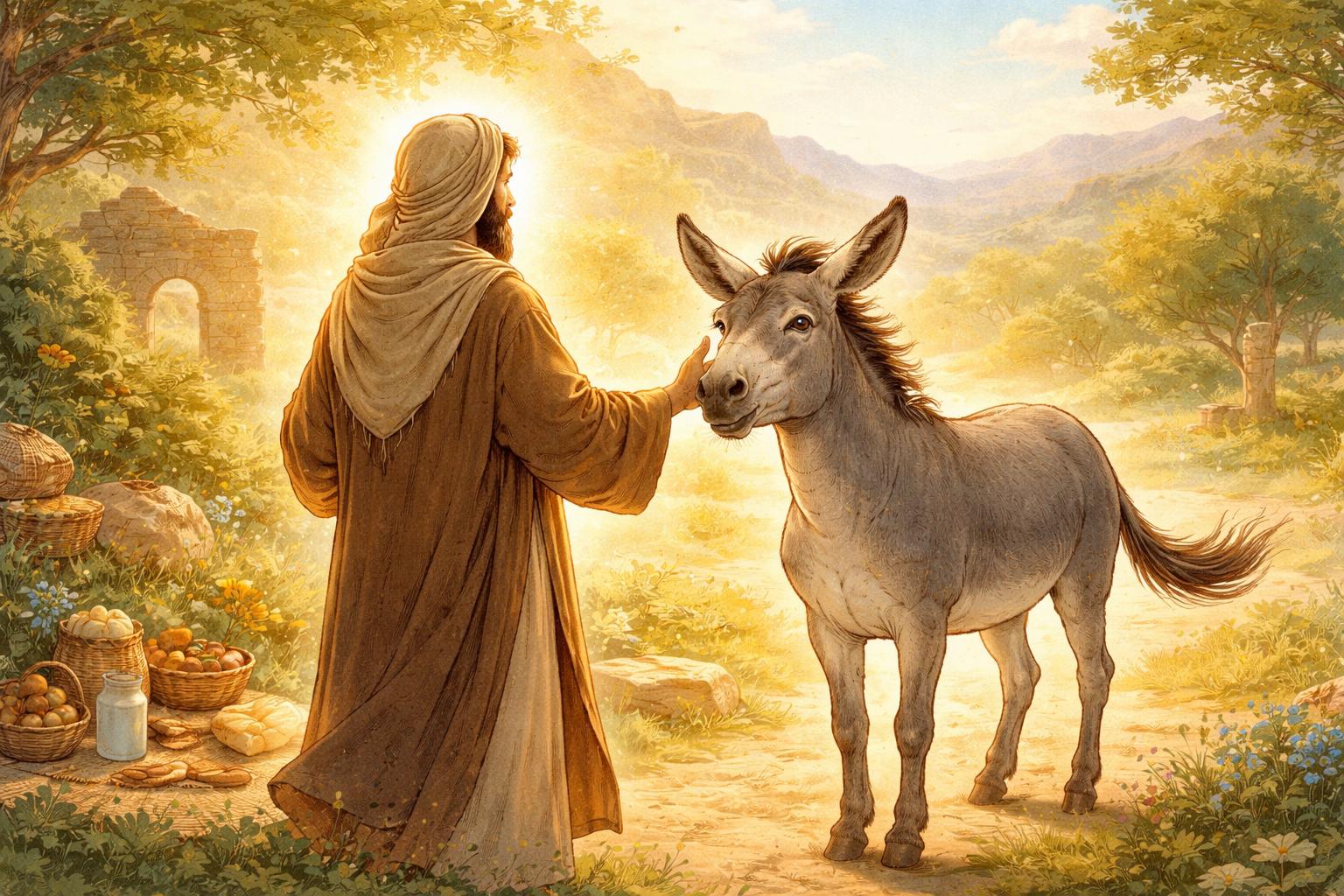
First: "Look at your food and your drink; it has not changed with time." The man looked at his provisions, the food he had been carrying, the drink in his container. After a hundred years, they were perfectly fresh, as if he had prepared them that very morning. Not a speck of mold, not a drop of spoilage. Time had not touched them. This was a sign: Allah can preserve whatever He wills from the effects of time.
Second: "And look at your donkey." The man turned to where his donkey had been. All he saw were white bones, bleached by a century of sun. His donkey had died and decomposed completely, as is natural. The food was preserved; the donkey was not. Both had been in the same place for the same hundred years, but Allah had treated them differently, to make a point.
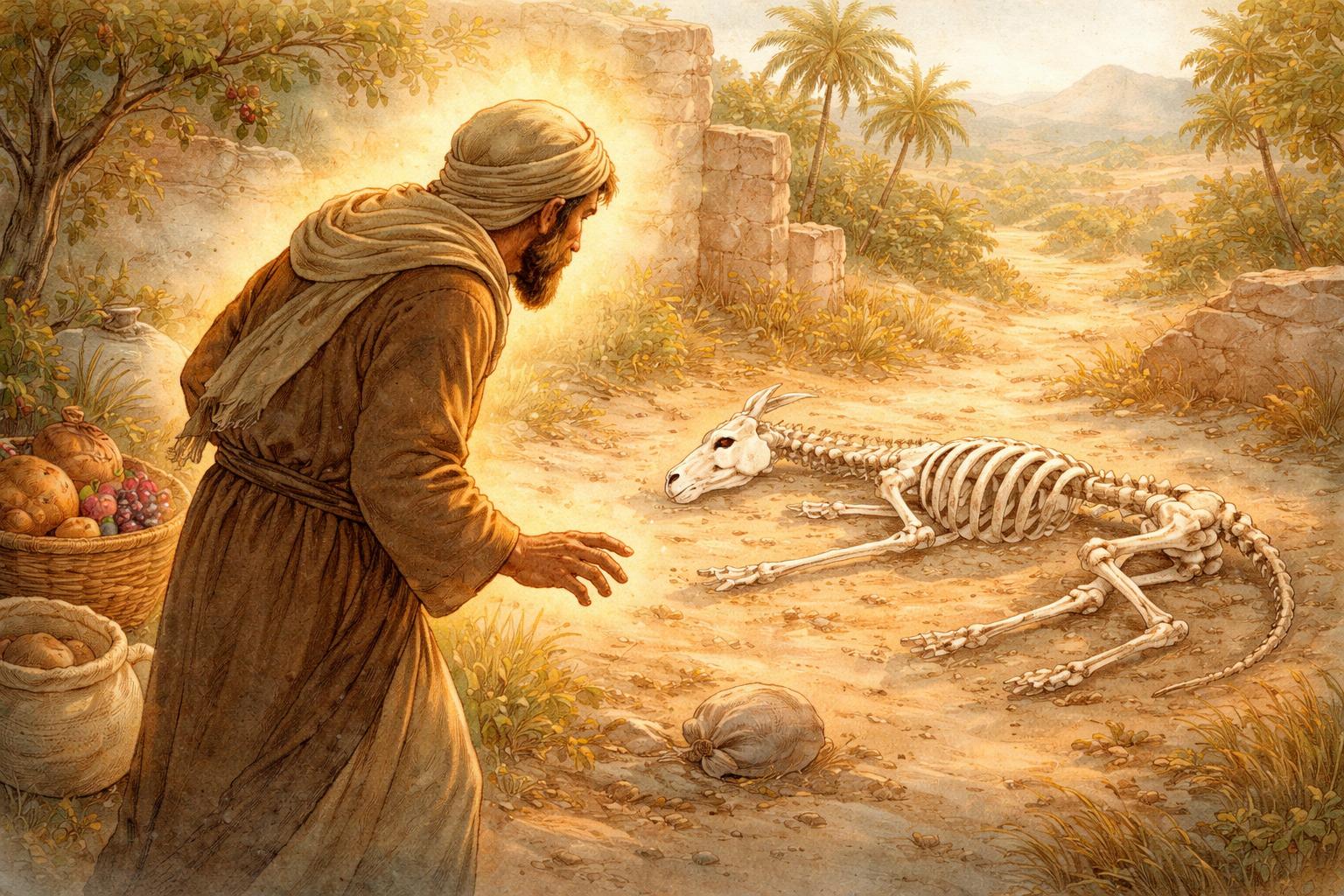
And then came the most astonishing part of the entire experience.
As the man watched, Allah reconstructed the donkey before his very eyes. The Quran says: "And look at the bones, how We raise them and then We cover them with flesh."
The white bones began to move. They assembled themselves, bone clicking into bone, each one finding its proper place, ribs forming, spine aligning, skull taking shape. Then tendons appeared, stretching between the bones, pulling them together. Then muscles grew over the tendons, red and living. Then skin covered the muscles, fur sprouting. And finally, the donkey opened its eyes and stood up, alive and breathing, shaking its head as if waking from a nap.
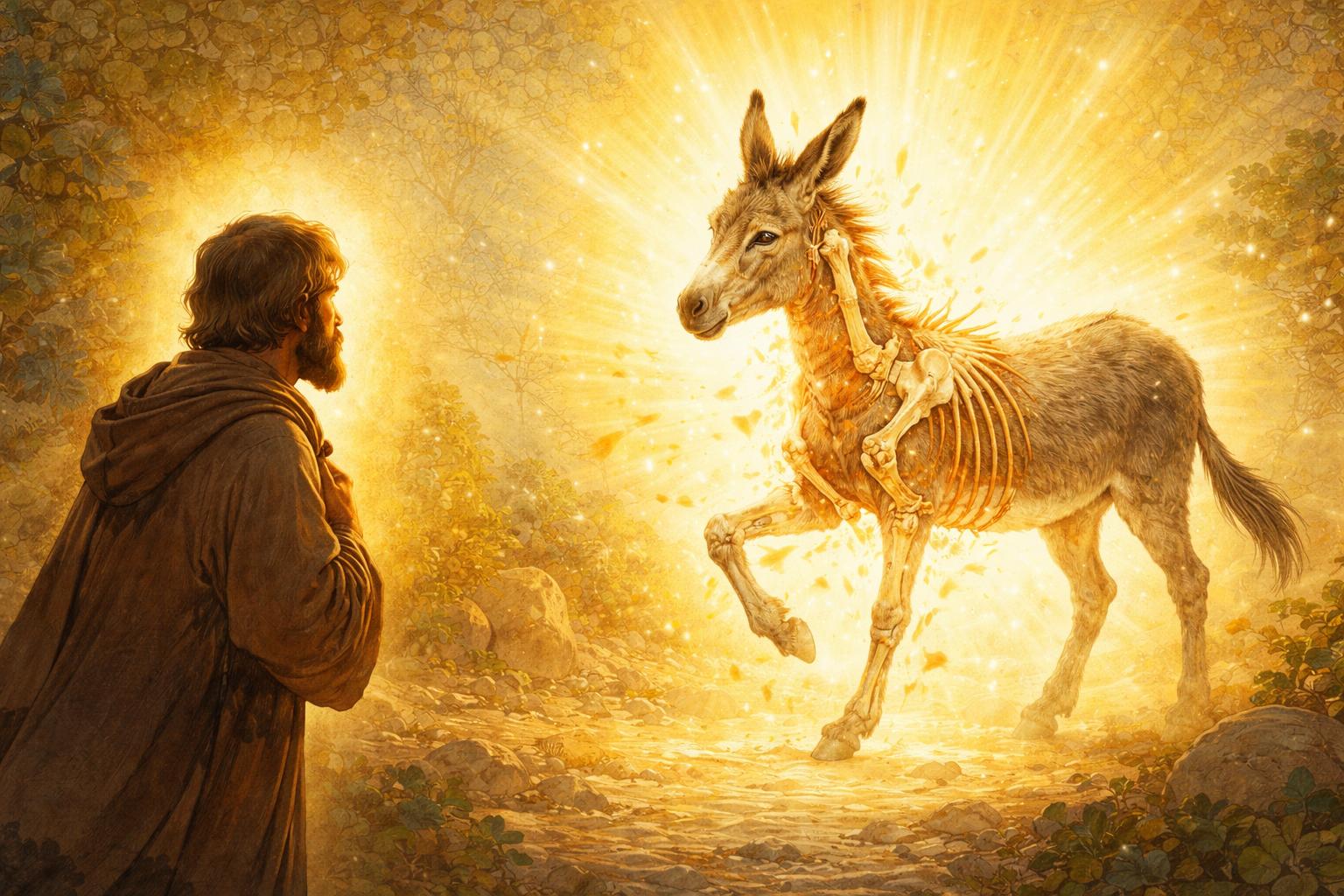
The man had just witnessed resurrection in real time. He had watched a pile of bleached bones transform, step by step, back into a living, breathing creature. He had his answer.
When the man saw this, he said: "I know that Allah is over all things competent."
Not "I believe." He said "I know." He had moved from belief to certainty, from faith in the unseen to faith confirmed by the seen. He had watched death reversed before his eyes.
This story, contained in a single verse of the Quran, is one of the most powerful demonstrations of Allah's ability to bring the dead back to life. It answers the question that humans have asked since the beginning of time: what happens after death? Can the dead truly live again?
The answer, demonstrated through the man and his donkey, is absolute: yes. The One who created life from nothing in the first place can certainly restore it. The One who preserved food for a century and reassembled bones into a living creature has power over all things.
In the Shia tradition, belief in Ma'ad, the Day of Resurrection, is one of the five pillars of faith (Usul al-Din), alongside Tawhid (oneness of God), Nubuwwah (prophethood), Adalah (divine justice), and Imamah (leadership after the Prophet). The story of the man and the donkey is considered one of the clearest Quranic proofs of resurrection.
Imam Ali (AS) said: "He who created you the first time is the one who will bring you back. Do you think it is harder for Him to restore you than to create you in the first place?" This beautiful logic echoes the Quran's own argument: the initial creation is the greater miracle. Restoration is, if anything, easier.
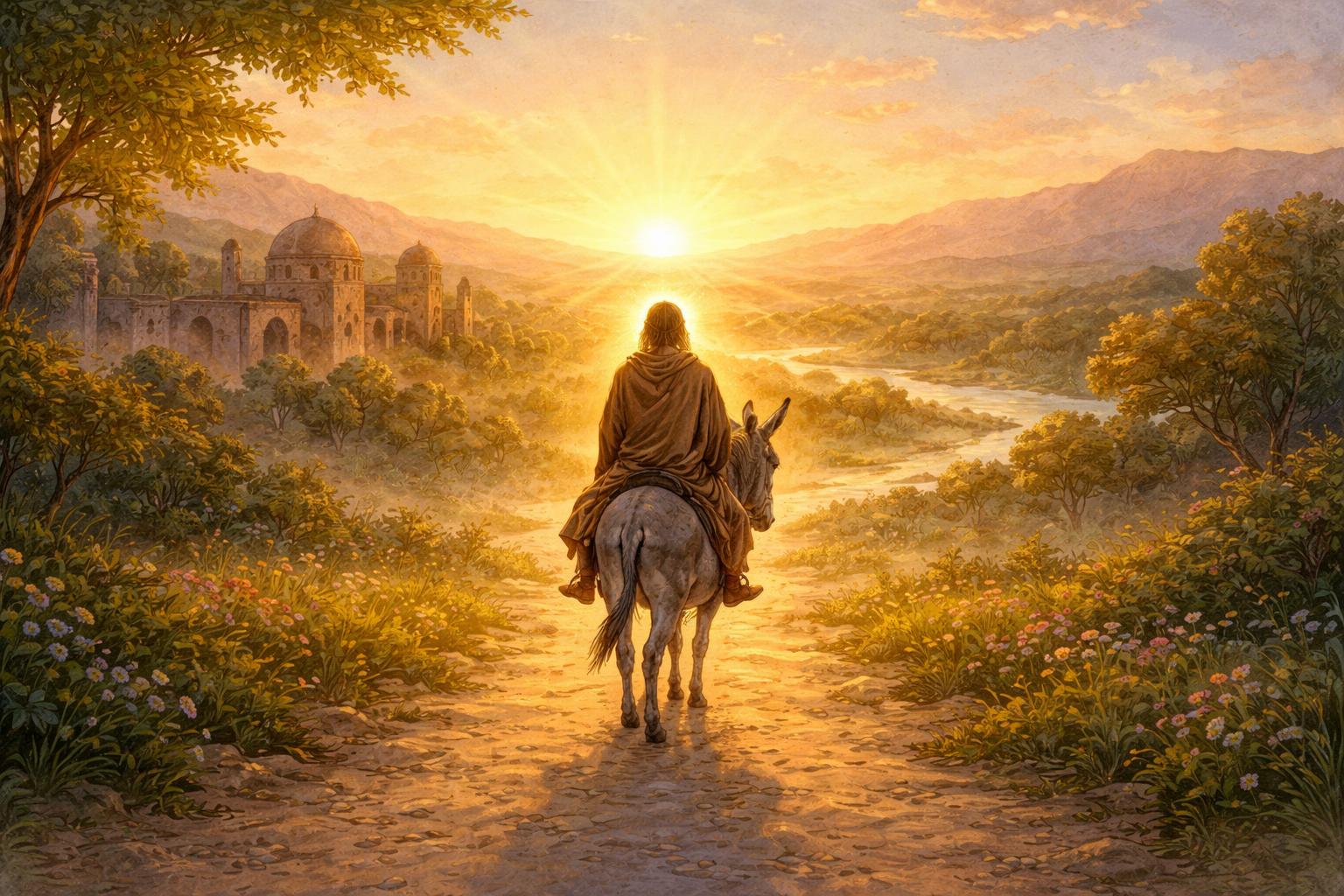
Imam Sadiq (AS) explained that the story shows us three things: First, Allah's power to preserve, since the food remained fresh. Second, Allah's wisdom in allowing natural processes, since the donkey decomposed naturally. Third, Allah's power to reverse death completely, since the donkey was brought back to life from bones. These three together give us the complete picture of Allah's relationship with creation: He can preserve, He allows change, and He can restore.
The next time you look at a fallen leaf, a crumbling wall, or the bones of a creature, remember this story. Remember that nothing is truly lost to Allah. He who assembled the bones of a donkey after a hundred years can reassemble the universe itself.
Key Verse
"Fa amatahuAllahu mi'ata 'amin thumma ba'athah, qala kam labithta, qala labithtu yawman aw ba'da yawm, qala bal labithta mi'ata 'am" "So Allah caused him to die for a hundred years; then He revived him. He said, 'How long have you remained?' He said, 'I have remained a day or part of a day.' He said, 'Rather, you have remained one hundred years.'" -- Al-Baqarah (2:259)
Reflection Questions
- The food stayed fresh for 100 years while the donkey decomposed naturally. Why do you think Allah showed both preservation and natural decay in the same story?
- After witnessing the miracle, the man said "I know" instead of "I believe." What do you think is the difference between knowing something and believing it?
- Imam Ali (AS) said that the first creation is harder than the second. If Allah created the entire universe from nothing, why should we find it difficult to believe He can bring people back to life?
Have you ever looked at something that is completely broken, like a toy that fell apart or a sandcastle that got washed away, and wondered, "Can it ever be put back together?" Tonight, we have an amazing story about a man, a donkey, and a hundred years. It is one of the most surprising stories in the whole Quran!
A long time ago, there was a good man who loved Allah. Many scholars say his name was Uzair (peace be upon him). He was traveling on a journey, riding his donkey. He had packed some food and a drink to keep him going on his trip. The sun was warm, the road was long, and his little donkey clip-clopped along the dusty path.
Then Uzair came to a town. But it was not a happy town. It was not a town at all, really. It was a pile of broken stones and crumbled walls. The buildings had fallen down. The streets were empty. Nobody lived there anymore. It looked like it had been empty for a very, very long time. Even the bones of people who had once lived there were scattered on the ground.
Uzair stopped his donkey and looked around. He felt so sad. This place had once been full of life! Children had played in these streets. Families had eaten dinner in these houses. People had laughed and talked and worked here. And now it was all gone. Just dust and rubble and old, old bones.
Uzair looked at all that destruction and he wondered out loud, "How will Allah bring this town back to life after it has died?"
Now, this is very important: Uzair was not saying he did not believe Allah could do it. He knew Allah could do anything! He was just amazed. He was wondering, "How does it work? How can something so broken be made whole again?" It was a question from his heart, full of wonder.
And Allah decided to show him the answer. Not just tell him, but show him, in the most incredible way.
Allah caused Uzair to die, right there beside the ruins. He was no longer alive. His body lay still on the ground next to his donkey, with his food and drink nearby. And he stayed like that for one hundred years!
One hundred years! Can you even imagine that? Think about how long one year feels. Now imagine a hundred of them! While Uzair was gone, the world kept going. Spring came, then summer, then fall, then winter, and then spring again, over and over and over, a hundred times. Rain fell on him. Sun shone on him. The seasons changed again and again and again.
His donkey, who had been standing right beside him, also passed away. Over the hundred years, the donkey's body slowly turned into just a pile of white bones, bleached by the sun. That is what happens naturally over a very long time.
But here is the first amazing thing. While Uzair was gone for a hundred years, and while his donkey turned to bones, his food and his drink stayed perfectly fresh! Not a single spot of mold on the food. Not a single drop of the drink had gone bad. After a hundred years, his lunch looked like he had packed it that very morning!
How is that possible? Because Allah can keep anything fresh if He wants to. Time only does what Allah allows it to do.
Then, after one hundred years, Allah brought Uzair back to life!
Uzair opened his eyes. He looked around. Things seemed a little different, but he was not sure why. He felt like he had only been gone for a short time.
Allah asked him, "How long have you been here?"
Uzair thought about it. It did not feel like a long time at all. "Maybe a day?" he said. "Or maybe even less than a day?"
Allah said, "No. You have been here for one hundred years."
One hundred years! Uzair could not believe it. A hundred years had gone by and it felt like just one afternoon!
Then Allah told him, "Look at your food and your drink." Uzair looked, and there they were, perfectly fresh. Just as good as when he had packed them. One hundred years, and not a thing had changed. That was Allah showing Uzair, "I can stop time whenever I want. I can keep things fresh forever if I choose to."
Then Allah said, "Now, look at your donkey."
Uzair turned to look, and his heart jumped. Where his donkey had been, there was nothing but a pile of old, white bones lying on the ground. His poor donkey had been gone for a very long time.
But then, right before his eyes, the most unbelievable thing happened.
The bones started to move! All by themselves, the bones began to wiggle and shake. Then they started coming together, piece by piece. One bone connected to another bone. Click! Click! Click! The leg bones found the other leg bones. The rib bones lined up in a row. The backbone stretched out straight. The skull settled right on top.
Then, over the bones, Uzair could see something growing. Muscles! Red, strong muscles wrapped around the bones, like someone was knitting a blanket over them. Then skin grew over the muscles, and soft fur sprouted all over the skin.
And then, the donkey blinked its eyes open! It shook its head, swished its tail, and stood up on all four legs! It was alive! It was healthy! It looked at Uzair as if to say, "Hey there! Are we going now?"
Uzair had just watched a pile of old bones turn back into a living, breathing donkey, right in front of his eyes! He had seen death turned backwards!
When Uzair saw all of this, he said, "I know that Allah has power over all things."
He did not say "I think" or "I believe." He said "I know." He was completely, totally sure. He had seen it with his own eyes. Allah can bring anything back to life. Anything!
This story teaches us something very important in our faith. In our Shia tradition, we believe in something called Ma'ad. That is a big word, but it means "coming back to life." It means that one day, Allah will bring everyone back to life for a very important day, the Day of Judgment. On that day, Allah will bring every person who ever lived back to life.
Some people might wonder, "How can that happen?" And this story is the answer! If Allah can keep food fresh for a hundred years, and if Allah can put a donkey back together from old bones, then He can certainly bring people back to life.
Imam Ali (peace be upon him) said something very smart about this. He said, "The One who created you the very first time can bring you back again. Do you think it is harder for Him to put you back together than to create you from nothing in the first place?" That is such a good point! If Allah made the whole universe from nothing, then bringing us back is even easier for Him.
Imam Sadiq (peace be upon him) taught us that this story shows three things about Allah. First, Allah can keep things safe. He kept the food fresh. Second, Allah lets things follow their normal path. The donkey's body went back to the earth naturally. Third, Allah can bring anything back to life whenever He wants. He rebuilt the donkey from bones!
So the next time you see a dry, crumbly leaf on the ground, or a broken seashell on the beach, remember this story. Remember that nothing is too broken for Allah to fix. Nothing is too lost for Allah to find. Nothing is too old for Allah to make new.
Allah has power over everything. And that is the most comforting thing in the whole world.
Key Verse
"Fa amatahuAllahu mi'ata 'amin thumma ba'athah, qala kam labithta, qala labithtu yawman aw ba'da yawm, qala bal labithta mi'ata 'am" "So Allah caused him to die for a hundred years, then brought him back to life. He asked, 'How long were you here?' He said, 'A day, or part of a day.' He said, 'No, you were here for a hundred years!'" -- Al-Baqarah (2:259)
Let's Talk About It
- The food stayed fresh for a hundred years, but the donkey turned into bones. Why do you think Allah showed both things happening at the same time?
- When the donkey's bones came back together and it came back to life, how do you think Uzair felt? What would you feel if you saw that?
- Imam Ali said that if Allah created us from nothing, He can easily bring us back to life. What is something amazing that Allah created that makes you say "wow"?