The Elephant Army: Allah Protects His House
Allah's protection; no army can defeat His will
Tonight's story takes place in a year that changed history, the year that Prophet Muhammad (PBUH) was born. But our story is not about his birth. It is about what happened just weeks before, when a mighty army with war elephants marched toward Makkah to destroy the Ka'bah, the sacred House of Allah. And it is about how Allah protected His House in a way that no human defense could have matched.
In the land of Yemen, far to the south of Makkah, there was a powerful ruler named Abraha. He was the governor of Yemen under the Abyssinian (Ethiopian) king, and he was an ambitious man. He noticed that the Arabs made pilgrimage to the Ka'bah in Makkah every year, a practice that brought honor and trade to the city. Abraha wanted that honor for himself.
So he built a magnificent cathedral in the Yemeni city of San'a. It was adorned with gold, silver, and precious stones, intended to rival and replace the Ka'bah as the center of pilgrimage. But the Arabs would not come. No matter how beautiful the cathedral, their hearts were drawn to the ancient Ka'bah, the house built by Ibrahim and Ismail (AS) so many centuries before. The Ka'bah was simple, unadorned stones, but it held a place in their souls that no amount of gold could replace.
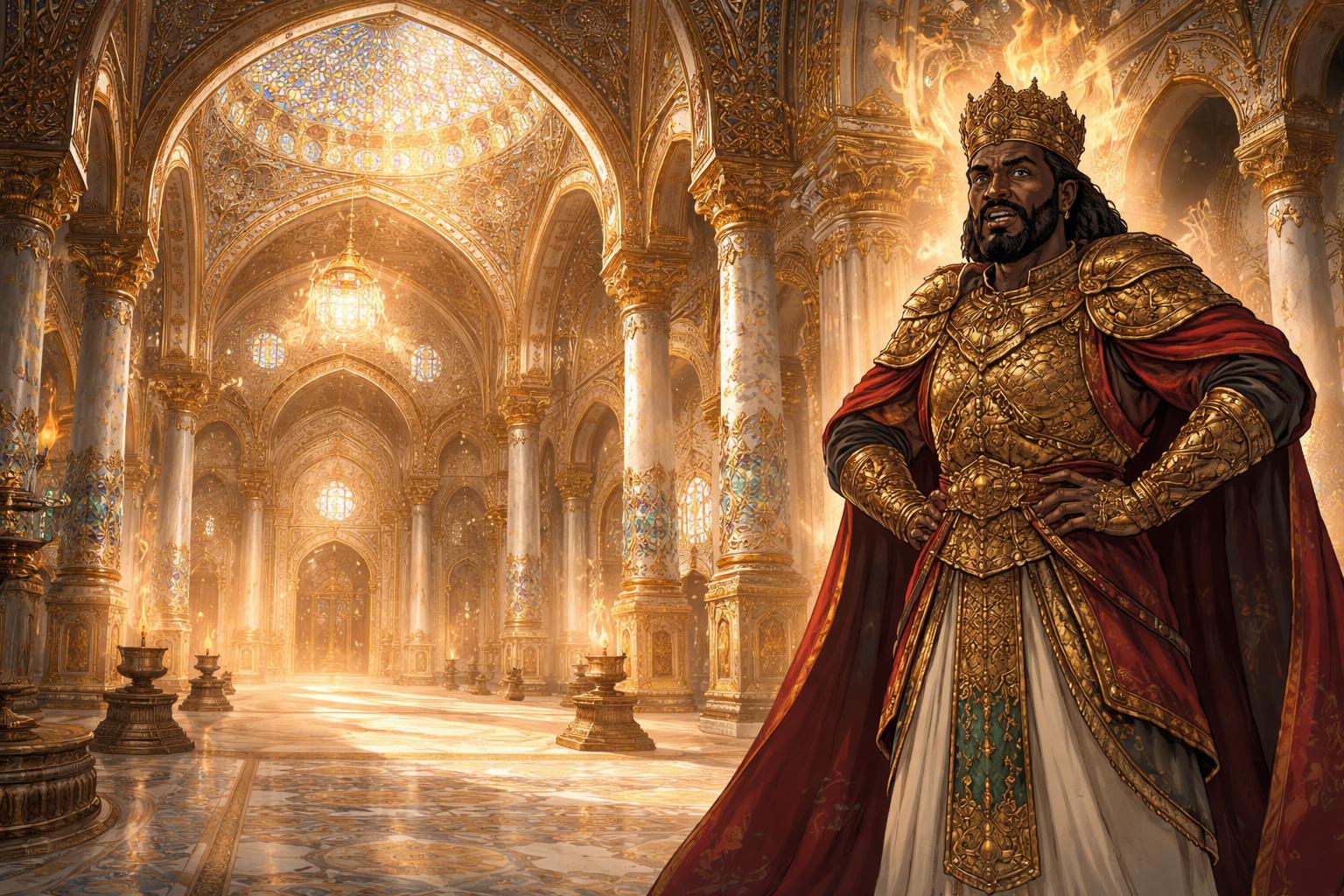
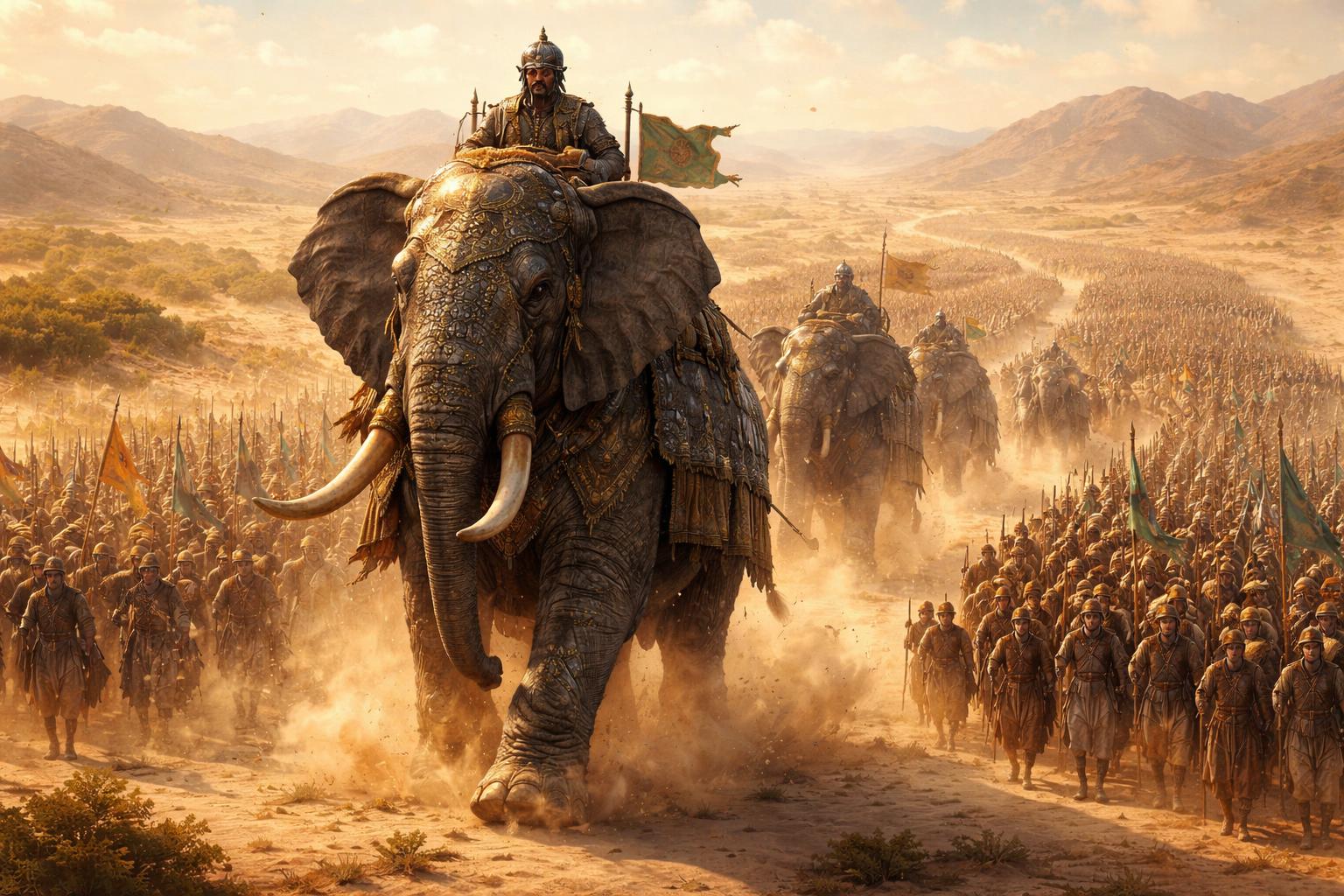
Abraha was furious. If the Arabs would not come to his cathedral, then he would destroy their Ka'bah. He assembled the mightiest army the region had ever seen: thousands of soldiers, war horses, and, most terrifyingly, a force of war elephants. These elephants were the tanks of the ancient world, massive, armored, and nearly unstoppable. The lead elephant was a giant named Mahmud, the largest anyone had ever seen.
As Abraha's army marched north toward Makkah, word spread ahead of them. Tribes and towns trembled. Some tried to resist and were crushed. Others stepped aside, unwilling to face the elephants. The army seemed invincible, an unstoppable force of destruction rolling toward the sacred city.
When word reached Makkah, the people were terrified. They had no army that could stand against Abraha's elephants and soldiers. The leader of Makkah at that time was Abdul Muttalib, the grandfather of the Prophet Muhammad (PBUH). He was a wise and dignified man, respected by all.
As Abraha's army camped on the outskirts of Makkah, they seized some of the Makkans' camels, including two hundred that belonged to Abdul Muttalib. Abraha sent a messenger inviting Abdul Muttalib to negotiate.
When Abdul Muttalib entered Abraha's tent, the general was impressed by his dignity and bearing. He came down from his throne and sat beside Abdul Muttalib as an equal, expecting the Makkan leader to beg for the Ka'bah's safety.
But Abdul Muttalib surprised him. "Return my camels that your soldiers have taken," he said.
Abraha was confused. "You come to me about camels? I am marching to destroy the house that is the center of your people's religion, and you ask me about camels?"
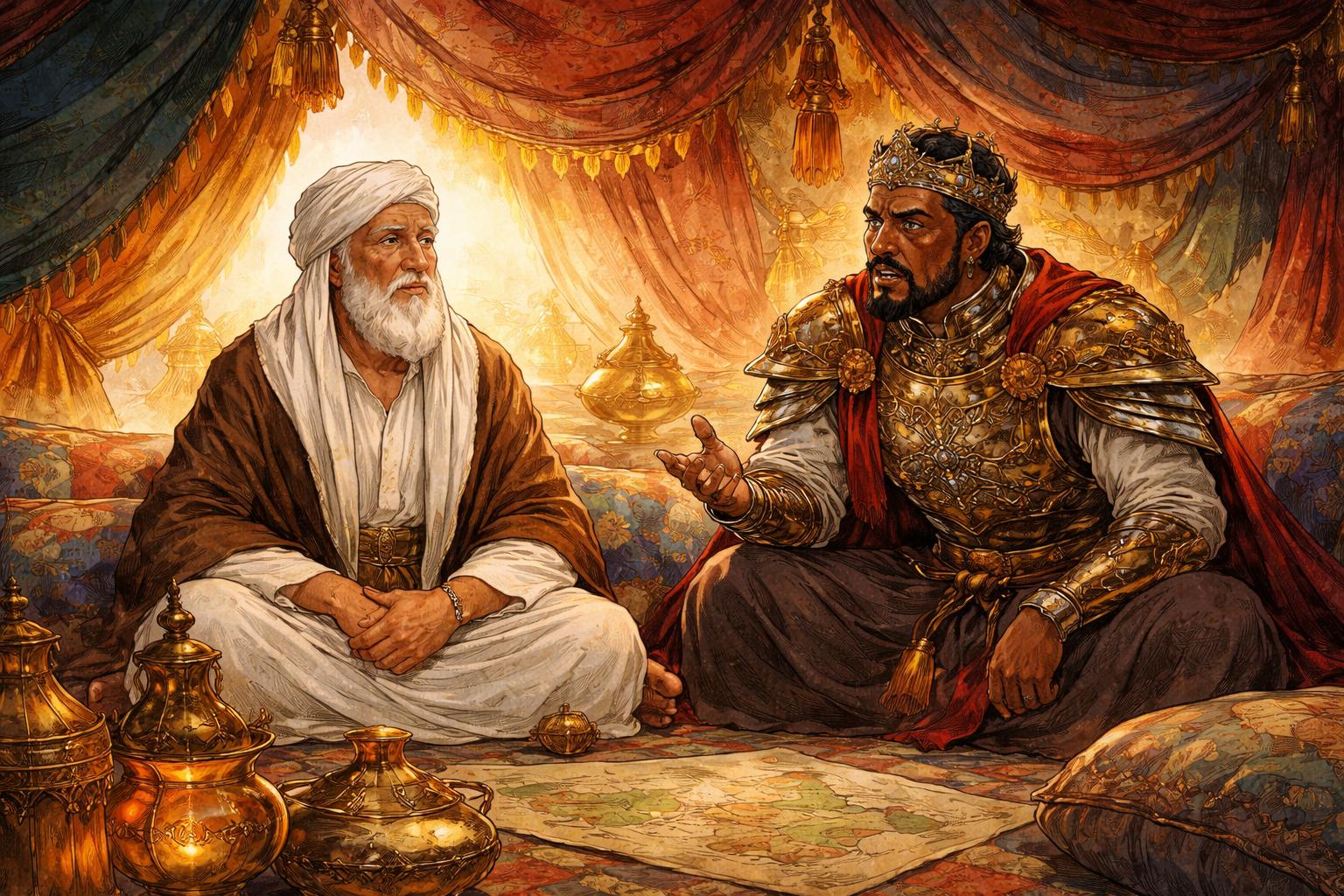
Abdul Muttalib gave an answer that echoes through history: "I am the lord of the camels, and the House has a Lord who will protect it."
This statement carries the weight of absolute trust in Allah. Abdul Muttalib did not beg, he did not plead, he did not try to negotiate for the Ka'bah. He simply stated a fact: the Ka'bah belongs to Allah, and Allah protects what is His. He took care of what he was responsible for (his camels), and left what belonged to Allah in Allah's hands.
Abraha returned the camels and dismissed Abdul Muttalib, confident that nothing could stop his army. He ordered the march on Makkah to begin the next morning.
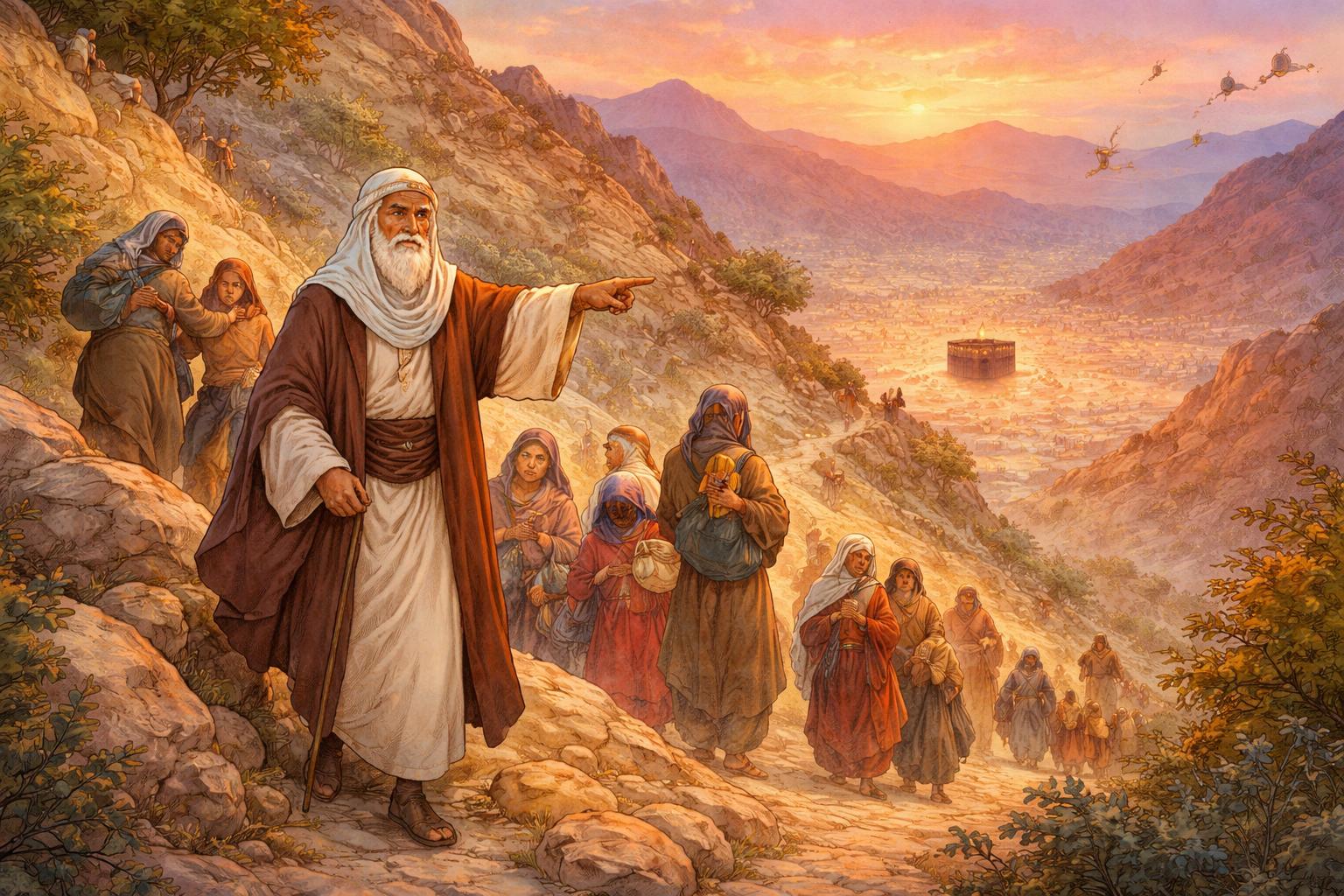
Abdul Muttalib returned to the Makkans and told them to leave the city, to take refuge in the surrounding mountains. "Allah will protect His House," he assured them. The people evacuated, climbing into the hills and looking down at their vulnerable city and the sacred Ka'bah below.
The next morning, Abraha lined up his army. The elephants were positioned at the front, with the mighty Mahmud leading the charge. The soldiers formed their ranks behind. The order was given to advance toward Makkah and the Ka'bah.
But Mahmud would not move.
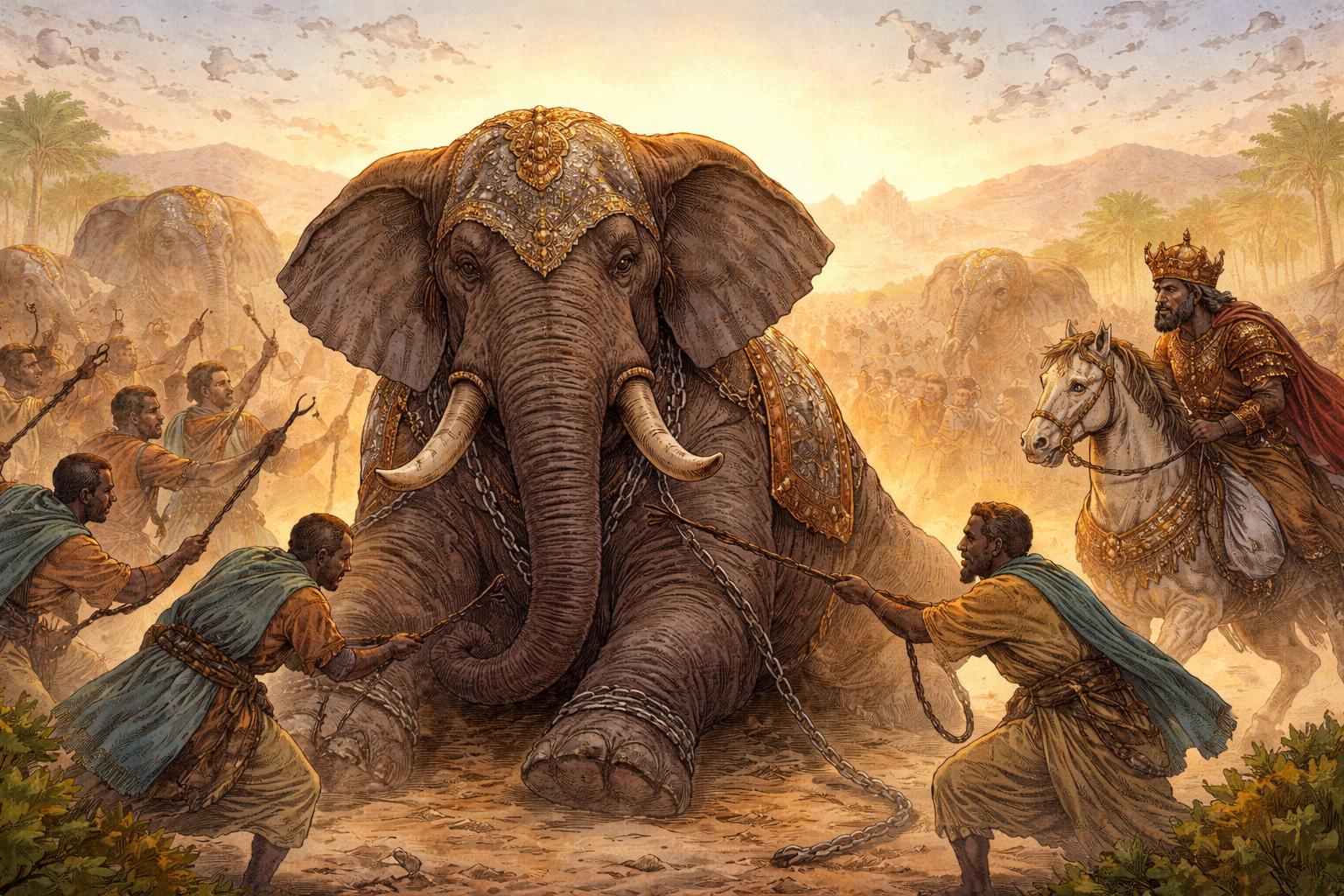
The great elephant, who had charged into battles and trampled cities, stopped dead. He sat down on the ground and refused to move toward Makkah. They beat him, they prodded him, they used hooks and chains. When they turned him toward any other direction, east, south, north, he would stand and walk. But the moment they pointed him toward Makkah, he sat down again and would not budge. It was as if an invisible wall stood between the elephant and the sacred city.
While Abraha struggled with his stubborn elephant, the sky began to change. From the direction of the sea, a dark cloud appeared on the horizon. As it drew closer, the soldiers realized it was not a cloud at all. It was a flock of birds, thousands upon thousands of them, stretching across the sky in a dark, living mass.
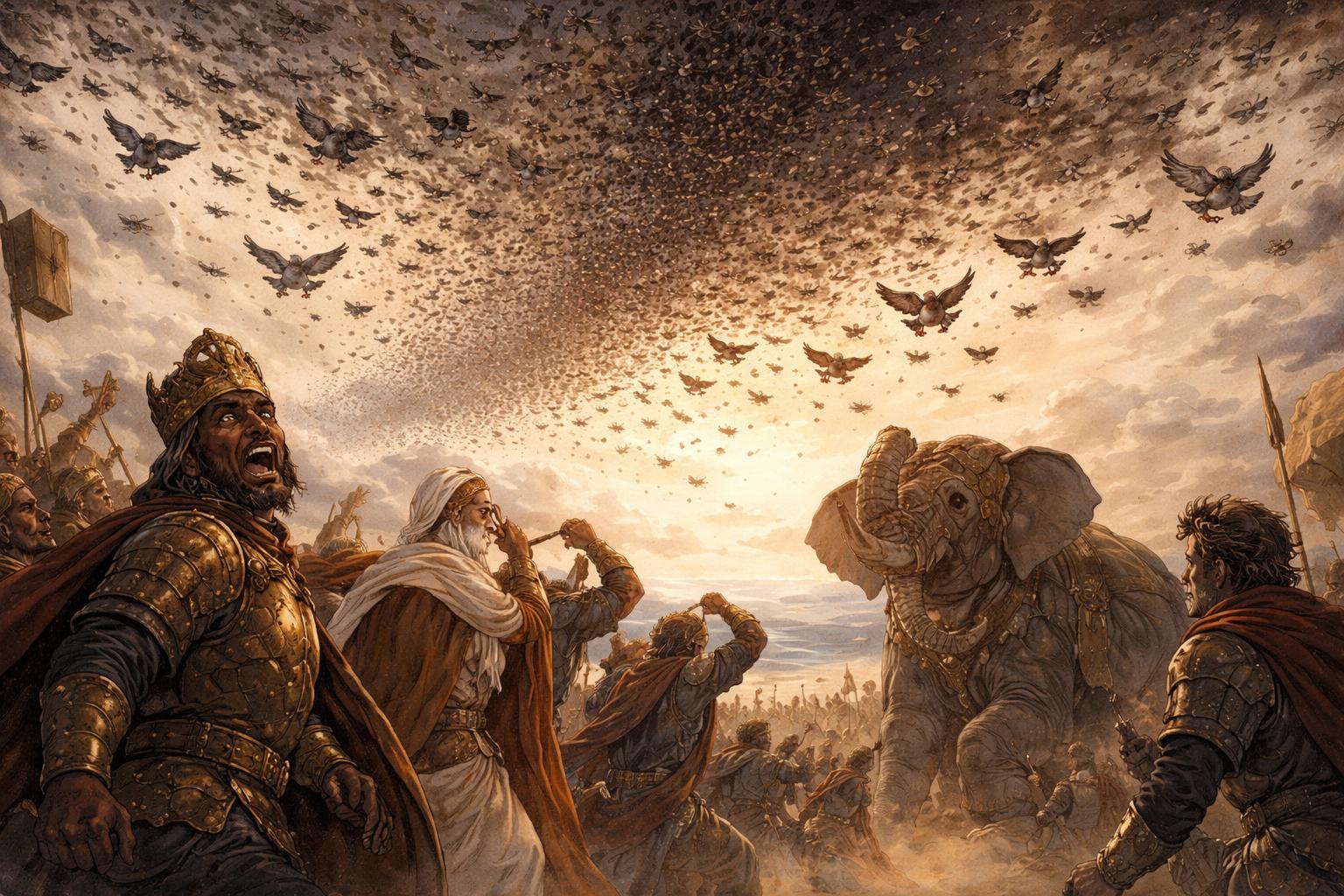
The Quran describes what happened next with terrifying simplicity: "And He sent against them birds in flocks, striking them with stones of hard clay, and He made them like eaten straw."
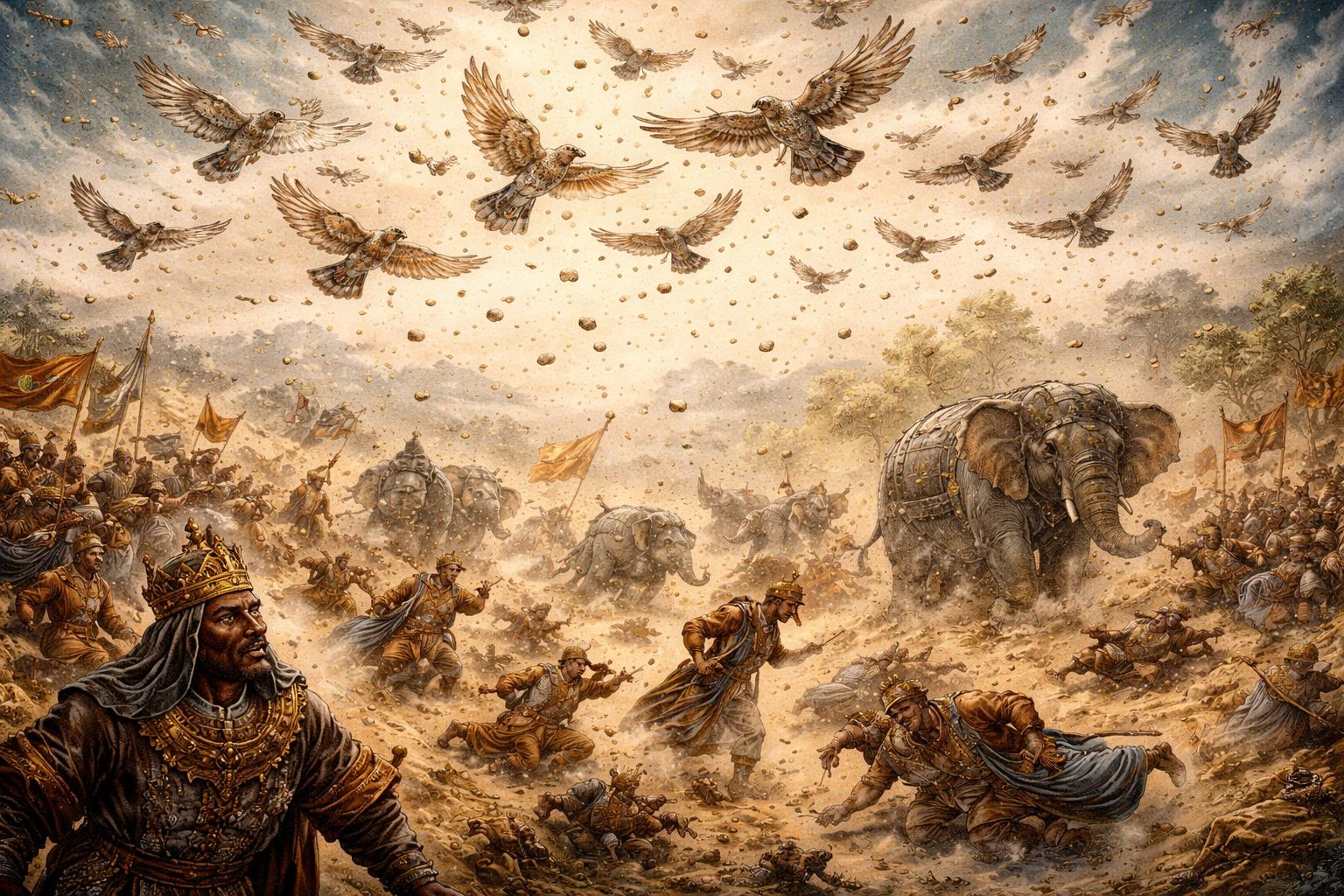
Each bird carried three small stones, one in its beak and one in each claw. These stones were small, made of baked clay, but they were sent by Allah. As the birds flew over Abraha's army, they released their stones, and wherever a stone struck a soldier, it pierced through him as if his armor were paper. The stones were tiny but carried the power of divine judgment.
The mighty army that had terrified an entire region was destroyed in minutes. Soldiers fell by the thousands. The elephants stampeded in panic. Abraha himself was struck and wounded, and he died on the retreat back to Yemen, his body breaking down as he tried to flee.
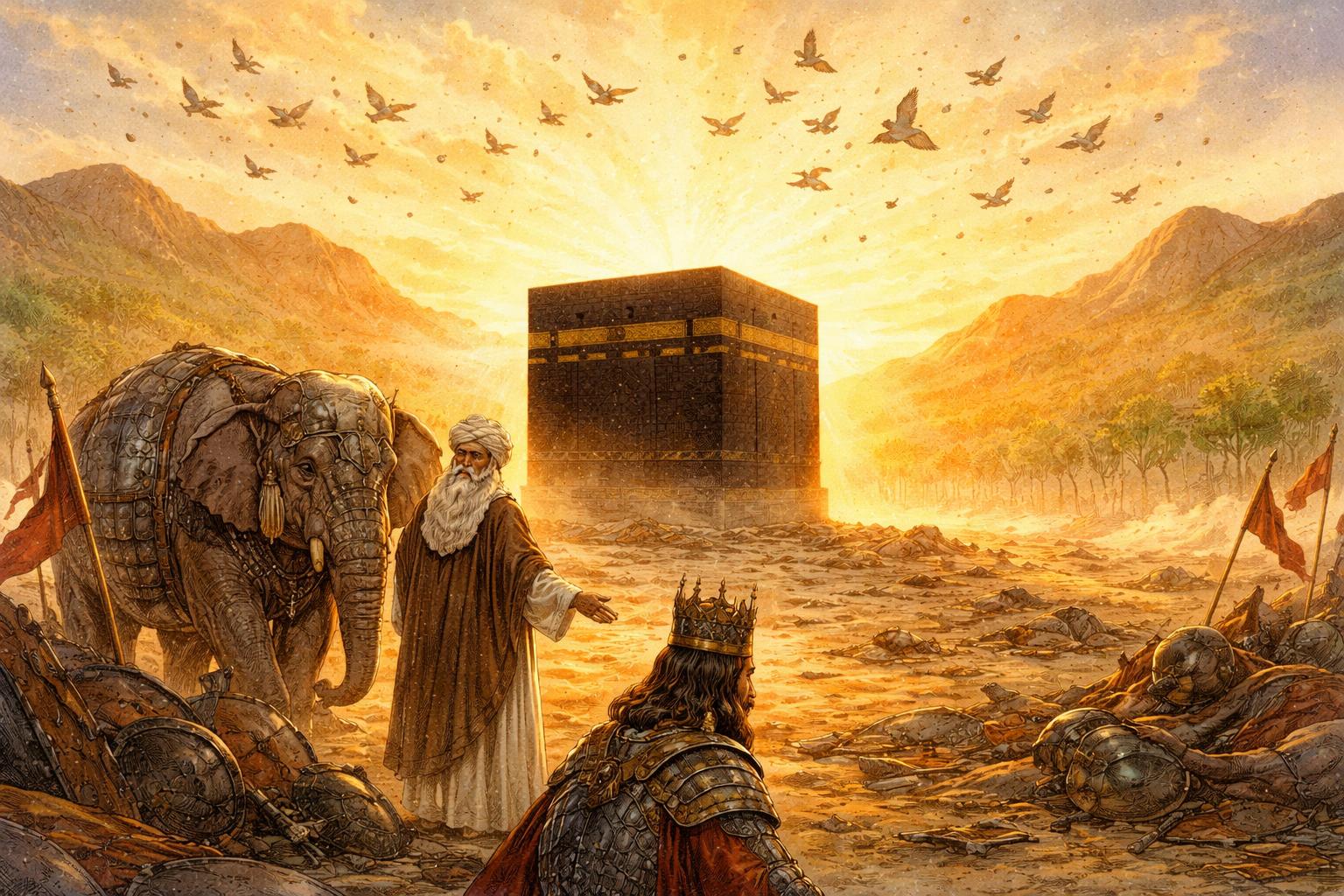
The Ka'bah stood untouched. The sacred House of Allah was protected not by human swords but by birds and clay, the humblest of weapons wielded by the mightiest of hands.
The year became known as the Year of the Elephant, 'Am al-Fil. And in that same year, just weeks after the army was destroyed, a baby was born in Makkah. His name was Muhammad, peace be upon him and his family.
In the Shia tradition, the story of the Elephant carries deep significance. It demonstrates that Allah protects what is sacred, not by human power but by divine will. The Ka'bah was entrusted to Ibrahim (AS) and his descendants, and Allah protected that trust even when the guardians themselves could not.
Imam Ali (AS) taught that the story shows us that the size of the army does not matter to Allah. "Do not be worried about the number of your enemies. Be worried about the strength of your faith." The birds were small. The stones were tiny. But they were sent by Allah, and that was enough.
Imam Sadiq (AS) connected this event to the birth of the Prophet: "Allah did not protect the Ka'bah because of the stones and mortar. He protected it because it was time for the greatest mercy to the worlds to be born, and the Ka'bah was his cradle." The protection of the Ka'bah was preparation for the arrival of Prophet Muhammad (PBUH), the final messenger.
Key Verse
"Alam tara kayfa fa'ala Rabbuka bi As'habil-fil. Alam yaj'al kaydahum fi tadlil. Wa arsala 'alayhim tayran ababil. Tarmihim bi hijaratim min sijjil. Faja'alahum ka'asfim ma'kul" "Have you not seen how your Lord dealt with the People of the Elephant? Did He not make their plan go astray? And He sent against them birds in flocks, striking them with stones of hard clay, and made them like eaten straw." -- Al-Fil (105:1-5)
Reflection Questions
- Abdul Muttalib said, "The House has a Lord who will protect it." What does this level of trust in Allah look like in your daily life? Can you think of a time when you had to trust that Allah would take care of something you could not control?
- The mightiest army with the biggest elephants was defeated by tiny birds with small stones. What does this teach us about the relationship between worldly power and divine power?
- The Ka'bah was protected just before the Prophet's birth. What does this timing tell us about how Allah prepares the world for important events?
Tonight, we have a story about a very special building, and about tiny little birds who were stronger than the biggest animals on earth. Are you ready? This story is so amazing that Allah put the whole thing in the Quran as its very own surah, its very own chapter, called Surah Al-Fil, which means "The Elephant."
A long time ago, in the land where the sun shines hot and the sand stretches far, there was a city called Makkah. And in the middle of Makkah, there was a building called the Ka'bah. Do you know about the Ka'bah? It is the cube-shaped building that Muslims all over the world face when they pray. It was built a very long time ago by Prophet Ibrahim (AS) and his son Ismail (AS), as a house for worshipping Allah, the one true God.
Every year, people from far away would travel to Makkah to visit the Ka'bah. They came on camels and horses and on foot. Visiting the Ka'bah made them happy because it was Allah's special house on earth.
Now, far away from Makkah, in a land called Yemen, there was a man named Abraha. Abraha was a general, a leader of a big army. He was proud and he wanted everyone to pay attention to him. When he heard that so many people traveled to visit the Ka'bah in Makkah every year, he got jealous.
"Why does everyone go to Makkah?" he said, frowning. "I want them to come to MY city instead!"
So Abraha built a huge, fancy building in his city. He used gold and silver and shiny jewels to make it sparkle. "There!" he said. "Now people will come to see MY building instead of that old Ka'bah!"
But guess what? Nobody came. The people still went to Makkah. No matter how shiny Abraha's building was, the Ka'bah held a special place in people's hearts that no amount of gold could replace. The Ka'bah was simple, just plain stones, but it was built with love for Allah, and that made it more beautiful than anything.
Abraha was so angry! He stomped his feet. "If they will not come to my building," he growled, "then I will go and destroy theirs!"
So Abraha gathered the biggest army anyone had ever seen. There were thousands and thousands of soldiers with horses and weapons. And at the very front of the army, there were elephants. Real elephants! Big, giant, enormous elephants with thick gray skin and long trunks and legs like tree trunks. The biggest elephant of all was named Mahmud. He was so huge that the ground shook when he walked. BOOM, BOOM, BOOM went his feet with every step.
In those days, war elephants were like tanks. Nobody could stop them. Abraha smiled. "Nothing can stop my army!" he said. "We will crush the Ka'bah to pieces!"
The army began to march toward Makkah. BOOM, BOOM, BOOM. Day after day, they marched closer and closer to the holy city.
When the people of Makkah heard that Abraha and his elephants were coming, they were very scared. They did not have a big army. They did not have elephants. How could they stop such a powerful force?
The leader of Makkah at that time was a wise old man named Abdul Muttalib. He was the grandfather of someone very special, but we will get to that part later. Abdul Muttalib was calm and brave, even when everyone around him was worried.
Abraha's soldiers camped near Makkah and took some camels, including two hundred that belonged to Abdul Muttalib. Abraha sent a message: "Come and talk to me."
So Abdul Muttalib went to see Abraha in his big fancy tent. Abraha expected him to beg, "Please, do not destroy our Ka'bah!"
But Abdul Muttalib did not say that at all. He said, "I want my camels back. Your soldiers took them."
Abraha could not believe his ears. "Camels?" he said, laughing. "I am about to destroy the Ka'bah, the most important building your people have, and you are worried about camels?"
Abdul Muttalib looked at Abraha calmly and said something so wise and so brave that people still remember it today: "I am the owner of the camels, so I am asking for my camels. As for the Ka'bah, it has its own Owner, and He will protect it."
Do you understand what he said? He was saying, "The Ka'bah belongs to Allah. And Allah will take care of His own house. I do not need to beg you, because Allah is bigger and stronger than any army."
That is what we call tawakkul, trust in Allah. Abdul Muttalib did not panic. He did not cry. He trusted that Allah would protect His house.
Abraha gave back the camels and laughed. "We will see about that!" he said. He ordered his army to march on Makkah the very next morning.
Abdul Muttalib went back to the people of Makkah and told them, "Leave the city. Go up into the mountains. Allah will protect His house." The people gathered their children and their belongings and climbed up, up, up into the hills around Makkah. They looked down at their little city and the Ka'bah below, and they prayed.
The next morning, Abraha lined up his army. The mighty Mahmud was at the front, trunk swinging, ready to charge. Abraha pointed at Makkah and shouted, "FORWARD!"
But Mahmud did not move.
The biggest, strongest elephant in the world, the elephant that had charged through battles and knocked down walls, he just sat down. Right there. On the ground. And he would not get up.
The soldiers pushed him. They pulled him. They poked him with sticks. They tried everything! But Mahmud would not budge. When they turned him to face east, he stood up and walked. When they turned him north, he walked. But every single time they turned him toward Makkah, he sat right back down again.
It was as if there was an invisible wall around Makkah that no elephant could walk through. Even the animals knew that this was Allah's house, and you do not march against Allah.
While Abraha was trying to make his elephant move, something appeared in the sky. At first, it looked like a dark cloud coming from far away. But as it got closer, the soldiers looked up and gasped. It was not a cloud at all.
It was birds. Thousands and thousands of birds, so many that they covered the sky like a blanket. They were small birds, but there were so, so many of them, filling the sky from one side to the other.
Each little bird carried three tiny stones, one in its beak and one in each of its little feet. The stones were made of hard clay, smaller than pebbles.
But these stones were sent by Allah. When the birds flew over Abraha's mighty army and dropped those tiny stones, each one went right through the soldiers' armor as if it were made of paper. The little stones were more powerful than any sword or arrow because they carried the power of Allah.
The Quran describes it so clearly: "And He sent against them birds in flocks, throwing at them stones of hard clay, and He made them like chewed-up straw." The whole army, the soldiers, the elephants, all of them, were destroyed. The biggest army in the land was beaten by the smallest birds with the tiniest stones.
Abraha himself was hurt badly. He tried to run away, back to his country, but he never made it. His body broke down as he fled.
And the Ka'bah? Not a single stone of it was touched. Not a scratch. Allah's house stood there, safe and peaceful, just as it always had.
The people of Makkah came down from the mountains and saw the empty battlefield. The great army was gone. The Ka'bah was standing tall. "Allah protected His house!" they said.
That year became known as the Year of the Elephant. And here is the most wonderful part of all: in that very same year, just a little while after the birds saved the Ka'bah, a baby was born in Makkah. A very special baby. His name was Muhammad, peace be upon him and his family. He would grow up to be the last and greatest Prophet of Allah.
Imam Ali (AS), who was from the Prophet's family and one of the wisest people who ever lived, taught us something beautiful about this story. He said, "Do not worry about how big your problems are. Worry about how strong your faith is." The birds were small. The stones were tiny. But Allah sent them, and that was all that mattered. It does not matter how small you are. If Allah is with you, nothing can beat you.
Imam Sadiq (AS), another great teacher from the Prophet's family, explained why Allah protected the Ka'bah that year: "Allah did not protect the Ka'bah because of its stones and walls. He protected it because the greatest gift to the whole world was about to be born there, and Allah was getting the world ready for Prophet Muhammad."
So the birds and the tiny stones were not just protecting a building. They were protecting the place where the most special person in the world was about to arrive. Allah had a beautiful plan, and nobody, not even the biggest army with the biggest elephants, could get in the way of Allah's plan.
Key Verse
"Alam tara kayfa fa'ala Rabbuka bi As'habil-fil. Alam yaj'al kaydahum fi tadlil. Wa arsala 'alayhim tayran ababil. Tarmihim bi hijaratim min sijjil. Faja'alahum ka'asfim ma'kul" "Did you see what Allah did to the Elephant Army? He ruined their plans. He sent little birds in big flocks. The birds threw tiny stones of hard clay. And Allah made the army like chewed-up straw." -- Al-Fil (105:1-5)
Let's Talk About It
- Abdul Muttalib trusted that Allah would protect the Ka'bah. Can you think of a time when you trusted Allah to help you with something?
- The tiny birds with little stones beat the big elephants. What does that teach us about who is really the strongest?
- Allah protected Makkah right before Prophet Muhammad (PBUH) was born there. Why do you think Allah chose that special time?